 Guide On Map
District 3: Memory, Villas, and Secret Rooms
From the War Remnants Museum to Tân Định Church
Guide On Map on your phone
Open the walk like a regular app
It takes about 10 seconds to install. No app store needed.
The whole path
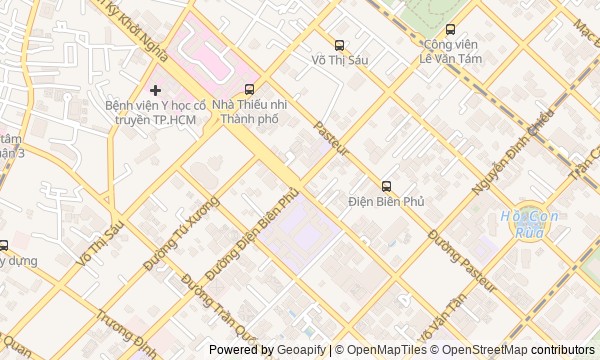
Route map
About the walk
You will cross District 3 from the War Remnants Museum to the pink Tân Định Church. First you will reach a square above the water, then turn back into streets of villas, pagodas, and homes. Here, official memorials stand beside a cellar beneath the floorboards, a gated estate, and a temple that once became a headquarters.
Instead of a sweeping lecture, you will follow objects and human decisions. Why did a museum have to print its photographs again? Where will the bronze turtle go? What will appear beneath ten layers of paint? You will separate what is established from what is assumed, and notice how political history entered ordinary rooms.
By the end, you will read District 3 through an absent turtle, a cover made of six tiles, locked gates, and a pink bell tower.
Why this order
From the museum, you will head east along Võ Văn Tần Street to Turtle Lake: after a preserved photo archive, you will encounter memory without its surviving central object. Then you will return west to the Thích Quảng Đức Memorial, moving from a vanished state symbol to the site of direct political action. A short stretch through residential streets leads to the house with the cellar, where the consequences of crisis give way to preparations for an armed assault. Next, Xá Lợi Pagoda provides the institutional backdrop to the events at the memorial. From the pagoda, you will continue to a gated mansion, where state violence gives way to another question: what happens to heritage after an expensive restoration? The neighboring Southern Women's Museum brings back the theme of collected memory, now through women's work. The final northern stretch ends at Tân Định Church: after museums and memorials come an active parish, a school, and the story of a craft that gave its students a profession.
Those who want to understand District 3 beyond the ceremonial center Those who care about human details within larger history Those ready to connect museums, sacred places, and residential streets
Those looking for an easy walk without war and religious history Those expecting to see every interior Those uncomfortable with frequent street crossings
Before you go
Check in advance whether the museum displays and the house with the cellar are accessible: small memorial sites may keep less predictable hours than major institutions. Some material at the War Remnants Museum is intense even for adults; if you are visiting with children, decide before you go which rooms to skip. Choose clothing appropriate for active religious sites at the pagoda and church, and be ready to postpone your visit during prayer or a service. Treat Phương Nam Mansion as a private property behind a fence: access inside cannot be assumed to be part of a regular visit.
When to go
Start in the morning if you want to explore the museums at an unhurried pace and leave the religious sites for a quieter part of the day. Another good option is to begin after the afternoon heat, knowing that indoor displays may be unavailable and that the finish at Tân Định Church will fall into the evening street rhythm.
Backup plan
If the War Remnants Museum is closed, spend more time with the equipment outside and keep the main story as a frame for the stops ahead. View the closed house with the cellar and the inaccessible villa only from public space, without trying to enter the courtyard. If a service is under way at Xá Lợi Pagoda or Tân Định Church, do not interrupt it: take in the architecture from outside and return to the audio away from the entrance. Give any extra time to Turtle Lake and the Thích Quảng Đức Memorial—both can be understood in open urban space.
Route conditions
Surface. Asphalt — 3.8 km; paving_stones — 262 m (data covers 95% of the route)
Facilities. Toilets — 1; drinking water — 2
Elevation. Ascent — 26 m; descent — 31 m
OpenStreetMap extract of August 25, 2026: database data, not a check on the ground. Data © OpenStreetMap contributors, ODbL licence
Walk plan
Open in maps ↗- 1
War Remnants Museum
The exhibition will begin a conversation about how photographs by fallen correspondents became a lasting public memory. - 2
Turtle Lake
Here you will see how residents adapted a ceremonial square for meeting, trade, and food. - 3
Thích Quảng Đức Memorial
This stop connects an act of personal self-sacrifice, a photojournalist's work, and a political turning point. - 4
Secret Weapon Cellar
The house brings the history of the underground out of military reports and beneath the floor of an ordinary living room. - 5
Xá Lợi Pagoda
Here you will learn why a building with a shrine, school, and library became the headquarters of the Buddhist movement. - 6
Phương Nam Mansion
The closed estate raises the question of whether costly restoration is enough when no use has been found for the house. - 7
Southern Women's Museum
Here, private testimonies from Southern women come together in the story of a distinct museum and the Mother of the South Monument. - 8
Tân Định Church
The finale will connect the parish, the orphanage, and the craft from which Vietnamese publishing grew.
Route features
Everything you need stays in the browser
Progress, saves and your trip plan are stored on this device.
Add Guide On Map to your home screen so the walk opens outside the browser.
How we handle sources, maps and corrections: our editorial standards