 Guide On Map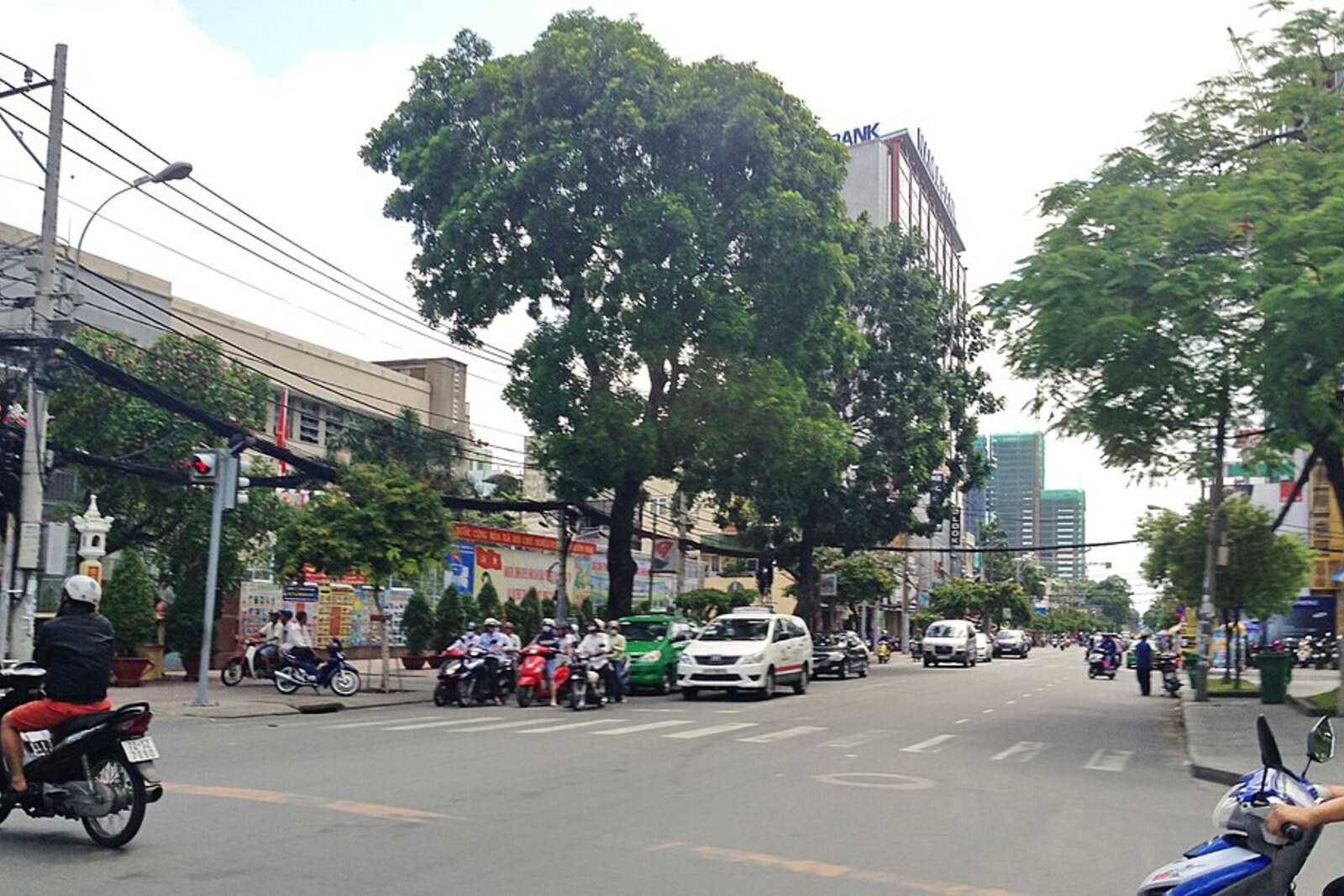
Look around first
What to notice
- Bronze figure of the monk
- Outline of a flame
- Corner park
- Intersection roadway
The story of the place
The corner park is occupied by a bronze sculpture of a monk placed within the silhouette of a flame. The memorial space does not coincide with the point it commemorates: that point lies in the roadway, between traffic lanes. The Cambodian diplomatic mission once stood opposite. At the time, the intersection connected Phan Đình Phùng Street and Lê Văn Duyệt Street; today they are called Nguyễn Đình Chiểu Street and Cách Mạng Tháng Tám Street.
On the morning of June eleventh, nineteen sixty-three, a blue Austin stopped in the middle of this intersection. Thích Quảng Đức, a sixty-six-year-old Buddhist monk, stepped out of the car. He agreed to die in order to make Ngô Đình Diệm, the president of South Vietnam, meet the demands of Buddhist communities.
A month earlier, the government had banned the display of Buddhist flags during the Buddha's Birthday festival. In Huế, soldiers opened fire on people gathered outside the radio station; nine people were killed. The monks demanded equal rules for religions, freedom of worship, an end to arrests, aid for the families of those killed, and punishment for those responsible. The negotiations dragged on, while Ngô Đình Diệm expected to quell the movement with minor concessions.
The day before, Buddhist representatives warned foreign correspondents that something important would happen in the morning near the Cambodian diplomatic mission. Most journalists had already grown tired of such reports. Only a few came.
More than three hundred monks and nuns surrounded the car. Thích Quảng Đức sat on a cushion in the lotus position. Two young monks poured gasoline over him. He lit the match himself. The participants in the procession closed the circle and did not let a fire truck through. After his death, his body was carried to Xá Lợi Pagoda.
In nineteen sixty-three, the streets were called Phan Đình Phùng Street and Lê Văn Duyệt Street; now they are Nguyễn Đình Chiểu Street and Cách Mạng Tháng Tám Street. The intersection stood in front of the Cambodian mission. The organizers left no indisputable explanation for choosing this spot. That same day, American diplomats suggested that the monks were seeking Cambodia's attention, since its leader had shortly before publicly accused Ngô Đình Diệm of persecuting Buddhists. But the preparation for an international audience is clear: journalists were summoned in advance, and the participants brought signs in Vietnamese and English with the five demands.
Malcolm Browne, a photographer for Associated Press, photographed the entire scene. He used about ten rolls of film, then handed them to a passenger on the next flight to Manila, from where the photographs were radioed out. A photograph of Thích Quảng Đức appeared in newspapers around the world and turned South Vietnam's internal crisis into an international one.
That same day, the American embassy warned the president's entourage that without serious concessions, his position would become extremely precarious. Five days later, the government signed an agreement with Buddhist representatives, but the confrontation resumed that summer. In August, security forces raided pagodas and carried out mass arrests. The United States stopped considering Ngô Đình Diệm a reliable partner. On November first, generals overthrew the president; the next day, he was killed.
Thích Quảng Đức was sitting in the roadway then. Now a bronze figure of the monk within the outline of a flame stands in a small corner park, while the place of his death itself remains between the lanes of the present-day intersection.
Useful on site
Open city memorial by a busy intersection; be careful of traffic.
Checked: date not specified. Check the official source before visiting.Do not step into the road to match the historical viewpoint. Listen from the safe side and keep in mind that the details of the self-immolation may be difficult.