 Guide On Map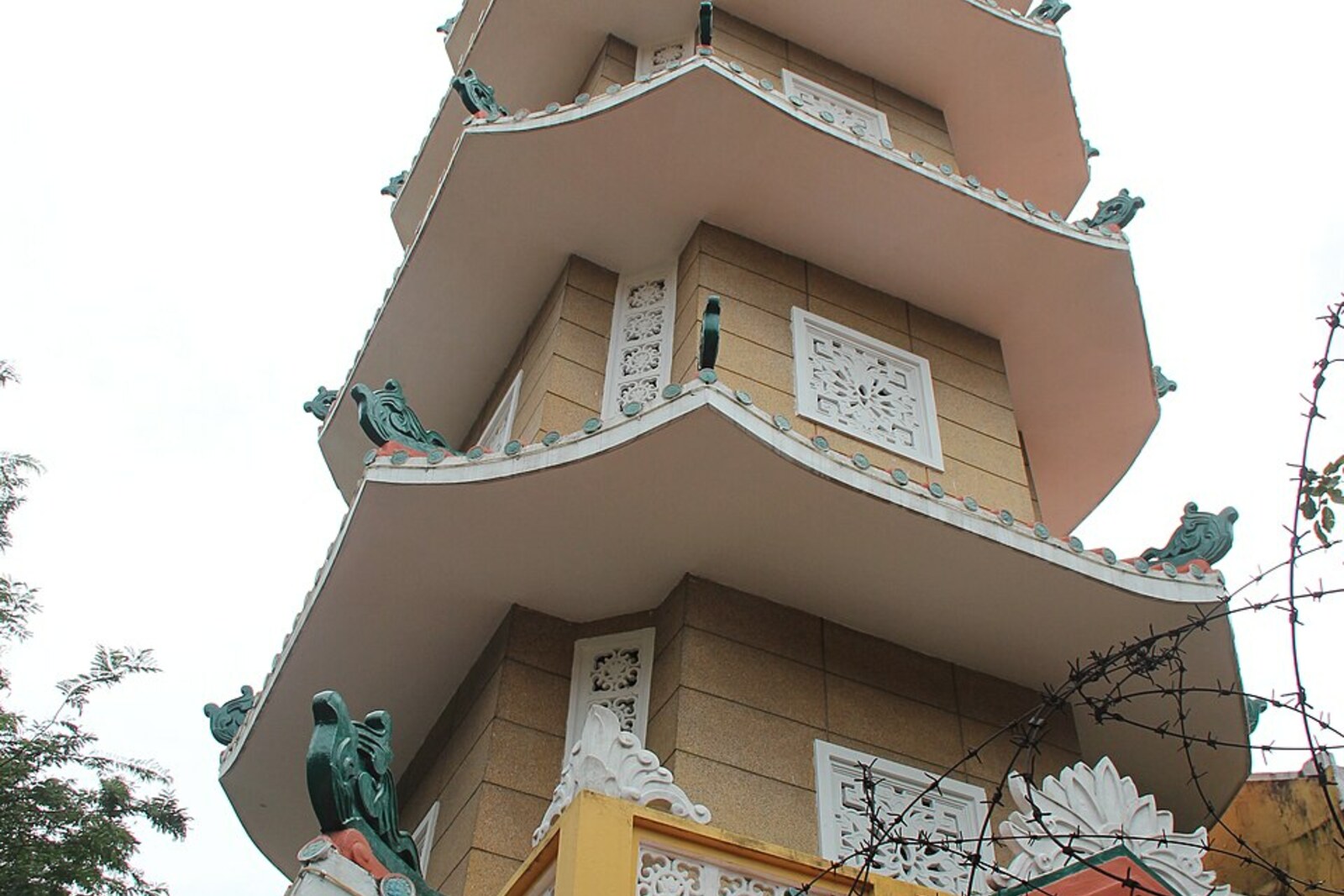
Look around first
What to notice
- Bodhi-leaf-shaped reliquary
- Golden statue of Buddha
- Bust of Mai Thọ Truyền
- Iron gates
The story of the place
At half past midnight on August twenty-first, nineteen sixty-three, trucks carrying special forces and field police appeared at the pagoda's iron gates. The monks managed to block the stairways with benches and struck the large gong to sound the alarm. The attackers broke through the gates, used tear gas, burst into the main hall, and began leading people out into the courtyard. Among those arrested was Mai Thọ Truyền—the man who built this pagoda and turned it into the headquarters of the Buddhist movement.
Mai Thọ Truyền was a layman. He earned his living in government service: he rose from administrative secretary to financial inspector and retired in nineteen sixty. At the same time, he headed the Southern Vietnam Buddhist Studies Association. The association needed a building where it could keep a Buddha relic, hold lectures, print a journal, and gather followers who did not live in a monastery.
The relic was brought from Sri Lanka by the monk Narada Maha Thera. After a dispute between Buddhist associations, it was entrusted for safekeeping to Dowager Empress Từ Cung, the mother of the last Vietnamese emperor. Two years later, she entrusted the relic to Mai Thọ Truyền's organization. He raised donations, obtained the site of the former Indochina Club for a symbolic one dong, and began construction in nineteen fifty-six.
The name “Xá Lợi” comes from the Sanskrit word “sharira,” the term for revered remains after the cremation of a Buddha or an esteemed teacher. Mai Thọ Truyền instructed the architects to place the shrine containing the relic at the top, with the lecture hall directly beneath it. The pagoda's full name can therefore be translated as “Buddhist Educational Pagoda of the Relic.” Its layout immediately brought together worship, a school, a library, and community administration.
In the spring of nineteen sixty-three, after Buddhists were killed in Huế, representatives of different branches gathered here. The premises of the Southern Vietnam Buddhist Studies Association became the office of the Interfaith Committee for the Defense of Buddhism. Mai Thọ Truyền took the post of general secretary: he signed appeals, sent them to the association's branches, and demanded religious equality and the fulfillment of government promises. Press conferences and hunger strikes were held here, and monks and laypeople converged here. A strike on Xá Lợi made it possible to seize people, documents, and the main coordinating center all at once.
The operation was ordered by Ngô Đình Nhu, the brother and chief political adviser of President Ngô Đình Diệm. Colonel Lê Quang Tung, who commanded units personally loyal to Nhu, provided the personnel. They took away Mai Thọ Truyền along with the eighty-year-old Buddhist patriarch Thích Tịnh Khiết and other leaders of the committee. Mai Thọ Truyền remained imprisoned until November first. When Ngô Đình Diệm's regime fell, he was released along with the other detainees and returned to lead his association.
On the top floor, before the golden statue of Shakyamuni Buddha, a small bodhi-leaf-shaped reliquary still stands. It holds the very relic for which Xá Lợi was built. Free classes in Buddhism and classical Chinese writing continue beneath the shrine. The lower hall bears Mai Thọ Truyền's Buddhist name, Chân Trí, and his bust stands in the courtyard.
Useful on site
An active religious site; check hours and access to the halls on site, and dress modestly.
Checked: date not specified. Check the official source before visiting.This is an active pagoda: speak quietly, do not block passageways, and do not photograph people without permission. During a ceremony, put away the audio and view the site from a respectful distance.