 Guide On Map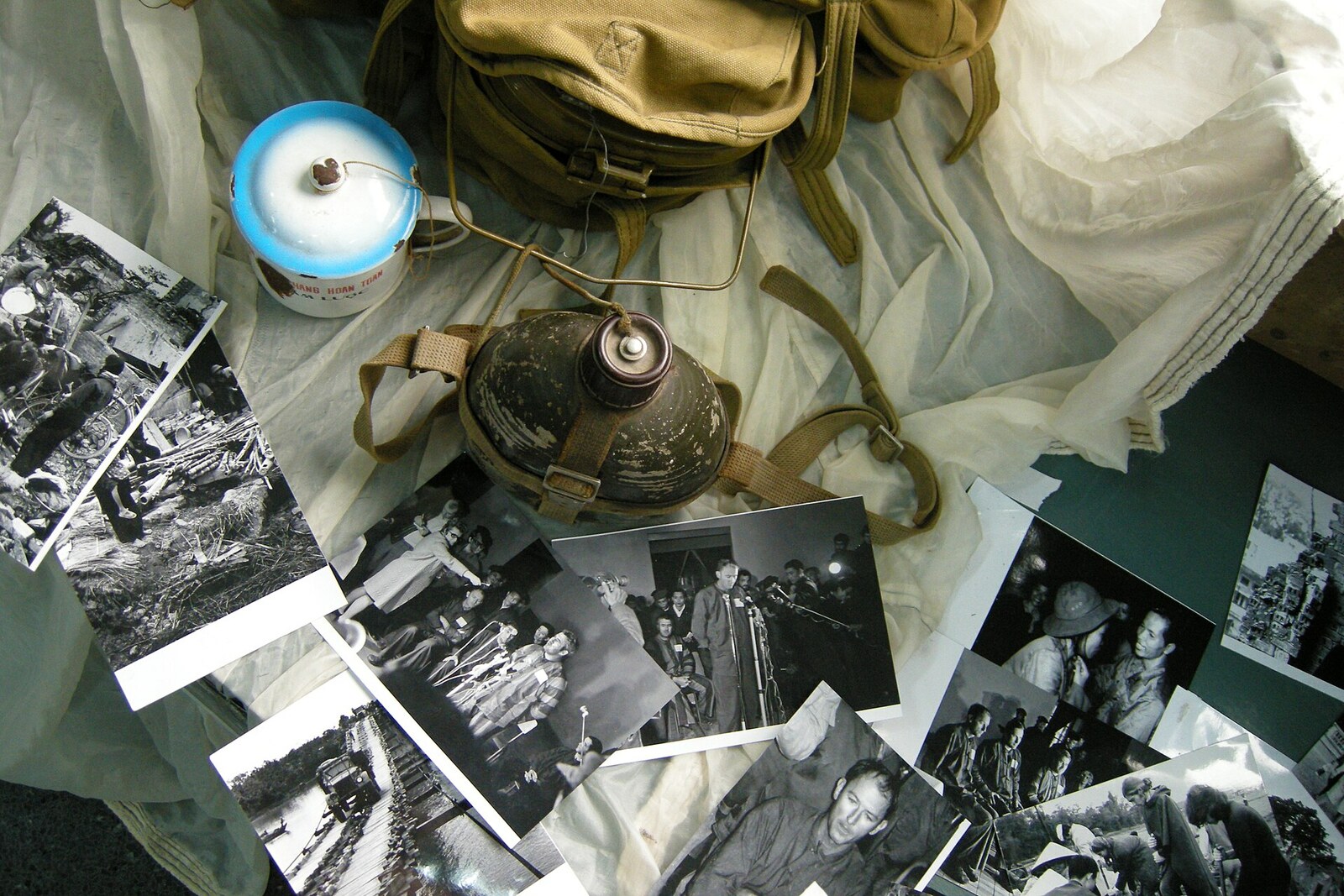
Look around first
What to notice
- Prints from the Requiem exhibition
- A photograph of a bullet-pierced camera
- Captions for correspondents' photographs
The story of the place
This museum stands at the same address where an American information agency operated until the end of the war. The first halls opened a few months after it ended; the current building appeared during a later redevelopment, so only the address remains from the former building. Inside are photographs, documents, weapons, and personal belongings that tell of the consequences of wars in Vietnam. Among the Requiem prints, you can see correspondents' captions and an image of a bullet-pierced camera: war photography had its own price.
On the morning of May fifth, two thousand, about a hundred people gathered in this part of the museum courtyard. Relatives of fallen photojournalists sat in the front row. Horst Faas, a German photographer with the Associated Press who had photographed the war in Vietnam for eight years, stepped up to the podium; he was now working to ensure that the work of his killed colleagues would be preserved for the public. Tim Page stood beside him, a British photojournalist with United Press International who had been searching for photographs by those who went out on assignment and never returned.
Both men knew the cost of such an assignment. In nineteen sixty-seven, Faas was badly wounded by a rocket-propelled grenade; a doctor managed to save his leg. Page was wounded several times, and in nineteen sixty-nine he barely survived a mine explosion. These men earned their living by bringing film from the front lines to newsrooms. While Page was recovering, he learned that his neighbor and close friend Sean Flynn, also a photojournalist, had disappeared in Cambodia. Flynn was never found. That disappearance was where Page's idea for the future exhibition began.
Together with Faas, he worked in the archives of Hanoi and Western news agencies and contacted the families of the dead. Relatives opened boxes of negatives that sometimes had not been printed for more than forty years. Gradually, they assembled thousands of images by one hundred thirty-five photographers who had been killed or had disappeared in Indochina. They included correspondents from opposing sides: Americans, Vietnamese, French, Japanese, and Cambodians. Some had already become famous; others were killed just days after their first assignment.
In nineteen ninety-seven, Faas and Page published the book Requiem from these photographs. The photographs were then arranged as an exhibition. Fourteen crates of prints and frames were sent from the American state of Kentucky to Vietnam. At the ceremony in Ho Chi Minh City, Faas announced that the collection was being given to the Vietnamese and that they wanted to turn it into a permanent memorial to its authors. After a temporary display, the original set was taken to Hanoi and placed in storage. Another set of prints was made for this museum; it remained here.
The museum itself appeared on this site before Requiem. On September fourth, nineteen seventy-five, a few months after the end of the war, the city opened its first exhibition in a building that had previously housed an American information agency. Staff began collecting photographs, documents, weapons, personal belongings, and testimony about the consequences of wars in Vietnam. The current building was constructed later, during the full redevelopment of the complex in the two thousands; only the address, not the walls, remains from the first building.
The permanent Requiem exhibition now includes two hundred seventy-five photographs by one hundred thirty-four correspondents of eleven nationalities. One photograph shows the bullet-pierced camera of Japanese reporter Taizo Ichinose. The damaged camera once saved his life, but in nineteen seventy-three, twenty-six-year-old Ichinose disappeared after setting out to photograph the civil war in Cambodia and was killed. The camera itself remained in Japan. What is kept here is its photograph—a picture of the working tool of a man whom Faas and Page later had to search for.
Useful on site
Public museum; check current hours and rules on the official page before your visit.
Checked: date not specified. Check the official source before visiting.Do not try to cover every hall in equal detail. You can skip the graphic material, and after the difficult sections it is worth taking a break in the courtyard.