 Guide On Map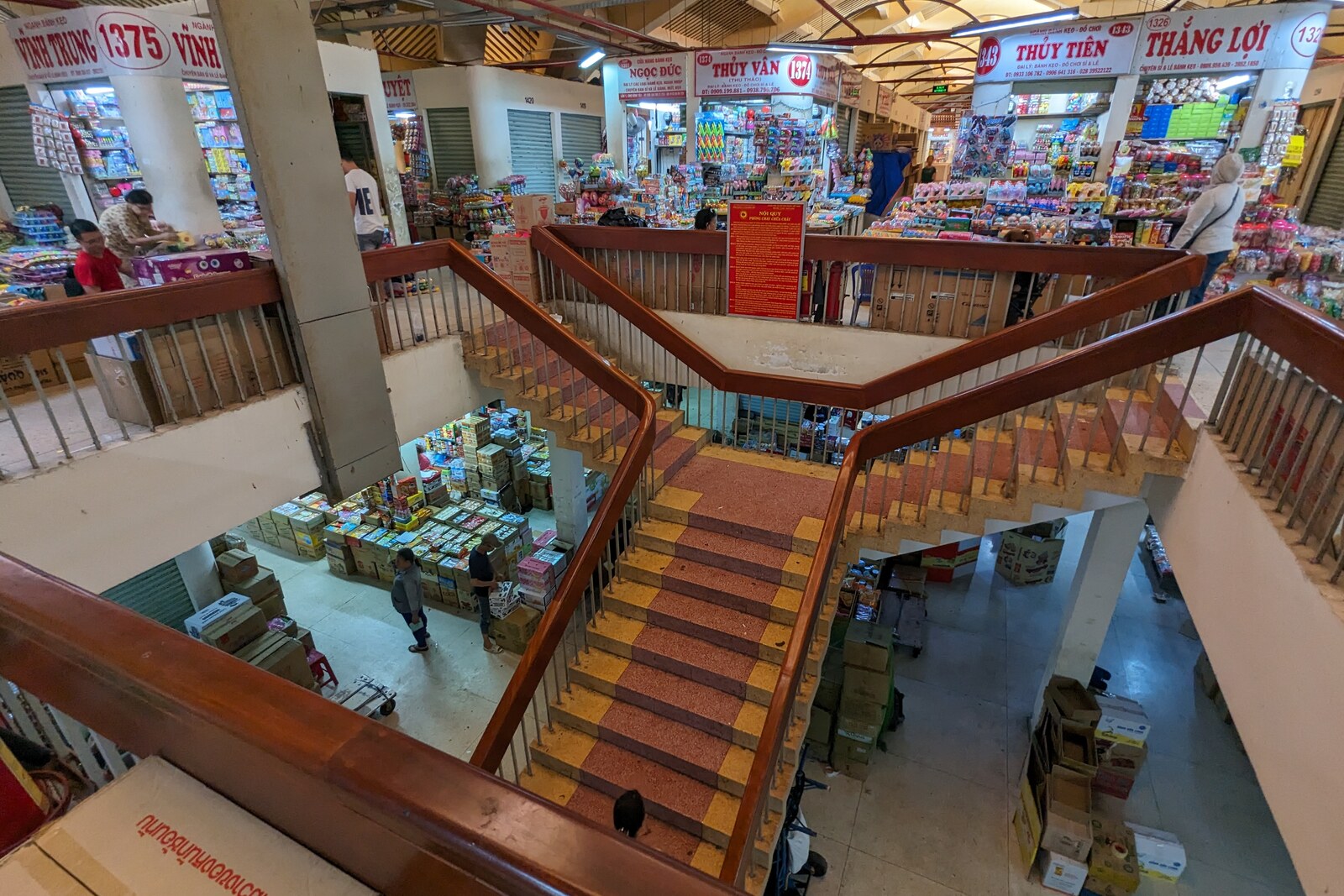
Look around first
What to notice
- The fountain in the central courtyard
- Bronze lions
- Dragon figures
- Bust of Quach Dam
The story of the place
Binh Tay’s market rows stand at the western edge of old Cholon, on land where there was once a navigable basin and junks were repaired. Goods arrive here from the water and over land, then are bought in packages for resale across the south of the country and beyond. Inside, more than two thousand three hundred trading places are divided by goods: cookware and fabrics stand alongside dried foods, tea, and spices. In the central courtyard, four bronze lions and four dragons surround the fountain.
In nineteen twenty-three, the wealthy rice merchant Quach Dam offered Cholon’s municipal commission a deal. He would give the city land and contribute money for a new central market. In return, he would be allowed to build income-producing houses around the future market rows. Quach Dam wanted the main flow of goods and customers to move here, to plots he already owned.
Cholon was then a separate trading city beside Saigon; it is now the western part of Ho Chi Minh City. Its Vietnamese name means “Big Market.” The old central market stood where the Cholon Post Office is now located. By the nineteen twenties, it could no longer accommodate the merchants. Then the administration filled in the canal that ran nearby, and boats carrying goods lost their former approach to the stalls.
Quach Dam understood the value of a waterway well. He arrived from China’s Chaozhou with no capital and earned money buying up bottles, duck feathers, and other scrap. After saving money, he went into buffalo hides and dried fish maws, and then moved on to rice. His mills processed harvests delivered from the Mekong Delta, and his vessels carried the goods farther on. Thus, a man who began with a junk dealer’s carrying yoke became one of the largest rice merchants in Cochinchina, a French colony in the south of what is now Vietnam.
Here, on Cholon’s western edge, another navigable canal remained. Beside it was the Lanessan Basin, with a shipyard for building and repairing junks. Quach Dam acquired rights to this land and the neighboring plots in advance. Under the deal, he transferred the site to the city and assumed a substantial part of the costs. The municipality filled in the basin, laid out streets, and paid for the rest of the construction. The market itself did not belong to Quach Dam: his future income lay in the houses around it. Merchants needed warehouses, shops, and housing; the more people came to the market, the more expensive the neighboring premises became.
Quach Dam did not live to see the outcome of his calculation. He died in May nineteen twenty-seven, while the building was still under construction. In September nineteen twenty-eight, the market opened, and trade did indeed move westward. The new building was called New Cholon Market. It received the name Binh Tay from the village on whose land the shipyard was drained and the market rows were built.
The location also determined the market’s business. Goods were brought here by water and land, and from here large consignments went out across the south of the country and farther, to neighboring states. This work continues: Binh Tay has more than two thousand three hundred stalls, and goods are divided among separate sectors. On one level, cookware, fabrics, shoes, and household goods are sold; in other rows, dried foods, spices, tea, coffee, and sweets. The main transaction here is often not for a single purchase: goods are bought in packages for resale.
After Quach Dam’s death, his family commissioned a fountain for the central courtyard, with four bronze lions and four dragons. In March nineteen thirty, a full-length statue of the merchant was installed above the fountain. In one hand, the sculptor gave him the deed transferring the land to the city; in the other, a scroll listing charitable deeds. That statue is now in the Ho Chi Minh City Museum of Fine Arts. At Binh Tay, the fountain, lions, dragons, and a small bust of Quach Dam remain—now without the document that explained why the market appeared precisely here.
Useful on site
The official website confirms the address, area, and trading groups. Exact hours vary among individual shops; for visitors, it is safer to plan for the morning and daytime, checked 2026-06-29.
Checked: June 29, 2026. Check the official source before visiting.This is a working wholesale market: do not linger in narrow passages or leave your belongings in the path of carts.