 Guide On Map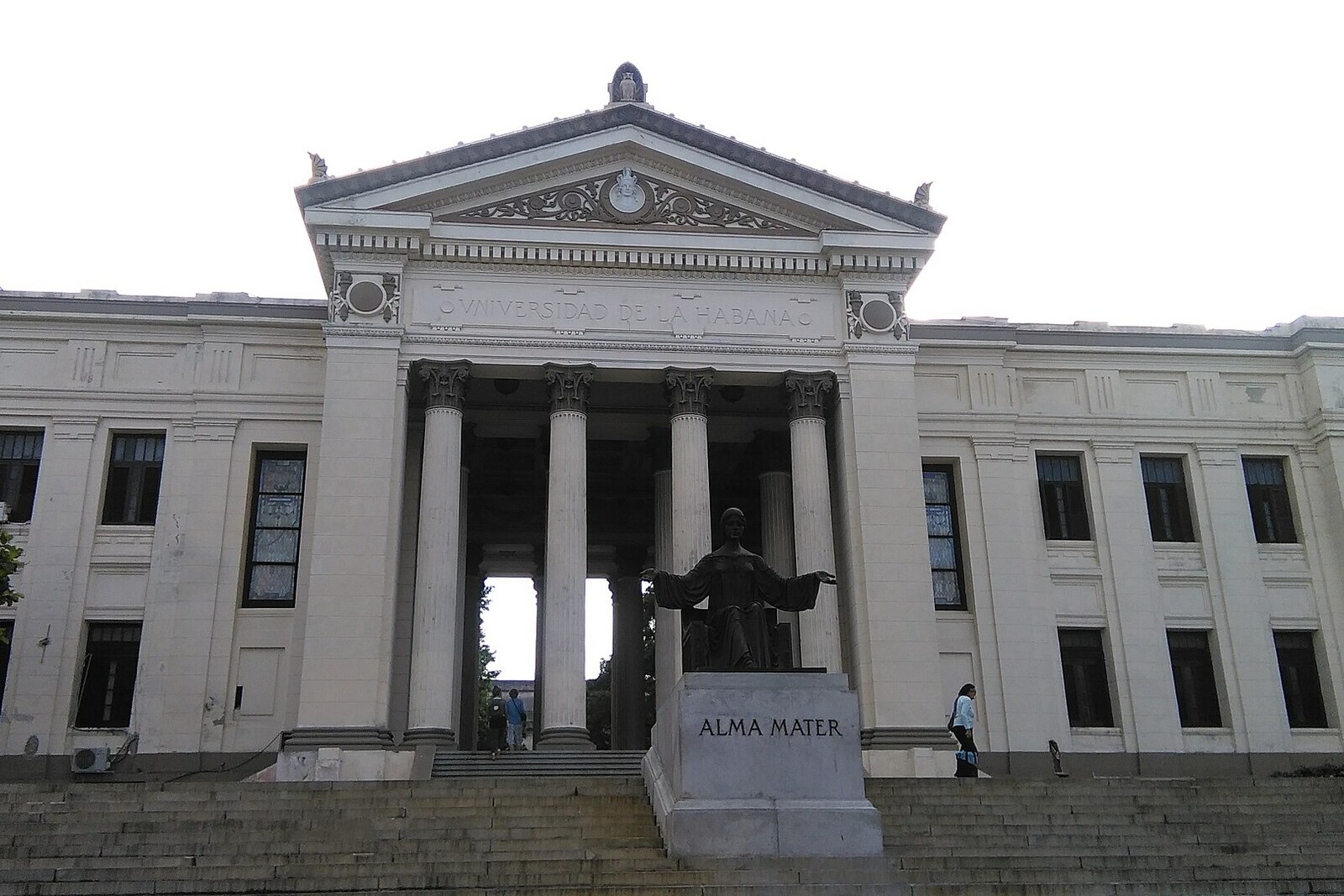
Look around first
What to notice
- Bronze Alma Mater
- Broad university staircase
- Side reliefs on the throne
- University courtyard behind the statue
The story of the place
The University of Havana moved to this hill in nineteen oh two, leaving its former buildings in Old Havana, where Dominican monks had once founded it. Before the academic buildings were built, this site housed colonial military pyrotechnics, with barracks and army workshops. The broad ascent from San Lázaro Street leads to the inner buildings, while the bronze figure at the top greets those approaching from below.
Above eighty-eight steps sits a woman for whom two real women from Havana posed. In nineteen nineteen, the Czech-American sculptor Mario Korbel took the face, head, and neck from sixteen-year-old Feliciana Villalón Wilson, the daughter of this university's professor of analytical mathematics. An older Cuban woman, whose name could not be established, posed for the body. On the sides of the bronze throne, Korbel depicted branches of knowledge: medicine, law, philosophy, literature, and architecture. Alma Mater is Latin for “nourishing mother”: that is what a university that gives its graduates an education is called.
At first, the statue stood closer to the rector's office. Late in nineteen twenty-seven, it was moved to its present pedestal, and on January seventeenth of the following year the broad staircase was completed. The University of Havana itself is much older: Dominican monks founded it in seventeen twenty-eight in Old Havana. The university moved to this hill in nineteen oh two, occupying the grounds of a former military pyrotechnics facility—barracks and workshops of the colonial army.
Just under three years after the staircase was completed, police blocked the approaches to this entrance. President Gerardo Machado secured an extension of his term despite his earlier promise not to seek reelection. Enrique José Varona, an elderly university professor and public philosopher, called on young people to openly oppose that decision. Students planned to gather in support of Varona and demand the president's resignation. Machado ordered the start of classes moved from October to November; the acting rector agreed. The postponement was meant to deprive the students of a reason to gather at the university, but it only sped up preparations for the protest.
Among the organizers was Rafael Trejo, a twenty-year-old third-year law student and deputy chair of his faculty's student association. His mother taught at a primary school. His father began as a tobacco worker and, with great difficulty, trained as a lawyer; his son was following the same path. Trejo enrolled at the university on September thirtieth, nineteen twenty-seven. Exactly three years later, he came here for a meeting that could cost him his education and his future profession.
The students intended to meet in the inner Patio de los Laureles and then go to Varona's home. On the morning of September thirtieth, nineteen thirty, police did not allow them onto university grounds. About a hundred people gathered farther down the slope, by Eloy Alfaro Park, and decided to head instead to the presidential palace. Police split the column with batons. During the scuffle, Trejo grappled with one of them; another student tried to seize a pistol, and a shot rang out. Trejo was seriously wounded. He underwent surgery in the hospital, but died the next day.
The coordinating committee created by the students—the Student Directorate—announced a boycott of classes after his death and published a program that now included the names of its authors. They demanded an investigation into the attack, the readmission of expelled fellow students, student participation in university governance, and autonomy for the university. In December, Machado closed the university. His government fell three years later amid a broader political crisis; university autonomy, which the participants in the march had advocated, was first introduced in nineteen thirty-three, then abolished and restored by a law of nineteen thirty-seven.
Rafael Trejo's name does not appear on the bronze throne. The spatial layout from that morning survives: behind Alma Mater is the university courtyard, in front of it the steps descend to San Lázaro Street, and the site of the fatal scuffle lies farther down, closer to Infanta Street. Police did not let the students through this entrance, so the protest that began at the university ended beyond its fence.
Useful on site
The staircase is usually understood as an outdoor urban space; access to campus buildings may be restricted by security, the academic schedule, and weekends. Regular public hours for the interiors have not been confirmed. Checked 2026-06-29.
Checked: June 29, 2026. Check the official source before visiting.The climb is long and almost without shade, so do not rush and pause at the landing. If the staircase does not suit you or access to the top is restricted, listen to the story from below: the main details are visible from here.