 Guide On Map
Vedado: Malecón and Modern Havana
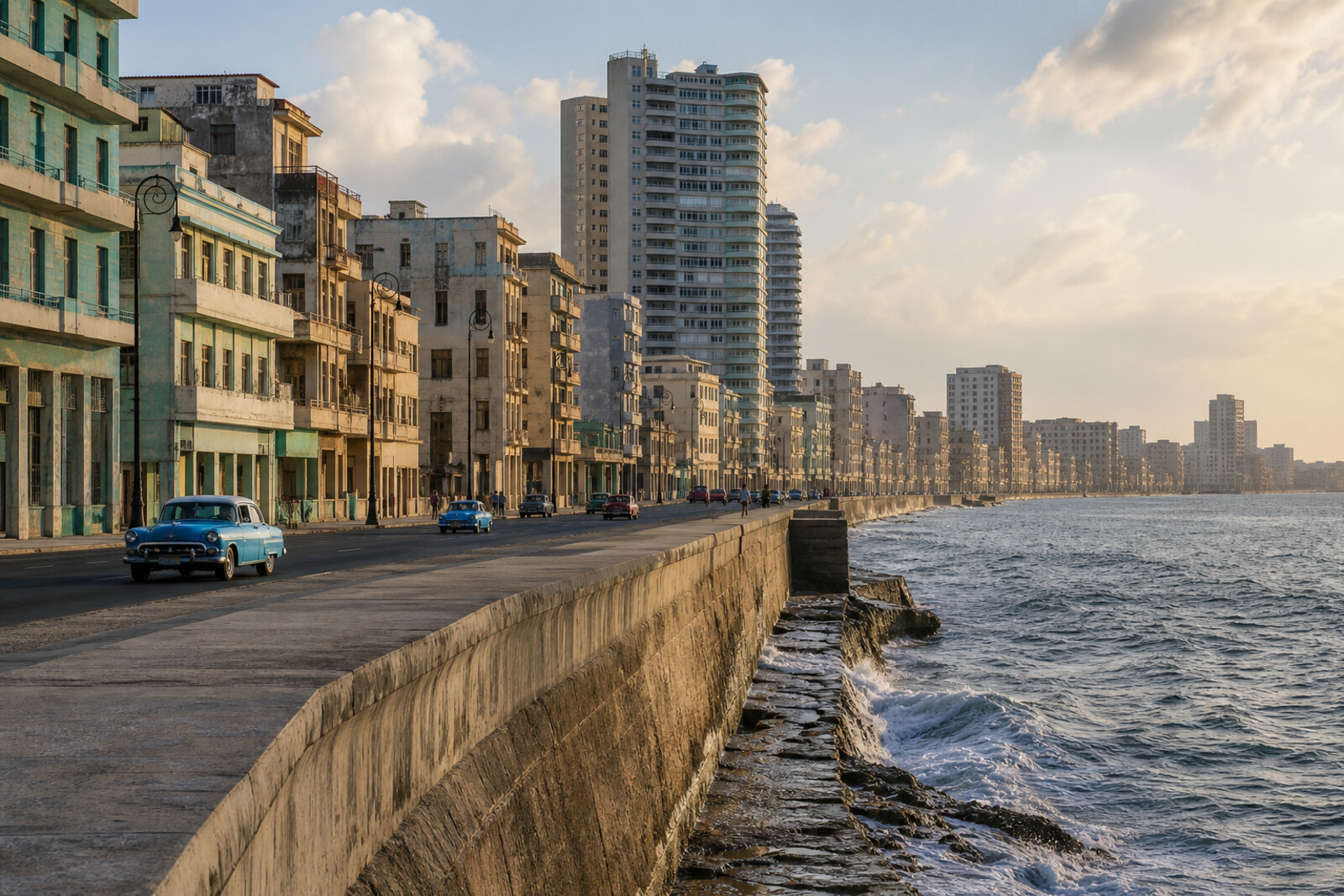
From the Malecón along La Rampa to Hotel Nacional de Cuba
Guide On Map on your phone
Open the walk like a regular app
It takes about 10 seconds to install. No app store needed.
The whole path
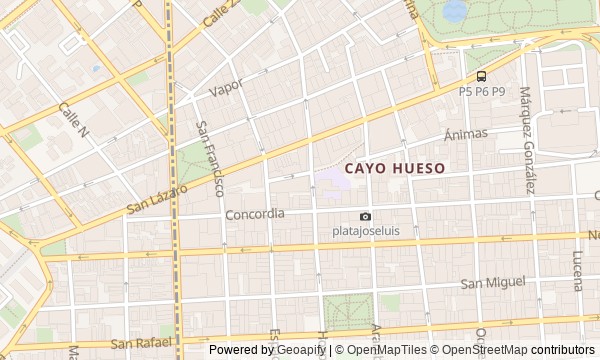
Route map
About the walk
You will begin by the sea, where 23rd Street rises into Vedado, and follow La Rampa toward the university hill. Then the route will bring you back to the district's main intersection, past radio studios, a cinema, and the garden of Coppelia Ice Cream Parlor, on to the FOCSA Building, and finally to Hotel Nacional de Cuba above the Malecón.
This is twentieth-century Havana, not a colonial postcard. Here, the city will be changed by broadcasting, student protests, major public commissions, and the money of apartment buyers. Why will no monument remain at the seaward end of the street? Why will a technician cut off a broadcast? And who will decide that anyone needs a cafe with a thousand seats at all?
The story will move through actions and surviving objects. It will separate what is confirmed from common versions, without embellishing difficult episodes. After the walk, you will recognize Vedado by its own evidence: an empty spot by the sea, a staircase, a radio façade, concrete supports, a high-rise, and guns in a hotel garden.
Why this order
The seaward end of 23rd Street sets the starting line: La Rampa begins here, along with the theme of public signs of power. The climb to the University of Havana continues it where a civic gesture gives way to student resistance. From the university staircase, the route returns via San Lázaro Street and L Street to the Radiocentro CMQ Building: the next generation of students will try to move the action from the street to the airwaves. At the same intersection, Coppelia Ice Cream Parlor changes the way the city is discussed—after the armed seizure of a studio comes a major peaceful commission for everyday life. A short walk to the FOCSA Building reveals private money behind neighboring modern architecture. The final approach to Hotel Nacional de Cuba brings the route back to the sea, this time to an old military hill where a hotel façade, coastal guns, and a struggle for control of the army stand side by side.
Those who want to see twentieth-century Havana beyond Old Havana Lovers of architecture, urban history, and political stories Those who prefer a connected route to a collection of separate sights
Those looking only for colonial architecture and Old Havana postcards Those who find noticeable climbs difficult Those who do not want to hear about street violence and armed conflicts
Before you go
Save an offline map of Vedado: after the FOCSA Building, the route turns toward the University of Havana and then returns to the shore. Bring water, a hat, and shoes suitable for stairs and uneven sidewalks. On 23rd Street, cross only where it is appropriate, and do not play the audio so loudly that you cannot hear traffic. By the Malecón, stay farther from the seawall in strong winds and high waves. All stories can be experienced from outside; if ice cream, a film screening, a restaurant, a garden, or the tunnels at Hotel Nacional de Cuba matter to you, check access separately.
When to go
2 hr 15 min
Backup plan
If the heat becomes too much, take breaks in the shade and walk the open stretches without long stops, saving the audio for a calmer place. Even when Coppelia Ice Cream Parlor is closed, its pavilions and canopies still tell the story; Yara Cinema can be read through the exterior volume of the Radiocentro CMQ Building, and the FOCSA Building does not require going upstairs. Do not spend time waiting in line or trying to enter an inaccessible interior. If you need to shorten the walk, keep at least the approach to the university staircase and the finale at Hotel Nacional de Cuba: without them, the story loses its turn from the optimism of modern architecture to conflict, memory, and defense.
Route conditions
Elevation. Ascent — 39 m; descent — 27 m
OpenStreetMap extract of June 18, 2026: database data, not a check on the ground. Data © OpenStreetMap contributors, ODbL licence
Walk plan
Open in maps ↗- 1
Malecón at 23rd Street
It opens the route with an empty place where two successive eras tried to secure their own memory. - 2
University of Havana and Alma Mater
Shows how the university's ceremonial entrance became the boundary between study and open protest. - 3
Radiocentro CMQ Building and Yara Cinema
Links the architecture of mass entertainment with an attempt to turn an ordinary news broadcast into a call to action. - 4
Coppelia Ice Cream Parlor
It helps show how a large public commission was divided into several spaces on a human scale. - 5
FOCSA Building
Explains why the tower's height was not only an architectural calculation but a financial one. - 6
Hotel Nacional de Cuba and Santa Clara Battery
Brings together, at one point, the old coastal defense and the struggle for control of the new army.
Route features
Everything you need stays in the browser
Progress, saves and your trip plan are stored on this device.
Add Guide On Map to your home screen so the walk opens outside the browser.
How we handle sources, maps and corrections: our editorial standards