 Guide On Map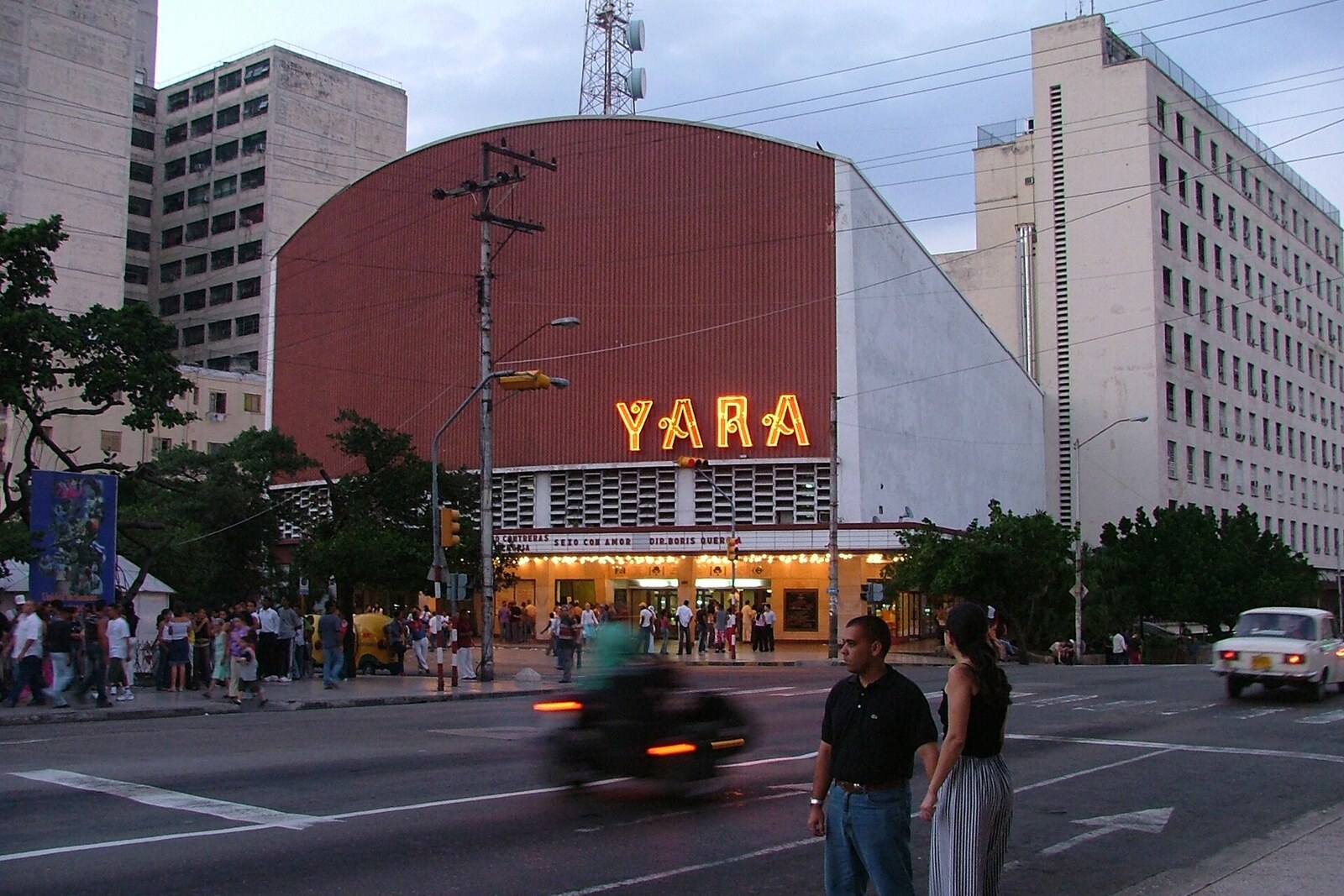
Look around first
What to notice
- The cinema's curved façade
- The Yara sign
- The Radiocentro CMQ Building's high-rise section
- The cinema's main entrance
The story of the place
Yara Cinema occupies the rounded low section of the Radiocentro CMQ Building: the auditorium seats one thousand five hundred, while the high-rise section rises behind it. Goar Mestre commissioned the complex for his growing media network, which no longer fit in its previous premises. Under one roof, it brought together a cinema screen, shops, offices, radio studios, and facilities for future television. The first Warner Bros. sign was replaced by the name of an eastern Cuban settlement associated with the beginning of the struggle for independence.
On March thirteenth, nineteen fifty-seven, announcer Floreal Chomón began his noon shift at Radio Reloj. He read news and advertisements, but that day he was expecting armed men. Chomón belonged to the underground Revolutionary Directorate and knew that his comrades were preparing an attack on the Presidential Palace. He had not been told the exact time.
Reloj means “clock” in Spanish. The station broadcast brief news reports and the exact time around the clock, so listeners were used to learning about an event here immediately after it happened. At first, the participants in the attack planned to seize a more powerful radio station owned by the same company. Chomón persuaded them to choose Radio Reloj: the public would be more likely to take a message broadcast here for an urgent news bulletin.
The studio was on the fourth floor of the Radiocentro CMQ Building. This complex was built by media entrepreneur Goar Mestre, whose radio network had outgrown its previous premises. He commissioned studios, offices, shops, future television facilities, and a large cinema auditorium in one building. The cinema opened in December nineteen forty-seven, and the radio stations moved here in the spring of the following year. The American company Warner Bros. received the right to operate the auditorium, so its first sign read Warner Radiocentro Theater. The low structure with the curved façade was intended for one thousand five hundred spectators; behind it stood the floors where broadcasts were prepared and put on the air.
At about twenty minutes past three, José Antonio Echeverría entered the booth. He was a twenty-four-year-old architecture student, chairman of the University Student Federation, and leader of the Revolutionary Directorate. He sought the overthrow of Fulgencio Batista, who had led the country after the military coup of nineteen fifty-two. While one group was supposed to kill Batista at the palace, Echeverría planned to announce it on the radio, call for an uprising, and then make his way to the university, where he was known as a student leader.
Echeverría placed typed messages before the announcers. In them, the outcome of the palace attack was already treated as known: Batista had been killed, and army units were joining the rebels. One of the announcers read the messages, then introduced Echeverría. He began his address with the words “People of Cuba!” and announced Batista's death.
In fact, the attackers did not reach their target at the palace. Batista remained alive, and the people in the Radiocentro CMQ Building still had no reliable information about the outcome. After a few sentences, a station technician cut off the broadcast. When Echeverría was told that he could no longer be heard, he fired at the control-room window and led the group toward the stairs. Downstairs, Chomón was told not to get into the car with them: it had to appear that the announcer had been taken from the studio against his will, otherwise his connection to the underground would have been exposed.
Echeverría's car headed toward the university, but near the hill it encountered a police patrol. The student got out of the car, opened fire, and was fatally wounded. The call did not bring about the uprising for which they had seized the microphone; the recording of the interrupted speech became Echeverría's last surviving address.
The historic booth is still on the fourth floor of the complex. In two thousand nineteen, it was declared a national monument. Radio Reloj itself now occupies the eighth floor of the same Radiocentro CMQ Building and continues to broadcast the time and the news.
The cinema auditorium was called simply Radiocentro from nineteen fifty-three, and it received its current name in nineteen seventy-three. Yara is a settlement in eastern Cuba that gave its name to the beginning of the uprising against Spanish colonial rule. In October eighteen sixty-eight, Carlos Manuel de Céspedes del Castillo freed the enslaved people who belonged to him, proclaimed Cuba's independence, and led a detachment toward Yara. The rebels were defeated there, but the war they began continued for ten years. The curved façade now bears the name Yara; the former Warner Bros. name has disappeared, while the cinema auditorium remains in the same structure that Mestre joined to the radio studios.
Useful on site
The exterior is accessible from the street. Screenings, the box office, and access to the lobby depend on the cinema's current program; a regular schedule has not been confirmed. Checked 2026-06-29.
Checked: June 29, 2026. Check the official source before visiting.This account is designed to be experienced from the street: neither a screening nor access inside is needed. At this busy corner, choose a spot where you do not obstruct the flow of people and can hear the traffic clearly.