 Guide On Map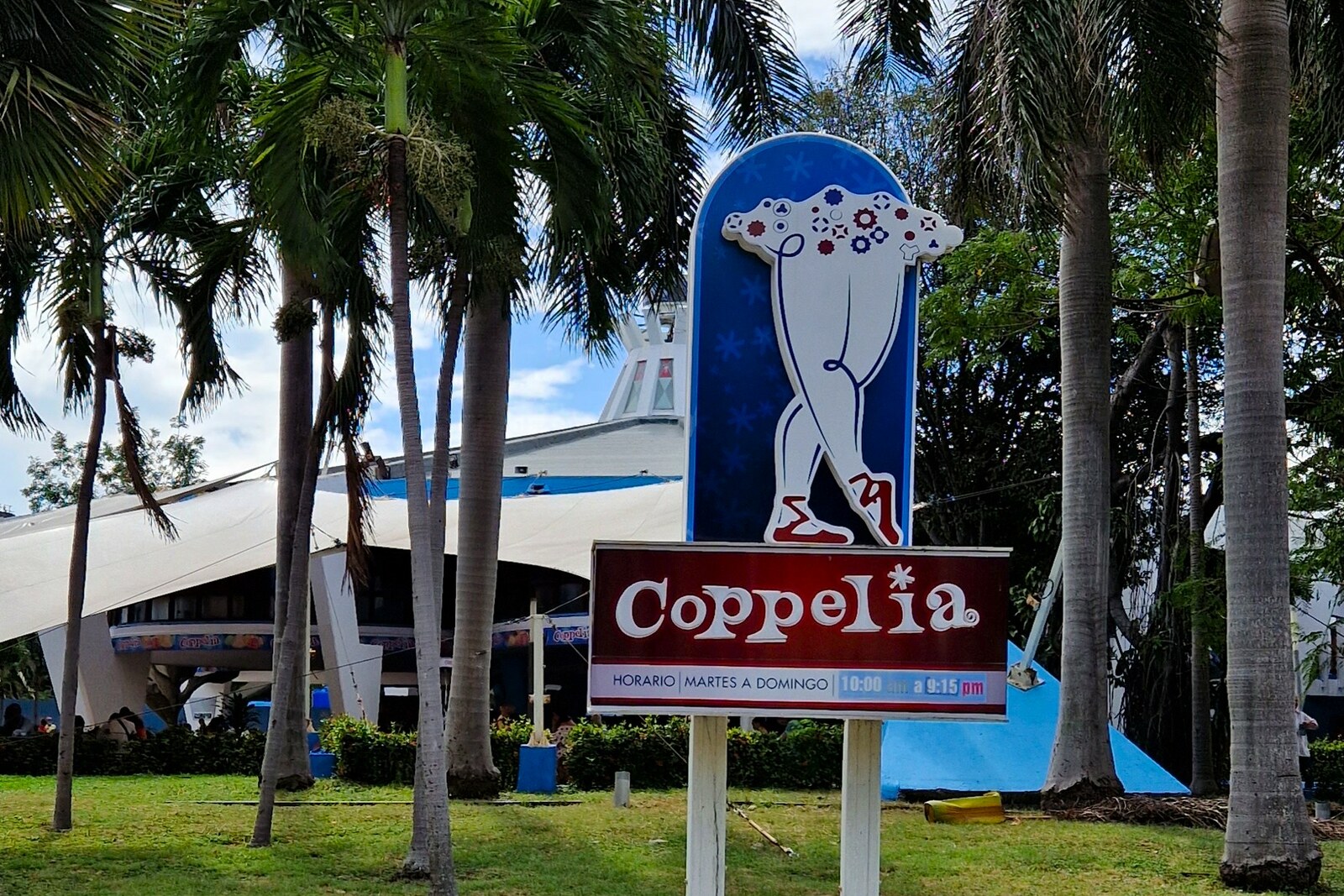
Look around first
What to notice
- Round concrete roof
- Spreading supports
- Spiral staircase
- Garden pavilions
The story of the place
After Reina Mercedes Hospital was demolished, this corner had time to become a tourist park and a nighttime venue with bars. Now people come here for ice cream beneath a round concrete roof held up by spreading supports; the garden pavilions and spiral staircase belong to the same ice cream parlor. The name came from a comic ballet: Coppélia there is a mechanical doll mistaken for a living girl.
In nineteen sixty-six, Celia Sánchez, secretary of the Council of Ministers and manager of major public projects, summoned the architect Mario Girona. She needed an ice cream parlor for one thousand visitors—the size of an entire city block.
The site was chosen deliberately. Reina Mercedes Hospital had once stood here. After it was demolished, the plot had time to become a tourist park, then a nighttime entertainment venue with bars. Girona recalled that Sánchez wanted to replace this corner's former use with a family-oriented one: instead of drinking, people were to come here for ice cream. The intersection of 23rd Street and L Street lay in the center of the new La Rampa, near Hotel Habana Libre, and the empty block could accommodate as many people as no previous Havana confectionery shop had held.
Girona himself was then working as an architect for the Ministry of Construction. He later admitted that he hardly ate ice cream and had never really visited dedicated ice cream parlors. When he heard Sánchez's requirement, he thought: who would come to eat ice cream in numbers planned for one thousand seats? But to refuse would have meant backing away from the most prominent commission of his career.
They were given six months for design and construction. Architects and engineers worked morning, afternoon, and night; some details were calculated in the builders' wake. So that one thousand visitors would not end up in one enormous hall, Girona distributed the seats among small sections, open areas, and an upper pavilion with a spiral staircase. Special precast beams and roof elements were made to speed things up. That is where the concrete supports spreading beneath the round roof and the halls hidden among the garden come from: they are parts of one large ice cream parlor, divided into human-scale spaces.
Sánchez chose the name. Coppélia is the name of the mechanical doll in Léo Delibes's comic ballet: the young Franz mistakes the motionless beauty in the window for a living girl until his fiancée Swanilda exposes the deception. It was Sánchez's favorite ballet, and she transferred its title to the new ice cream brand.
On June fourth, nineteen sixty-six, the ice cream parlor opened without a ceremonial event. Regular sales began, curious visitors came inside and took the tables. The menu had twenty-six flavors. Girona's doubt was resolved at once: the seats planned for one thousand people filled up, and soon the famous lines appeared nearby. Coppelia Ice Cream Parlor became his most recognizable building, and ice cream parlors like it began opening in other Cuban cities as well.
A dedication to Celia Sánchez survives on one of the concrete supports. Beside it, it states that she brought the idea to fruition and chose the name in honor of her favorite ballet. The round roof, separate halls, and garden remain from her commission for one thousand visitors; the word “Coppélia” above them comes from her personal choice.
Useful on site
An official source from 2025 listed opening Tuesday—Sunday 10:00—21:15, but access and ice cream availability are unstable; in 2026, the local press reported a closure and no product. Checked 2026-06-29; ask locally.
Checked: June 29, 2026. Check the official source before visiting.Do not tie this stop to making a purchase: the line, access, and range of flavors may change. The architecture is easy to view from outside without blocking the entrance or passageways.