 Guide On Map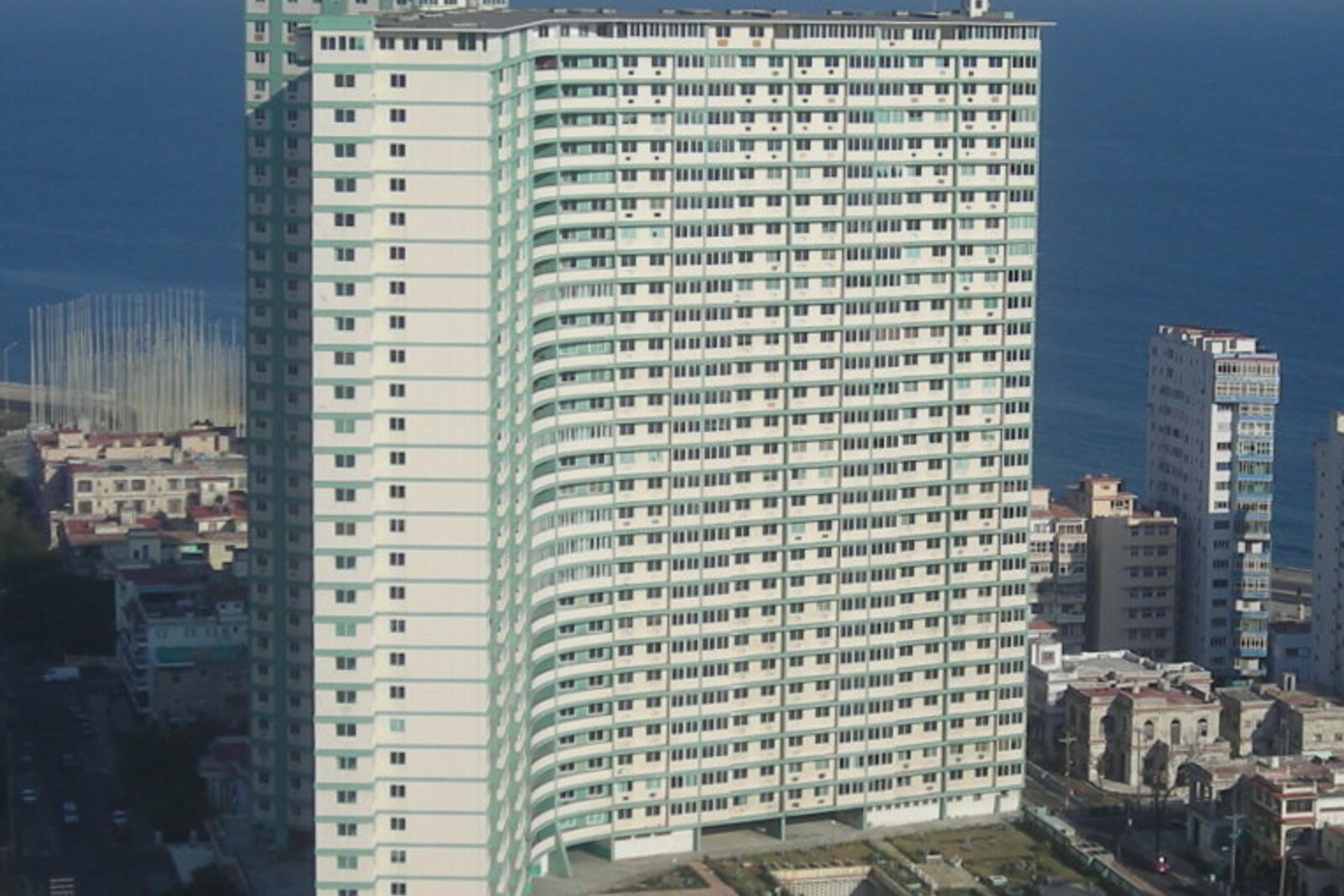
Look around first
What to notice
- High-rise tower
- Multi-level base
- Lower commercial premises
- Upper restaurant volume
The story of the place
The high-rise tower of the FOCSA Building rises above a multi-level base with shops and garages. Within one city block, three hundred seventy-three apartments, a bank, a post office, a restaurant, and two radio stations were placed. A cable linked the radio stations to CMQ's central control room, so housing, daily business, and work on the air were close together. La Torre Restaurant operates at the very top.
In nineteen fifty-two, Goar Mestre, the owner of Cuba's largest radio and television network, decided to house artists and employees near the studios. He initially chose a site in the outlying district of Arroyo Arenas, but rejected it: the daily commute would have deprived the plan of its point. Mestre then bought this city block between 17th Street, 19th Street, M Street, and N Street. From here, the already familiar Radiocentro CMQ Building is about two hundred meters away.
The land cost seven hundred thousand pesos. To make such a purchase pay for itself, about four hundred apartments had to be sold. Mestre, his brothers, and partners created Fomento de Obras y Construcciones, S.A. for the project. The first letters of its name formed the word FOCSA.
Mestre made money in radio and television, but built the skyscraper on credit. The mortgage authority agreed to finance eighty percent of the cost of apartments and sixty percent of commercial premises. Cuban Continental Bank issued another six million pesos. The bankers considered the risk acceptable: the debt was to be repaid by hundreds of buyers, rather than by a single owner of the building.
The architects Ernesto Gómez Sampera and Martín Domínguez had to fit this financial plan into one city block. Above a shared base, they placed three hundred seventy-three apartments, and below them, garages, shops, a bank, a post office, a restaurant, and two radio stations connected by cable to CMQ's central control room. This allowed employees to live, buy necessities, and go on the air while barely leaving the complex.
Work was completed in June nineteen fifty-six. One hundred twenty-one meters of concrete made FOCSA the world's second-tallest residential reinforced-concrete structure of its time. Thirty pesos was added to the price of an apartment for every subsequent floor, yet the upper apartments sold out before the lower ones. Mestre's calculation worked: the costly lot was paid for by people willing to pay more for height and a view of the sea.
People still live in the tower, the lower levels are occupied by institutions and commercial premises, and La Torre Restaurant operates at the top. What remains of Mestre's company is its abbreviated name. What remains of the commuting distance he chose is the same two blocks between FOCSA Building and Radiocentro CMQ Building.
Useful on site
Residential complex; basic viewing from the street only. Access to the lobby, shops, and restaurant depends on the actual operation of tenants and security; regular hours have not been confirmed. Checked 2026-06-29.
Checked: June 29, 2026. Check the official source before visiting.For this stop, you do not need to enter the building or look for a way up. Step back to the opposite side of the street or to an open area to see the tower's full form.