 Guide On Map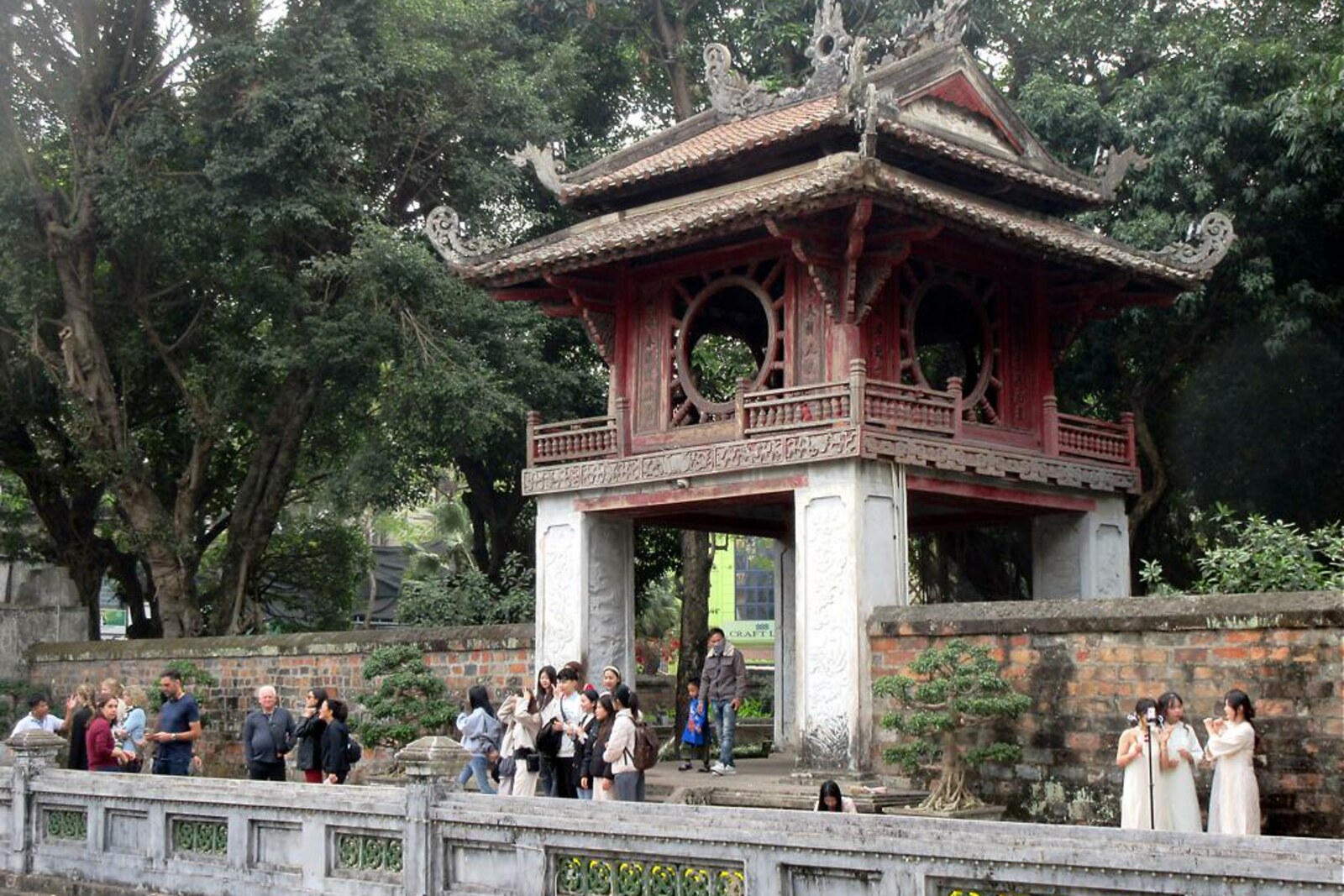
Look around first
What to notice
- Four brick pillars
- Wooden upper level
- Four round windows
- Radiating wooden spokes
The story of the place
Four brick supports carry a wooden pavilion, while the open middle leaves the road clear toward the well and the stone plaques bearing the names of those who passed the examinations. The upper level is cut through by round windows; radiating wooden spokes around them form a star that, in the old conception, was associated with writing. The pavilion was added to the Temple of Literature during its restoration. Over time, its silhouette became part of Hanoi’s official emblem.
In eighteen oh two, the commander Nguyen Van Thanh received an unusual appointment. For almost thirty years, he had fought for Nguyen Phuc Anh, the future Emperor Gia Long. After the victory, the emperor entrusted him with Bac Thanh—eleven northern provinces centered on Thang Long, then Hanoi. People here still remembered the former Le dynasty, and the new governor needed educated people capable of governing the north.
The position of the old Hanoi academy clearly showed the change. Gia Long kept the capital in Hue and in eighteen oh three founded a new institution of higher learning there. The former capital school in Thang Long became an ordinary school of Hoai Duc Prefecture. Scholars who had received degrees under the Le dynasty had lost the former court they had served, while the new dynasty needed their knowledge.
Nguyen Van Thanh received these people with marked respect and offered them posts. A chronicle reports that former holders of scholarly degrees came to him and agreed to serve. The governor issued rules for schools, attended to teachers and examinations, and in eighteen oh five ordered the Temple of Literature restored and this gate with its wooden pavilion added to it.
The name Khue Van explains why the pavilion was placed directly above the road to the well and the stones bearing the scholars’ names. In the old conception, Khue was a celestial region of sixteen stars associated with writing. Their arrangement was seen as the sign “van”—“literature.” On the upper level, four round windows are surrounded by radiating wooden spokes: the builders turned the name into an image of a shining star. Below, four brick pillars leave the central passage open.
The old Hanoi school never regained its position as the country’s main academy. Yet the structure added by the military governor at the moment of this demotion became the most recognizable image of scholarly Hanoi; its silhouette is now part of the capital’s official emblem. The central road still passes beneath the star that Nguyen Van Thanh placed before the names of northern graduates who agreed to live under the new dynasty.
Useful on site
Ticketed area of the Temple of Literature and Imperial Academy; check the hours and ticket on the day of your visit, as the official website was under reconstruction at the time of verification.
Checked: June 28, 2026. Check the official source before visiting.The pavilion also serves as a passageway, so look at the details without holding up movement beneath the arches.