 Guide On Map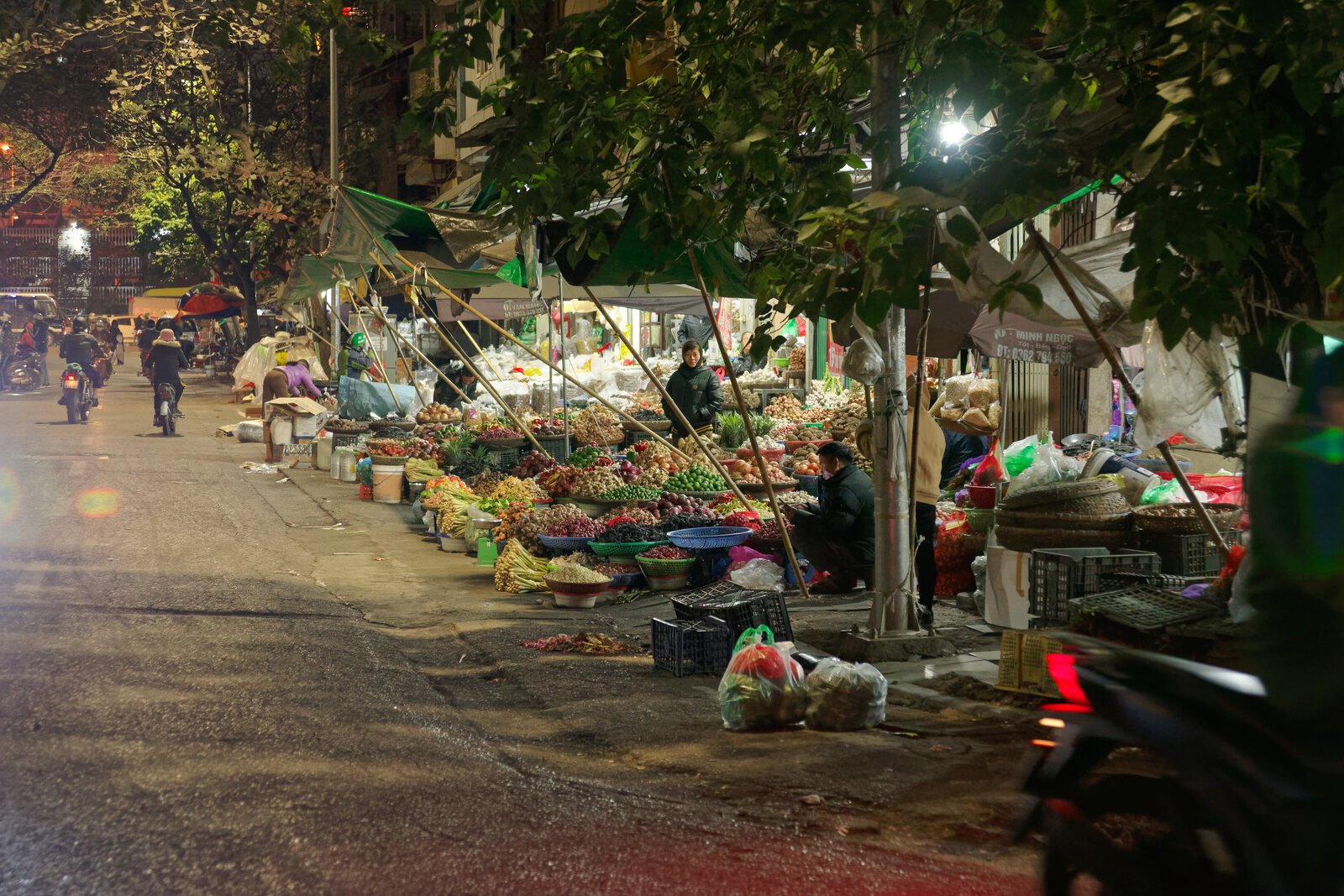
Look around first
What to notice
- Five facade arches
- The market's main entrance
- The bronze relief on the left
- The intersection with Hang Khoai Street
The story of the place
Dong Xuan Market is made up of several commercial blocks hidden behind a facade with five tall openings. The interior rows were rebuilt after the fire, preserving the outer division of the former building. To the left of the main entrance, at the intersection with Hang Khoai Street, a bronze relief shows fighters, workers, and women against the backdrop of the market. The old meat tables and ticket room have disappeared from here.
Five tall arches on the facade echo the five commercial blocks of the old Dong Xuan Market. Many sellers inside work primarily with wholesalers: goods from here are distributed to small shops in Hanoi and the surrounding area. This arrangement was established as early as eighteen eighty-nine. The French administration filled in a nearby branch of the To Lich River, closed two old riverside markets, and moved the traders to an empty plot near Dong Xuan Communal House. The site was enclosed by a bamboo fence, and a fee began to be charged for a trading place at the entrance. The French called the new complex the Great Market, but Hanoians continued to call it Dong Xuan Market, after the neighboring communal house.
In December nineteen forty-six, this concentration of trade determined the market's military role. To the north stood Long Bien Bridge, by which French units could enter the old city. At the same edge of the quarter, the defenders kept in touch with the outskirts. The loss of Dong Xuan Market threatened to cut off the Capital Regiment stationed here.
At about two o'clock in the morning on December twenty-second, a platoon of former bus station workers occupied the market. They were commanded by Vu Tam, a young Hanoian of about twenty, who had been assigned to hold the northern exit from the quarter. His fighters dug passages in front of the market, between the rows, and behind the blocks, and set up five firing positions. After the shelling, the roof had almost disappeared, and people dug shelters beneath the meat tables: fifteen-meter cement tables with smooth white slabs. The objects on which traders butchered their goods became roofs over the trenches.
On February fourteenth, nineteen forty-seven, French soldiers and tanks advanced toward the market from several directions. About one hundred thirty men remained in the ranks of Dong Xuan Market's one hundred first battalion, including two dozen wounded. By evening, French units had broken inside, and the fighting moved to those very meat tables.
Near one of them, deputy squad commander Nguyen Thanh Chuong found himself in hand-to-hand combat and began to lose ground to his opponent. His comrade Do Van Thin left cover to help. With a blow from his rifle butt, he knocked a French soldier to the ground, and together with Chuong, they stopped him. Rising above the counter, Thin made himself an open target for a shot in the back. Chuong shot the attacker and led the squad forward; the French soldiers had to withdraw from this part of the market.
Thin was carried to the ticket room to the left of the main entrance. It was impossible to take his body out through the encircled quarter, so his comrades buried him there. At night, the battalion gathered the remaining fighters, put the wounded into formation, received twenty reinforcements, and counterattacked. French units withdrew from the market to their previous positions. Vu Tam, himself wounded by shrapnel in the back of the head, later regarded the preserved route north as the main result of this battle: three nights later, the Capital Regiment was able to leave Hanoi and go beyond the Red River.
Nguyen Thanh Chuong survived the war and did not forget where his comrade lay. When the market was rebuilt in nineteen ninety, he indicated the site of the former ticket room. Forty-three years after the battle, the family and fellow servicemen found Do Van Thin's remains together with the belongings that had remained with him and moved them to a military cemetery.
The old meat tables and ticket room are no longer here today. After the fire of nineteen ninety-four, the interior blocks were rebuilt, and the five facade arches merely repeated the former division of the market. To the left, at the intersection with Hang Khoai Street, there is now a bronze relief showing fighters, workers, and women against the backdrop of Dong Xuan Market. The ticket room that Nguyen Thanh Chuong found from memory in nineteen ninety stood on this side of the entrance as it was then.
Useful on site
According to Vietnam Airlines, the main market is usually open daily 06:00–18:00; the night market, Fridays–Sundays until 22:30. Before going inside at a specific time, it is best to check on site.
Checked: June 29, 2026. Check the official source before visiting.Inside, keep to the edges of the aisles and let porters carrying goods pass. If it is crowded or the market is closed, the facade and surrounding streets are enough for this stop.