 Guide On Map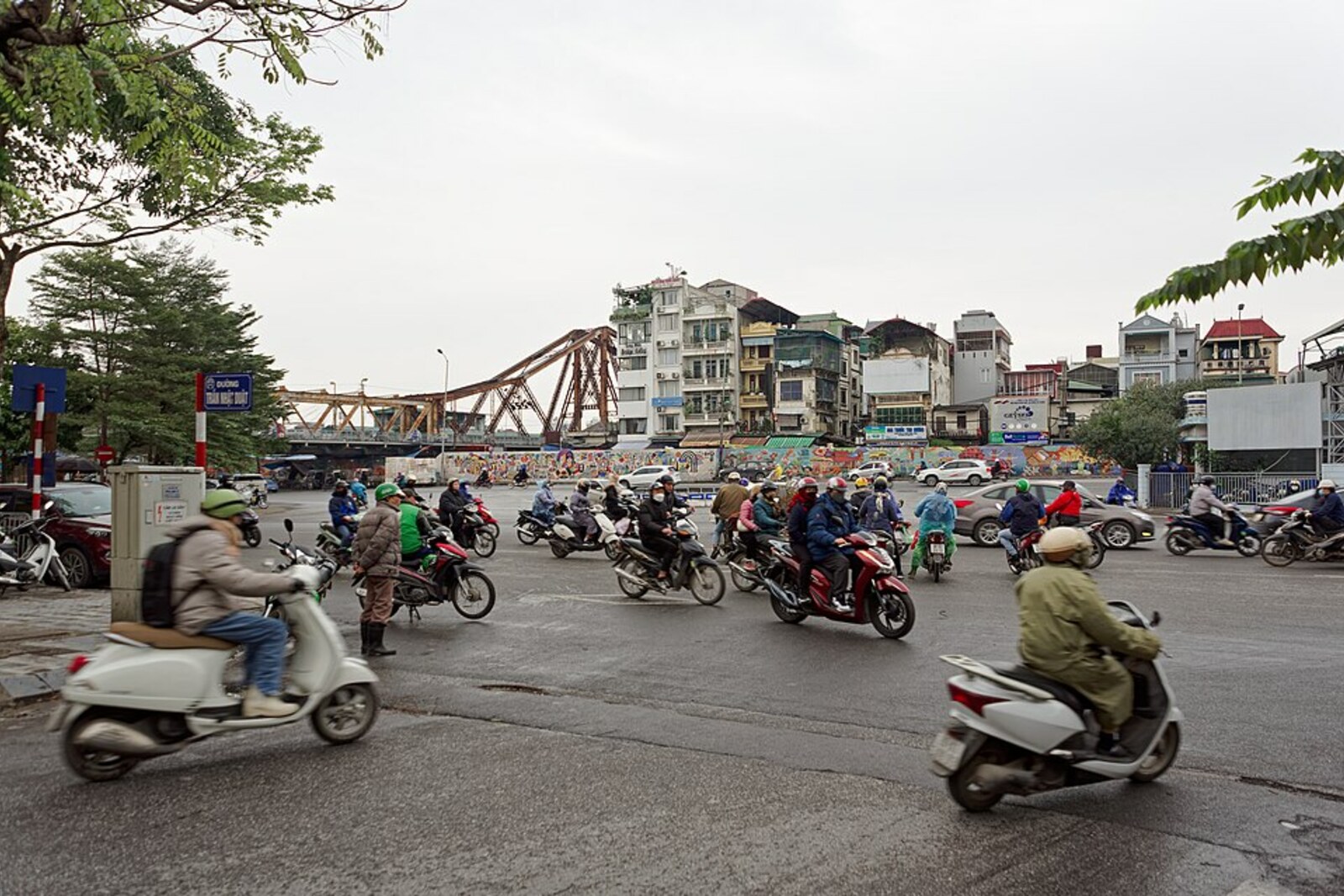
Look around first
What to notice
- Pedestrian bridge
- Fish and jellyfish made from recycled plastic
- Illuminated waves along the passage
- Carp by the stairs
The story of the place
The broad Tran Nhat Duat Street serves as the official eastern boundary of the Hanoi Old Quarter. This is how the conservation plan approved in nineteen ninety-five drew it: the trading streets remained to the west, while Phuc Tan and the houses beyond the dike lay outside. A pedestrian bridge over the road connects these parts of Hanoi. Its current form emerged from a story that began farther on, at the riverbank.
In the summer of two thousand nineteen, the artist and teacher Nguyen The Son was asked to work on a five-hundred-meter passage in Phuc Tan. Along the wall that separated the houses from the Red River floodplain, an informal dump had formed. Son wanted to turn it into a public space, and first asked local residents what they needed there. Only after that did he invite another fifteen artists. Local families helped collect discarded bottles, barrels, wheels, and metal parts.
At the start, the team received about forty percent of the estimated cost of the work. While there were no sponsors, some participants paid out of their own funds. For Son, this was money earned through teaching and artistic work; for his colleagues, it was an investment in works that were to stand in rain and sun. Son himself expected the materials to last from three to five years.
The artist Vu Xuan Dong collected more than ten thousand plastic bottles and motor-oil canisters from schools and residential neighborhoods. He made four sailboats from them, recalling the time when goods for the local markets arrived along the Red River. Son welded figures of peddlers and people who worked at the piers from old iron and mirrored steel. In all, by February two thousand twenty, sixteen works had appeared along the wall. The trash was removed, residents gained a lit place to walk, and they themselves began making sure the dump did not return.
But people from the Hanoi Old Quarter hardly came here. Tran Nhat Duat Street and the dike wall divided two neighboring districts. The infrequent passageways required a detour; some residents climbed over low sections of the wall. The pedestrian bridge, which had existed since two thousand fourteen, was used mainly by Phuc Tan residents going to the center to earn a living. Ten years later, its surface had peeled, its lighting worked intermittently, and holes had appeared in its roof. The exhibition beyond the dike remained a destination with no clear approach from the Hanoi Old Quarter.
Son spent three years pressing for the crossing to be remade and seeking funding. When the city administration found a sponsoring bank, he and Vu Xuan Dong, Le Dang Ninh, and Can Van An turned the entire bridge into a single work about water in four months. Fish and jellyfish made from recycled plastic were placed under the vault, illuminated waves with figures of Hanoi artisans of the past ran along the passage, and carp based on Hang Trong folk painting stood by the stairs. In early May two thousand twenty-four, the crossing reopened after its reconstruction. A two-way flow began: families and visitors started crossing from the Hanoi Old Quarter to Phuc Tan and then onward to the sixteen works by the river.
The name of the street beneath the bridge arose from another deliberate connection. Under the French administration, this same road was called Clemenceau Quay, after the French prime minister Georges Clemenceau. In the summer of nineteen forty-five, the physician Tran Van Lai held the post of Hanoi mayor for less than a month and managed to replace French names with Vietnamese ones. He grouped related names close together, so he named the quay after Tran Nhat Duat, a thirteenth-century prince and commander, and the neighboring street Ham Tu Quan Street.
The Battle of Ham Tu took place not here, but farther down the Red River. At the end of May twelve eighty-five, Tran Nhat Duat commanded an army there that crushed a fortified detachment of the Yuan dynasty and opened the way to the recapture of the former capital, Thang Long, present-day Hanoi. The next city administration retained the pair of names chosen by Tran Van Lai. Now a bridge to Phuc Tan passes above Tran Nhat Duat Street, and at its stairs, carp from a folk painting lead from the protected quarter to works assembled from things discarded beyond the dike.
Useful on site
Open street space on the eastern edge; no ticket required, but traffic moves noticeably faster than inside the quarter.
Checked: June 29, 2026. Check the official source before visiting.Listen from the safe side of the main road and cross it only at a marked crossing. Leave the descent to Phuc Tan and the viewing of the riverside works for a separate continuation if the route is convenient.