 Guide On Map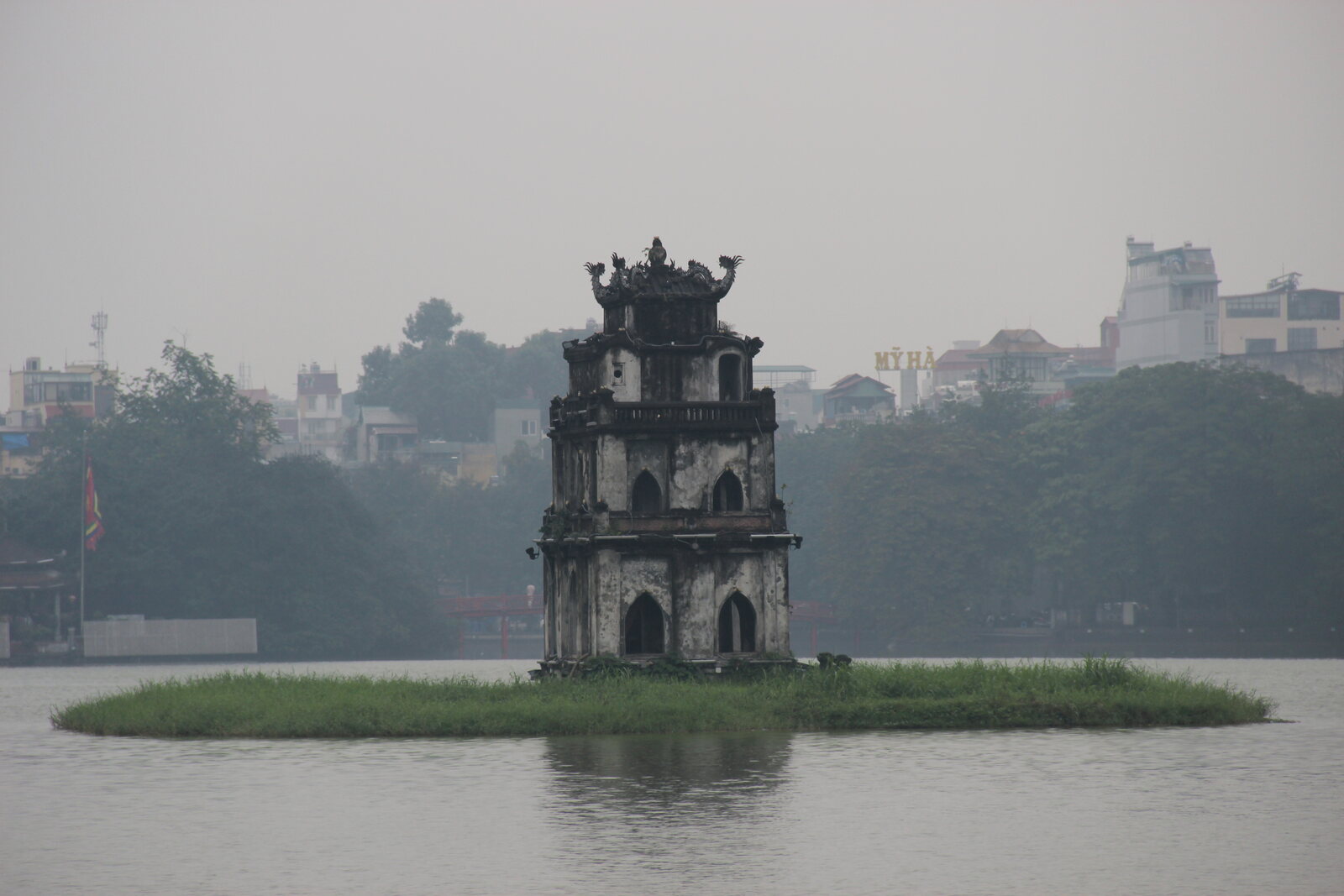
Look around first
What to notice
- Three-tiered brick tower
- Upper level with inscription
- Islet without a bridge
- Strip of water to the shore
The story of the place
In the middle of Hoan Kiem Lake, a three-tiered brick tower rises on a tiny islet. There is no bridge to it, and a strip of water still separates it from the promenade. The structure was paid for by the well-to-do Hanoi furniture maker Ba Ho Kim, but its original purpose remains unknown. The islet was long called Turtle, and it was later linked to the legend of Le Loi and the Golden Turtle, to whom a magical sword was supposedly returned here after victory over the Ming dynasty.
On the night of May eighteenth to nineteenth, nineteen forty-eight, three students from Hanoi's Chu Van An School came to Hoan Kiem Lake with a flag and a pole prepared in advance. Nguyen Van Kham, the leader of their underground group, remained on the shore to watch the nearest French post. Nguyen Si Van and Nguyen Trong Quang entered the water and swam to the tower. On the islet, one lifted the other onto his shoulders to reach the upper level.
French units had controlled Hanoi for more than a year. The Vietnamese Capital Regiment, which had defended the city, had withdrawn, while Kham, Van, and Quang continued their studies and secretly carried out assignments for the underground. Van was due to receive his school diploma; on the evening of the operation, he told his parents he was going to the movies. His father worked on the railroad, and his mother sold tea on Hang Bai Street. The schoolboy making the nighttime swim came from a family that expected him to return home in the morning.
They wanted residents to see on May nineteenth, Ho Chi Minh's birthday, that resistance remained inside the occupied city. This required a point visible from every shore and standing a few hundred meters from the police post. No bridge led to the tower, so the French kept no guard on the islet.
In the morning, a red flag with a yellow star appeared above the roof. The French reached the islet and took it down, but residents had already spread the news through the city. Then the successful operation turned against its participants. The underground leadership demanded a written report. The courier carrying the paper was detained, and the document found on him led French intelligence to Kham's group.
All three were arrested. In his cell, Quang again drew a flag on the wall and confessed to being its author when the guards began beating prisoners to demand the author's name. Quang and Kham, along with two couriers, were taken out to Phung and shot; their burial places have not been found. Van was sent to hard labor in Khe Tu. After an unsuccessful escape attempt, he was caught and beaten to death. Van's remains were found only in nineteen oh one. Quang's family received official confirmation of his death eight years later—sixty-one years after the night on the lake.
The tower they climbed was then about sixty years old. It was paid for by the wealthy Hanoi furniture merchant Nguyen Huu Lien, known as Ba Ho Kim—a village elder and intermediary between the French and the townspeople. Construction was completed around eighteen eighty-six, and it was initially called Ba Ho Kim Tower.
Later, a story appeared that Ba Ho Kim chose the islet on the advice of feng shui experts and intended to bury his parents here in secret, but residents dug up and carried away the remains. This tradition was recorded decades later; the builder's descendants deny it, and there is no reliable evidence of a burial. All that is known for certain is that Ba Ho Kim paid for the brick tower and left a structure in the middle of the lake whose original purpose is unclear.
The inscription “Turtle Tower” survives on the upper level. The islet itself was called Turtle. It was also linked to a legend about the ruler Le Loi: after victory over the Chinese Ming dynasty, he supposedly returned a magical sword to the Golden Turtle on this very lake. Hence the name Hoan Kiem Lake, the lake where the sword was returned.
There is still no bridge to the islet today. Kham remained roughly where the present-day promenade runs, while Van and Quang crossed the strip of water that still separates the shore from Turtle Tower.
Useful on site
Exterior viewing from the western shore; the tower itself stands on an islet and is not a point of pedestrian access.
Checked: June 29, 2026. Check the official source before visiting.The tower stands on an inaccessible islet, so view it from the shore and use your camera's zoom. Do not try to find a way to the structure.