 Guide On Map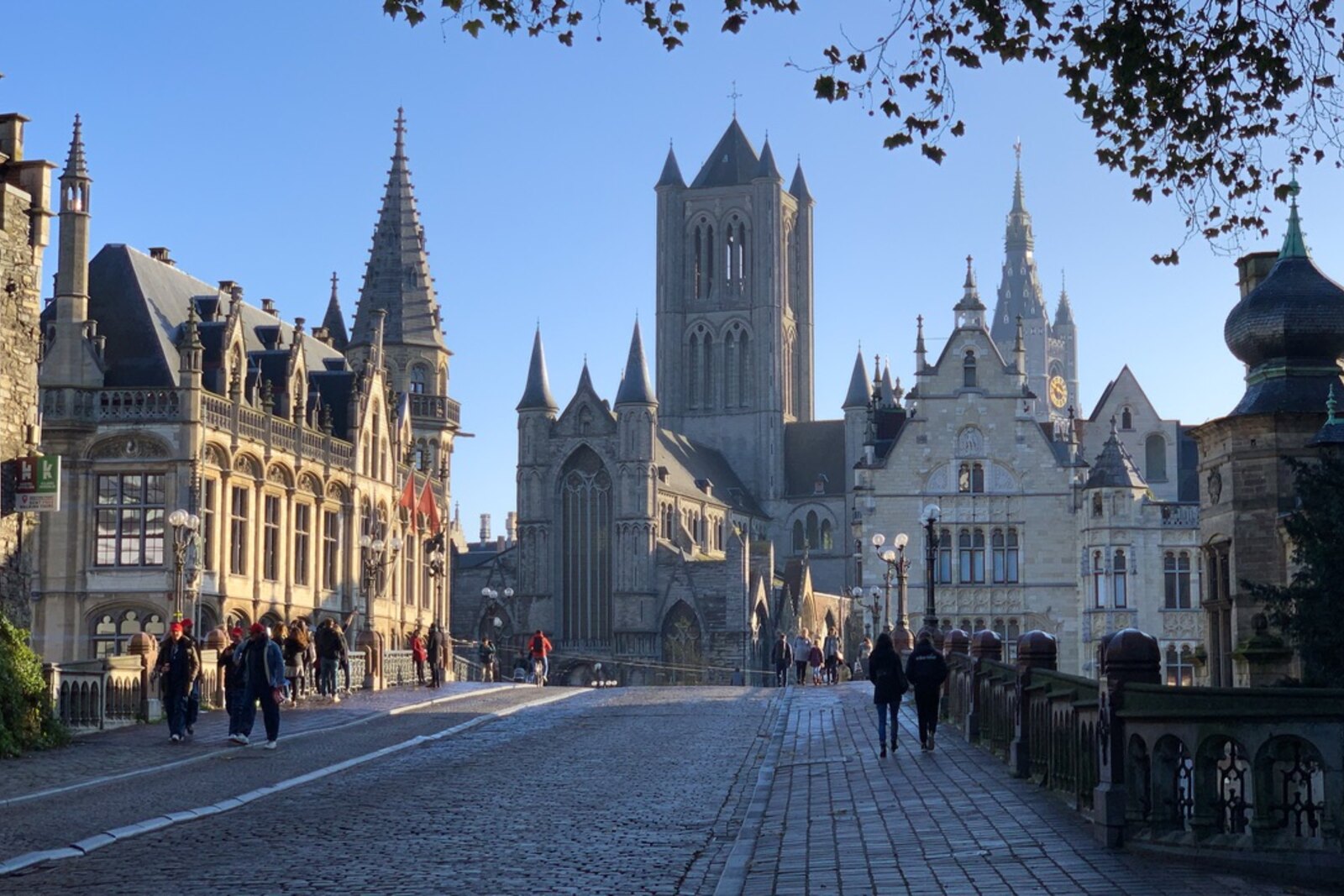
Look around first
What to notice
- The bridge's stone arch
- The central lamp
- The bronze Archangel Michael
- Three towers in a single line
The story of the place
St Michael's Bridge raises the street above the Lys: boats pass along the water, while pedestrians and urban transport move above them. Long approaches connect the arch with Korenmarkt and St Michael's Square, turning the crossing into a continuation of the street. On the central lamp, the bronze Archangel Michael fights a dragon, and from the height of the bridge the city's three towers converge into a single line.
At the beginning of the twentieth century, crossing the Lys depended on river traffic. A low metal bridge stood where the present stone arch now stands. As a vessel approached, the bridge operator swung it across the street. Pedestrians, cyclists, and trams waited on the banks until the vessel had passed and the tracks were connected again. So many complaints reached the city authorities that they abandoned another repair.
Paul de Smet de Naeyer—a cotton industrialist from Ghent and Minister of Public Works—took on the task of carrying the street over the river. He campaigned for a permanent crossing beneath which vessels could pass without stopping traffic on land. The engineer and architect Louis Cloquet designed a high fixed bridge and extended it on both sides with long approaches toward Korenmarkt and St Michael's Square.
It was precisely the height of the design that provoked opposition from the Society of History and Antiquities of Ghent. Its members defended the old cityscape and considered the bridge excessively massive: in their view, it would hide part of the quays, and the boats would disappear along with the swing structure. The historian Paul Fredericq proposed appealing directly to de Smet de Naeyer, a native of Ghent who had previously listened to preservationists. The Society sent petitions, sought personal meetings, and asked seventeen senators and deputies from among its members to support the protest.
The minister would not yield. He had been advancing this crossing for several years, and he got precisely the permanent bridge he had sought. The Van Ooteghem brothers built the main structure in nineteen oh six and nineteen oh seven. The finishing work dragged on, but the approach of the nineteen thirteen World's Fair forced the work to be accelerated. The city was preparing to receive international guests, and the new entrance to the historic center was meant to become part of the Ghent prepared for them. By nineteen oh nine, the bridge was complete.
The height the historians had opposed raised the roadway to today's viewing point. From here, the towers of St Nicholas' Church, the Belfry of Ghent, and St Bavo's Cathedral can be seen in a single line; in the other direction lie Graslei, Korenlei, and the channel of the Lys. The old bridge showed who was passing first at any given moment—a vessel or a tram. Here, their paths were separated by levels: boats travel beneath the stone arch, while people and urban transport move above it.
The name “St Michael's Bridge” means “the bridge of St Michael” and came from the neighboring church. The sculptor Remi Rooms placed the explanation directly on the central lamp: the bronze Archangel Michael strikes a dragon. The tour boats whose disappearance the project's opponents feared still pass beneath his feet.
Useful on site
Open around the clock
Checked: June 27, 2026. Check the official source before visiting.Listen at the edge of the pedestrian section without blocking the way; the entire story can be followed from outside.