 Guide On Map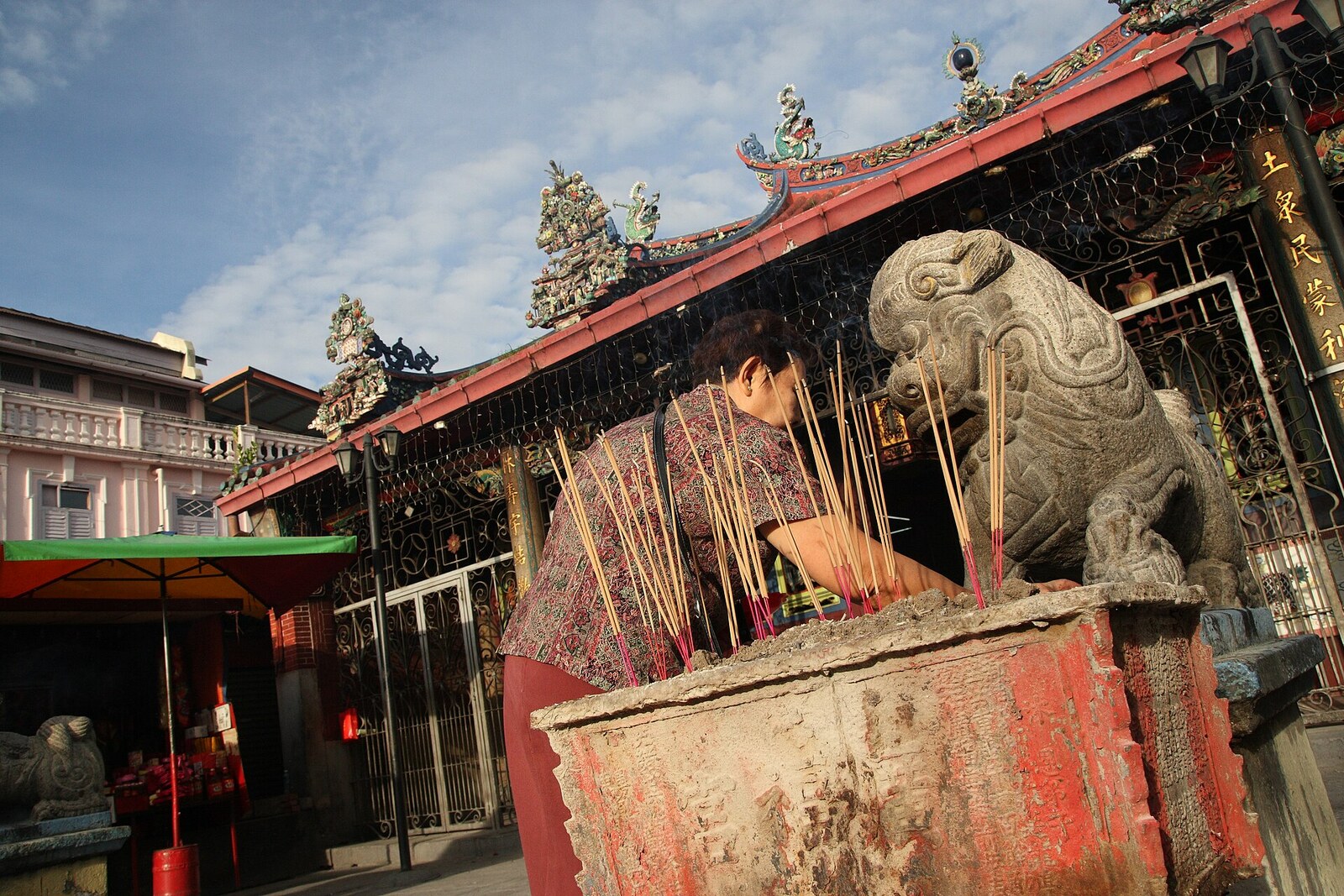
Look around first
What to notice
- Inscriptions above the entrance
- Stone inscription with the names of donors
- Main altar
- The nearby building of the Penang Chinese Town Hall
The story of the place
This temple has two names. On city signs it is called the Goddess of Mercy Temple; local people call it the Goddess of Mercy Temple—the pavilion of Guanyin. In Buddhist tradition, Guanyin is a bodhisattva of compassion, whom people turn to for protection and relief from misfortune. Its old official name is the Goddess of Mercy Temple. It combines the names of Guangdong and Fujian, two regions of South China. This name tells who built the temple.
In eighteen hundred, four hundred fifty-four people and trading businesses provided money for construction. Some migrants came from Guangdong, others from Fujian; they spoke different dialects, belonged to regional communities, and competed in trade. Many earned their living through sea transport, port work, and shops. The temple was built between the Cantonese and Hokkien quarters. No single community received it entirely: the board of trustees included representatives of both.
People prayed here, but they also brought disputes here. For the Chinese of George Town, the temple board served as a common court and mediator. In an unfamiliar colony, the sacred hall provided what a separate regional community could not: a place where people from different communities recognized an agreement.
In eighteen sixty-two, the directors raised funds for a major renovation of the temple. The names of donors remained on a stone inscription. Later, historians compared them with lists of participants in the Penang riots of eighteen sixty-seven. It turned out that the directors and donors included members of hostile secret societies. People who jointly paid for one temple and sat on its board had joined opposing alliances. For ten days, their supporters fired weapons and set houses ablaze on the streets of George Town. The council of the Goddess of Mercy Temple could not stop them.
After further clashes connected with the struggle for the tin mines of neighboring Perak, Chinese merchants decided to divide the responsibilities. In eighteen eighty-one, they established the Penang Chinese Town Hall. The first council elected seven representatives each from Fujian and Guangdong—the same balance that people had earlier tried to maintain here. The town hall took over the settlement of public and commercial affairs, while the temple retained religious services.
Researchers dispute who originally held the main place at the altar. One version says it was Mazu, the patroness of seafarers: migrants thanked her for the crossing of the South China Sea. Another says that Guanyin had been the principal object of veneration from the very founding. Both are now in the main hall, and the temple's familiar name became associated with Guanyin.
The division of responsibilities can be seen without an old map. The present building of the Penang Chinese Town Hall stands nearby. A community organization that grew out of the former temple board operates there; here, people place offerings before Guanyin and Mazu. And the trustees of the Goddess of Mercy Temple are still nominated by the communities of Guangdong and Fujian, whose names are joined above the entrance.
Useful on site
An active temple. Old tourist maps give daytime hours, but holidays, repairs, and the flow of worshippers affect access; check the signs and observe local practice.
Checked: July 1, 2026. Check the official source before visiting.Do not block access to the altars or photograph worshippers without consent; during a ceremony, remain an observer.