 Guide On Map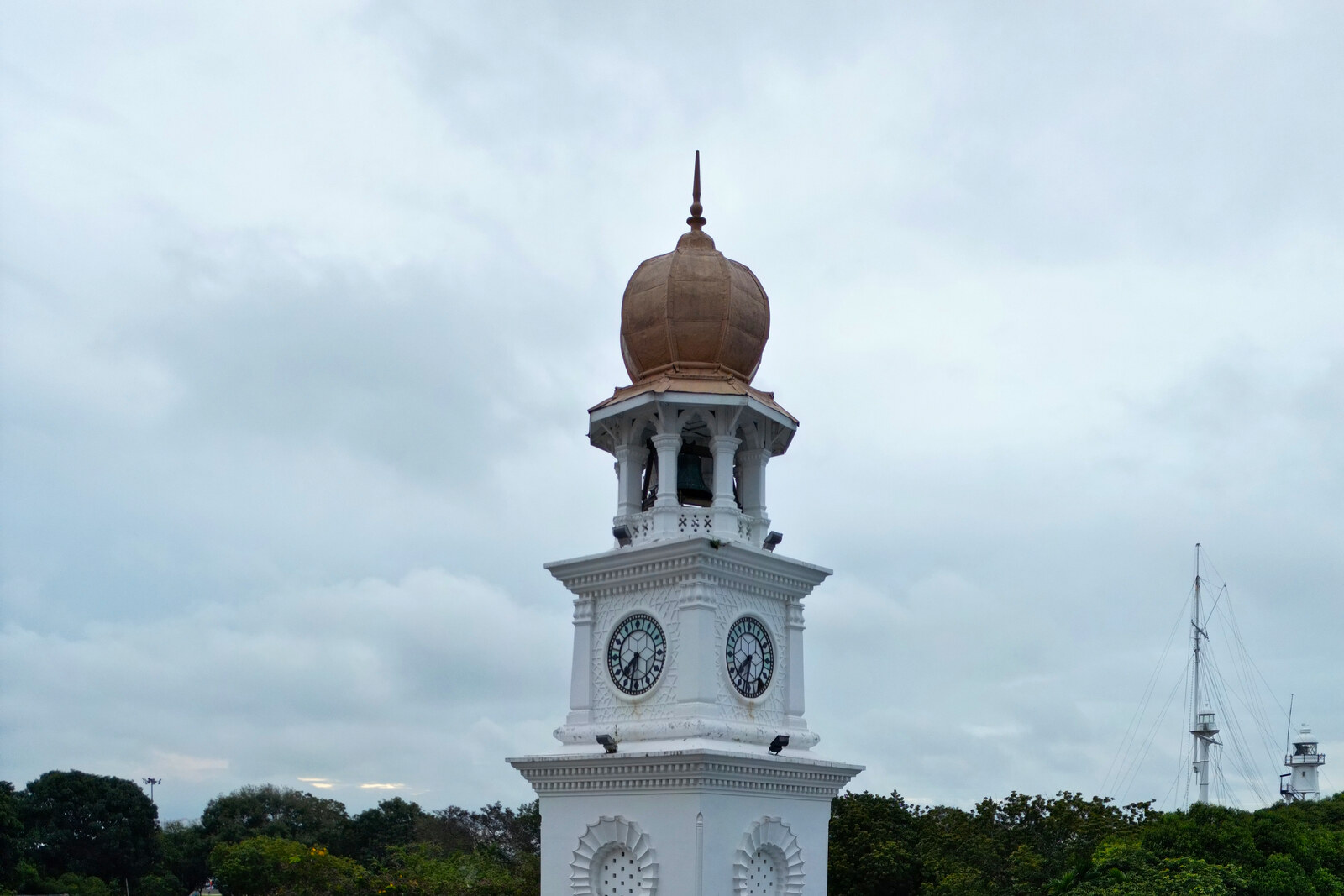
Look around first
What to notice
- Four clock faces
- Octagonal tier with inscriptions
- Town Hall facade
- City Hall facade
The story of the place
In June eighteen ninety-seven, Cheah Chen Eok, a Penang entrepreneur and member of the municipal commission, proposed to the commission that he pay for a clock tower. The commission was the city's administrative body: its members were responsible for streets, water supply, markets, and construction. Cheah intended to mark the sixtieth anniversary of Queen Victoria's reign and set aside thirty thousand dollars for it.
Victoria had ruled Britain since eighteen thirty-seven. Penang was then part of the Straits Settlements, a Crown colony that united it with Singapore and Malacca. That is why her jubilee was celebrated here as a state occasion. Cheah required the date to be expressed without a portrait: from the ground to the center of the clock faces, there had to be exactly sixty feet, one foot for every year of her reign. The dome rises above that mark.
Cheah's money came from the same colonial economy that he represented on the commission. At first, he supplied ships and traded in ordinary goods; then he joined syndicates that received from the administration the exclusive right to sell opium and strong liquor. Such licenses were issued for several years and then put up for auction again. By the end of the century, Cheah managed one of the largest such businesses in Malaya. There is no document linking the gift to a further renewal of a license. What is certain is something else: a local Chinese merchant whose fortune had grown from selling goods subject to colonial duties paid in full for a monument to a British queen.
The municipal commission took charge from there. It held a design competition, then canceled the results and organized a second round; the municipal engineer won both times. The commissioners took a long time choosing a site and eventually set aside a place between Light Street, the road to Fort Cornwallis, and the former Cornwallis moat. Here the port, commercial Beach Street, and the institutions they administered came together. While the project was being discussed, the estimate rose. Cheah added another five thousand dollars, and construction began only in nineteen hundred.
Queen Victoria died before the tower was completed. In July nineteen oh two, Cheah handed the key to the chairman of the municipal commission. The gift conceived for the jubilee was opened instead as a memorial to the deceased queen. The octagonal section beneath the clocks bore the years of her reign and the donor's name.
The commission chairman received the tower's key while his staff were still crowded into the old Town Hall by Padang Kota Lama. This first municipal building opened in eighteen eighty. It contained offices, a library, an assembly hall, and a ballroom at the same time. Evenings were held there for the European urban elite, while local residents nicknamed the building in Hokkien “Ang Mo Kong Kuan,” meaning “European Club.”
By the beginning of the new century, the commissioners decided that there was no longer enough room there for the officials. Separate Municipal Offices were built next door. The estimate rose from seventy-five thousand four hundred to nearly one hundred thousand dollars, and after the work was completed in nineteen oh three, the commission dispensed with a ceremony: the employees were, in its words, to “quietly take up their offices.” The vacated Town Hall was remodeled: side wings were added, the portico was roofed over, and the stage was enlarged. This created a pair of white facades: a hall for public events and the building of the city administration.
The Municipal Offices were named City Hall in nineteen fifty-seven, when George Town was granted city status. The city council still occupies this building. At the other end of Padang Kota Lama, beneath the tower's clock faces, two names remain: Victoria, whose jubilee gave it its height, and Cheah Chen Eok, who paid for it and handed the key to the municipal commission.
Useful on site
The tower and square can be viewed from outside without a ticket. The municipal buildings remain working and event venues; spontaneous tourist entry inside is not the standard scenario.
Checked: July 1, 2026. Check the official source before visiting.It is best to view the ensemble from some distance; watch for traffic by the roadway and cross only at permitted places.