 Guide On Map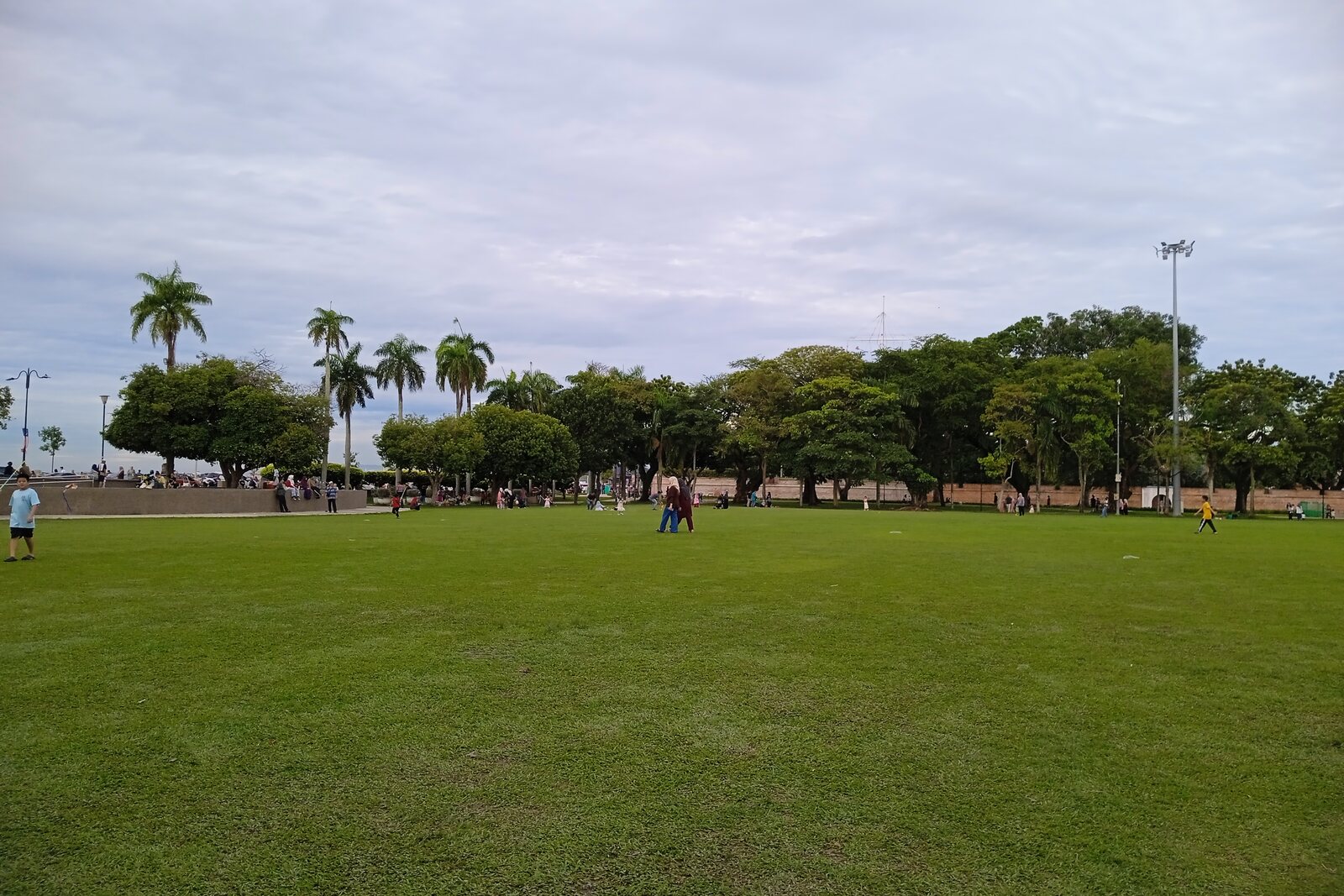
Look around first
What to notice
- The open rectangular lawn
- The fort’s low walls at the edge of the field
- Two white municipal facades
The story of the place
Padang Kota Lama translates as “the field of the old fort.” In seventeen eighty-six, the men of Francis Light, a merchant whom the East India Company had tasked with founding a port here, cleared this plot by the cape. Company officials kept the strip in front of the fort open so that the space before the guns could be seen from the fortifications. At first, sepoys—Indian soldiers hired by the Company—lived here; later, officers brought them out here for drill exercises. The English name Esplanade originally referred precisely to such an open field beside a fortress.
When the military stopped occupying the site, townspeople began playing cricket and football here. But belonging to the city still did not give everyone equal rights to its main field. In eighteen eighty-four, the predominantly European Penang Cricket Club built its pavilion at the western edge. Six years later, a pavilion of the Penang Recreation Club appeared at the opposite edge; it had been founded for Eurasians—families of mixed European and Asian descent. These were private club buildings, with their own members and spectators.
Chinese football players had also played on Padang before. When the two clubs occupied the field, little space was left for them, and they were not admitted into the established club system. In eighteen ninety-two, the players founded the Chinese Recreation Club in order to obtain a ground of their own. They left this place, and five Hokkien Chinese clan associations raised money to buy land in another part of the city. Rejection on one field led to the creation of a separate sports institution that still exists today.
Meanwhile, the European club strengthened its position on Padang. In nineteen oh eight, its members replaced the earlier structure with a large two-story pavilion. By the mid-nineteen thirties, the Penang Cricket Club had moved elsewhere, and in nineteen forty it agreed to vacate the plot and surrender the pavilion for demolition, so that the lawn could once again become accessible to everyone.
They did not have time to carry out this decision peacefully. Japanese military forces set up storage depots on the field and laid a light railway line. Allied aircraft bombed both the cricket pavilion and the new building of the Eurasian club. By about nineteen fifty, residents once again had an open green space.
Neither pavilion remains today. Between the old fort and the municipal facades lies a lawn used for parades, celebrations, and cultural performances. Permanent club walls did not return here: the empty rectangle before them is the very field that the members of the Penang Cricket Club agreed to vacate in nineteen forty.
Useful on site
Public field and waterfront. The space can be experienced without a ticket; major city events may close off individual sections.
Checked: July 1, 2026. Check the official source before visiting.There is almost no protection from the sun here; it is more convenient to listen at the edge of the field, without disturbing games and events.