 Guide On Map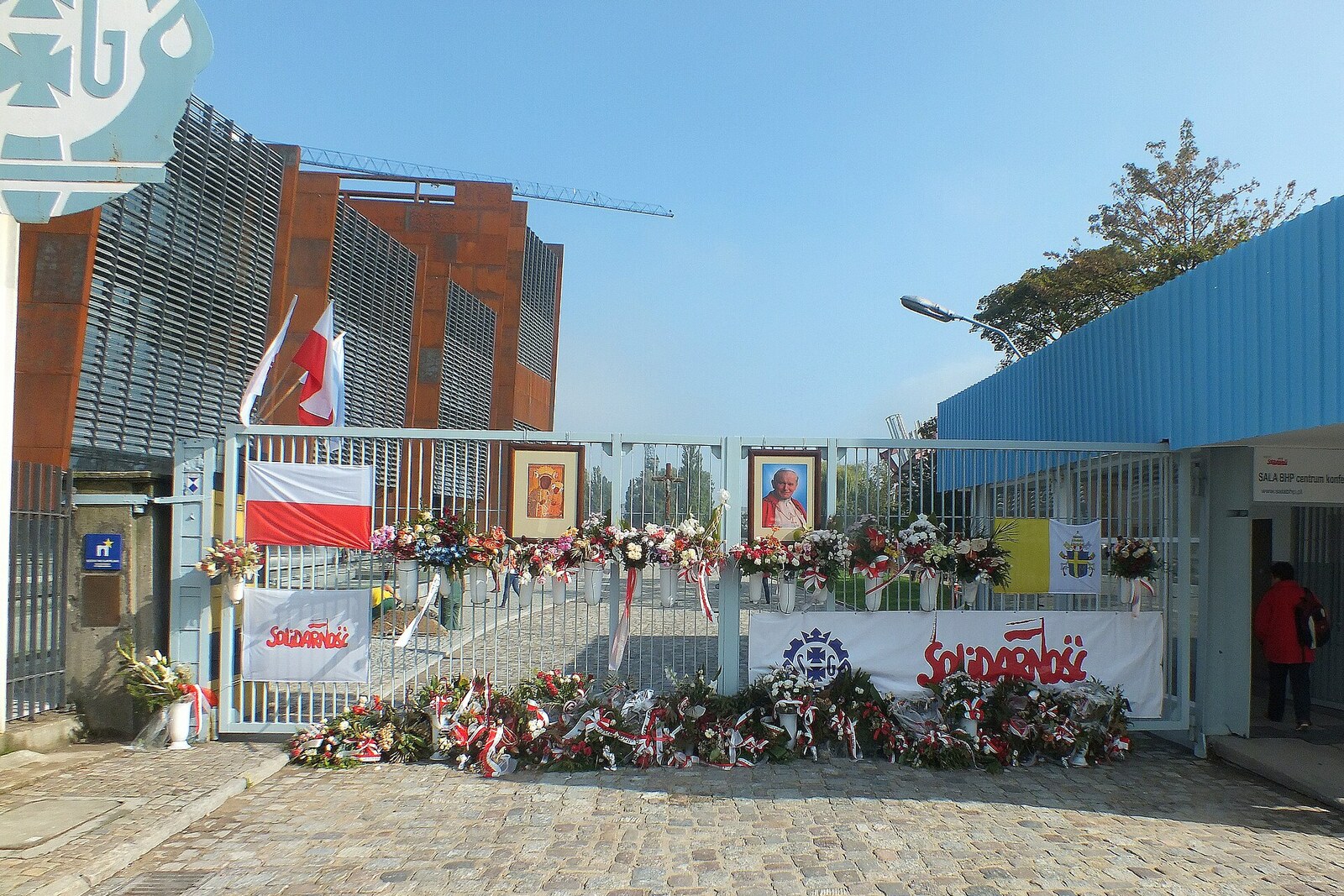
Look around first
What to notice
- Gray gate leaves
- Pass office
- Copies of the twenty-one demands
The story of the place
On August seventh, nineteen eighty, the management of Gdańsk Shipyard dismissed crane operator Anna Walentynowicz. At the time, the enterprise bore Lenin's name. Walentynowicz had worked here for thirty years: first as a welder, then, after an occupational illness, as a crane operator. She had five months left until retirement. She distributed an underground workers' newspaper at the shipyard and belonged to the banned Free Trade Unions of the Coast, which sought representation independent of the management and the ruling party. For this, she had already been detained, searched, and transferred to other work areas. Now she had lost her income.
A week later, the workers stopped production and demanded Walentynowicz's reinstatement. The strike was led by Lech Wałęsa, a former electrician at this shipyard who had been dismissed four years earlier. At first, the management agreed to meet the shipyard workers' demands, and Wałęsa declared the strike over. But representatives of other striking enterprises remained without agreements or guarantees. After their objections, Wałęsa reversed his decision. About one thousand people did not disperse and, during the night, formed the Inter-Enterprise Strike Committee: now the negotiators spoke on behalf of dozens of workforces.
About seven hundred demands came from these workforces. The committee reduced them to twenty-one. The first was the right to form independent trade unions; it was followed by the right to strike, the abolition of censorship, the release of political prisoners, higher wages, and improved supplies.
State newspapers and radio portrayed what was happening as a dispute over money, while telephone communications between the Coast and the rest of the country were cut off. Then Arkadiusz Rybicki and Maciej Grzywaczewski, members of the underground Young Poland movement, received two plywood boards used by shipyard marking workers. On August eighteenth, they spent several hours kneeling before them: Rybicki filled in the first board, Grzywaczewski the second. The headings and numbers were painted in red oil paint, the remaining text in dark pencil.
The boards were hung on the pass office at Gate No. 2, the shipyard's main entrance. The place was chosen for the sake of the people outside. Anyone gathered in front of the gatehouse could read what the strikers were demanding and pass the list on. Through these same gates, staff on duty accepted food, medicine, and money; here the workers met with their families. Wałęsa climbed onto the roof of a small battery-powered tractor and told the crowd how the negotiations were going. The industrial gatehouse became the only part of the shipyard where the closed strike could speak with the city.
On August thirty-first, Wałęsa and Deputy Prime Minister Mieczysław Jagielski, representing the government commission, signed the Gdańsk Agreement in the shipyard's occupational safety hall. Wałęsa then returned to Gate No. 2 and announced to those gathered that independent self-governing trade unions and the right to strike had been recognized. Walentynowicz was reinstated. In September, representatives of the new trade unions adopted the name Solidarity for their common association; soon about ten million people had joined it.
The original gates beside which Wałęsa announced the agreement were destroyed by a tank in December nineteen eighty-one. The remains were dismantled, and their fate is unknown. The gray gate leaves were restored from photographs in nineteen twelve. Copies of the demands hang at the gatehouse, while the two original plywood boards are in the European Solidarity Centre. On the reverse of one, an incorrectly begun line of the eighth demand has survived.
Useful on site
The gates are always visible from the square. Access through them to the European Solidarity Centre depends on the building policy; on June 24, 2026, the Centre is closed.
Checked: date not specified. Check the official source before visiting.This is an active memorial space: do not block the entrance or move the flowers or commemorative signs left here.