 Guide On Map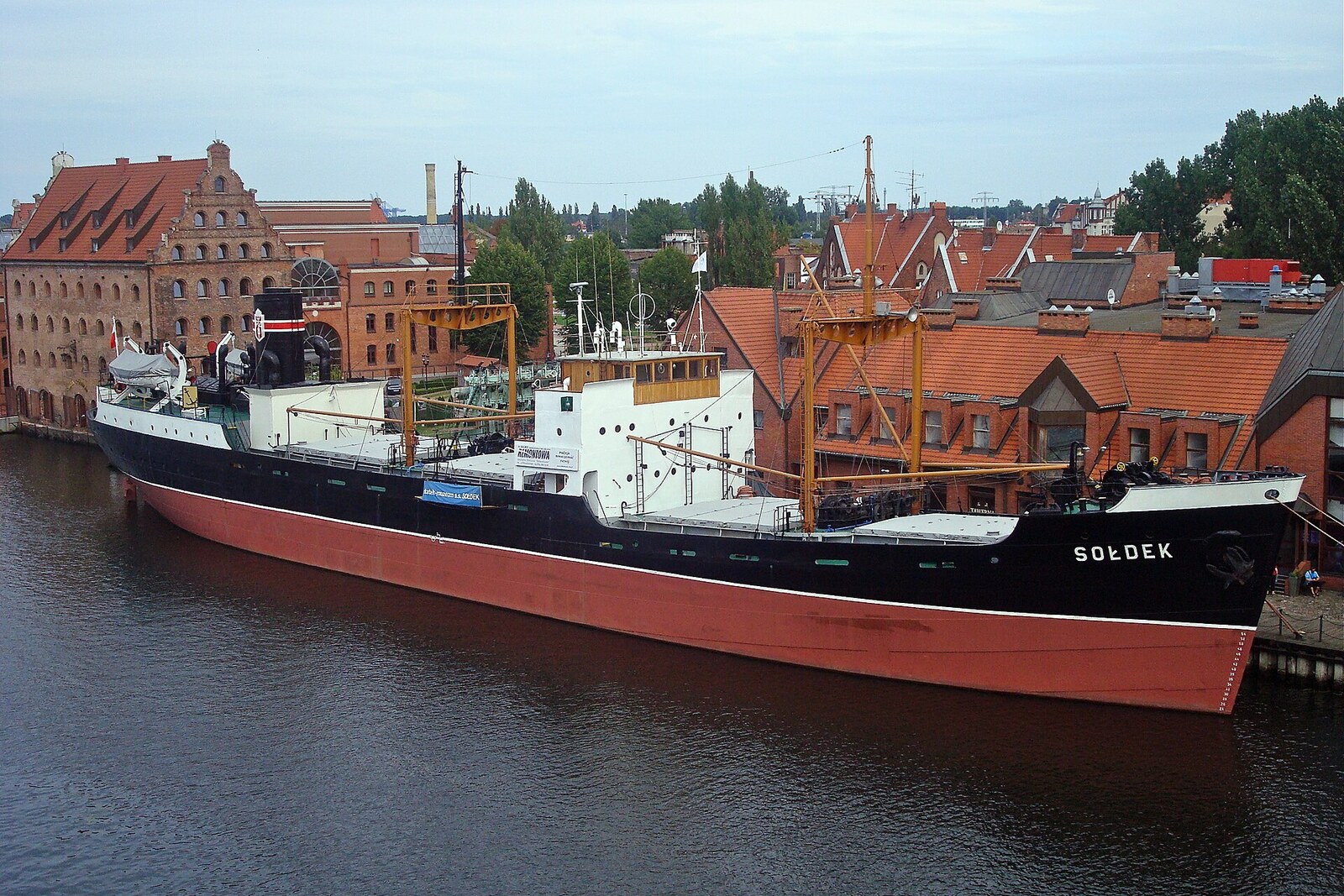
Look around first
What to notice
- White letters “Sołdek”
- Black hull
- Four cargo holds
- Engine room
The story of the place
The white letters on the black hull spell out the surname of Stanisław Sołdek. He did not command this ship or design it. At Gdańsk Shipyard, Sołdek worked as a loftsman: he transferred hull drawings into templates and marked on steel blanks the lines along which other workers cut the future parts. This work was paid for above all according to precision: a loftsman's mistake was later repeated in metal.
In nineteen forty-seven and nineteen forty-eight, the shipyard held a competition to exceed production quotas. According to the factory's calculation, Sołdek reached two hundred six percent and won the first stage. A rule had been set in advance for the first seagoing merchant ship built by the Polish shipbuilding industry after the war: it would receive the surname of an outstanding worker. That is how the name of the thirty-two-year-old loftsman ended up on the prototype of a new ore-and-coal carrier.
On November sixth, nineteen forty-eight, this hull stood on the slipway at Gdańsk Shipyard. Sołdek's wife Helena became its godmother. She spoke the naming formula, while Stanisław himself vowed before those gathered not to disgrace the surname that had become the name of the first Polish seagoing vessel. His production result became a lifelong public commitment.
After the launch, Sołdek's surname became known throughout the country. He completed a preparatory course equivalent to high school, enrolled in the shipbuilding faculty at Gdańsk Polytechnic, and earned an engineering degree. Later, the former loftsman oversaw the construction of large ships and headed Vistula Shipyard.
Meanwhile, the steamship did the work for which it had been built. With its four holds, it exported coal and carried iron ore. Over thirty-one years, its crews made one thousand four hundred seventy-nine voyages, delivered more than three and a half million tons of cargo, and called at more than sixty ports.
When the ship was decommissioned in nineteen eighty, its owner offered to transfer it to a museum in Szczecin, but the museum there declined. The hull was accepted by the Central Maritime Museum in Gdańsk. The committee preparing the steamship for preservation was headed by Professor Jerzy Dörffer—the very engineer who had overseen its construction. After repairs, Sołdek opened by Ołowianka Island in nineteen eighty-five. Beneath the deck, the holds and the fitted-out engine room have been preserved, while on board remains the surname of the loftsman with which this story began.
Useful on site
Until September 6, 2026: Monday–Tuesday 11:00–18:00, Wednesday 13:00–18:00, Thursday–Sunday 11:00–18:00.
Checked: date not specified. Check the official source before visiting.The ship can be viewed from the quay; going onto the deck is part of a separate museum visit and requires checking access.