 Guide On Map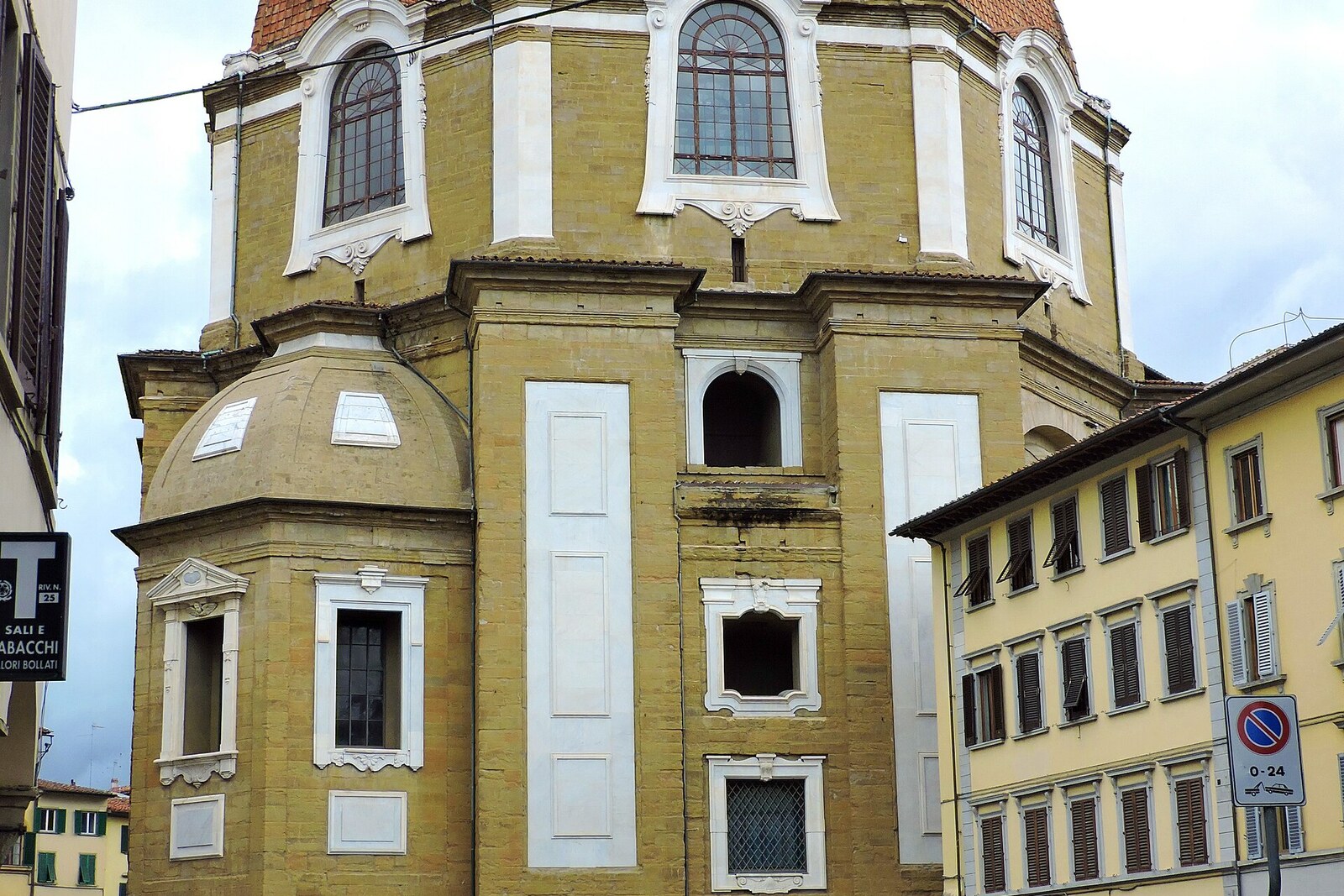
Look around first
What to notice
- New Sacristy
- Statues of Night and Day
- Statues of Dawn and Dusk
- The unfinished face of the statue Day
The story of the place
The Medici Chapels at San Lorenzo served as the burial place of the Florentine family. In the New Sacristy, four marble figures lie above two ducal sarcophagi: Night and Day above one, Dawn and Dusk above the other. The Chapel of the Princes was arranged beside them later, while before these burials the Medici had already buried earlier generations in the same church.
In the spring of fifteen twenty-nine, Michelangelo set down his chisel here and accepted the post of head of Florence's fortifications. He now had to defend Florence from the army returning his patrons—the Medici family—to the city.
The choice threatened him with the loss of income and with reprisals. Contracts tied almost all his working time to two popes from the Medici family. Pope Leo X and his cousin, Cardinal Giulio Medici, commissioned him to add a new burial chapel to San Lorenzo. Earlier generations already lay in the family church, and now the patrons needed places for four relatives.
The most sumptuous tombs were intended for two recently deceased dukes. Giuliano de' Medici, Duke of Nemours, was Leo X's brother; the marble Night and Day lie above his sarcophagus. Lorenzo de' Medici, Duke of Urbino, the pope's nephew, received Dawn and Dusk. The celebrated Lorenzo de' Medici and his brother Giuliano de' Medici, who was killed during a conspiracy in the cathedral, ultimately ended up together in a simpler sarcophagus beneath Michelangelo's Madonna and Child. These family burials gave the place its name. The plural arose because the museum brings together Michelangelo's New Sacristy and the later Chapel of the Princes.
In fifteen twenty-seven, the Florentines expelled the Medici and restored the Florentine Republic. Giulio Medici had by then become Pope Clement VII and was seeking the family's return. The troops of Emperor Charles V surrounded Florence. Michelangelo interrupted his work on the Medici tombs and took up the city's defense.
After a ten-month siege, the republic surrendered. The Medici returned, and Michelangelo disappeared: as an employee of the defeated government, he expected revenge. Clement VII, however, needed someone capable of completing the burial chapel already begun. The pope said that he would forgive the artist if he took up the tombs again. Michelangelo emerged from hiding and continued the work.
Where exactly he hid is not reliably known. In nineteen seventy-five, a narrow room beneath the New Sacristy, previously used as a coal store, was discovered by chance. Large drawings in charcoal and chalk were found beneath two layers of plaster. The museum director decided that Michelangelo had hidden here and had also drawn his own figures from memory here; one sketch resembles the legs of the statue of Giuliano one floor above. Some specialists accepted some of the drawings as his works, while others rejected the attribution. The connection between the secret room and the artist's refuge remains a theory.
In September fifteen thirty-four, Michelangelo left Florence for Rome forever. He left the New Sacristy unfinished. Later, other masters arranged the completed statues and moved the Medici remains into the chapel. Above the artist's presumed refuge, Day still lies with a barely outlined face, while the four river figures intended for the bases of the dukes' tombs were never carved.
Useful on site
Tue–Sun 08:15–18:50; last entry 40 minutes before closing. Mon – closed. Closed January 1 and December 25. Free admission on the first Sunday of the month.
Checked: June 17, 2026. Check the official source before visiting.The chapels are visited separately from the main basilica. Do not expect to see the closed underground room with drawings as a regular part of the visit; possible access to it is regulated by the museum.