 Guide On Map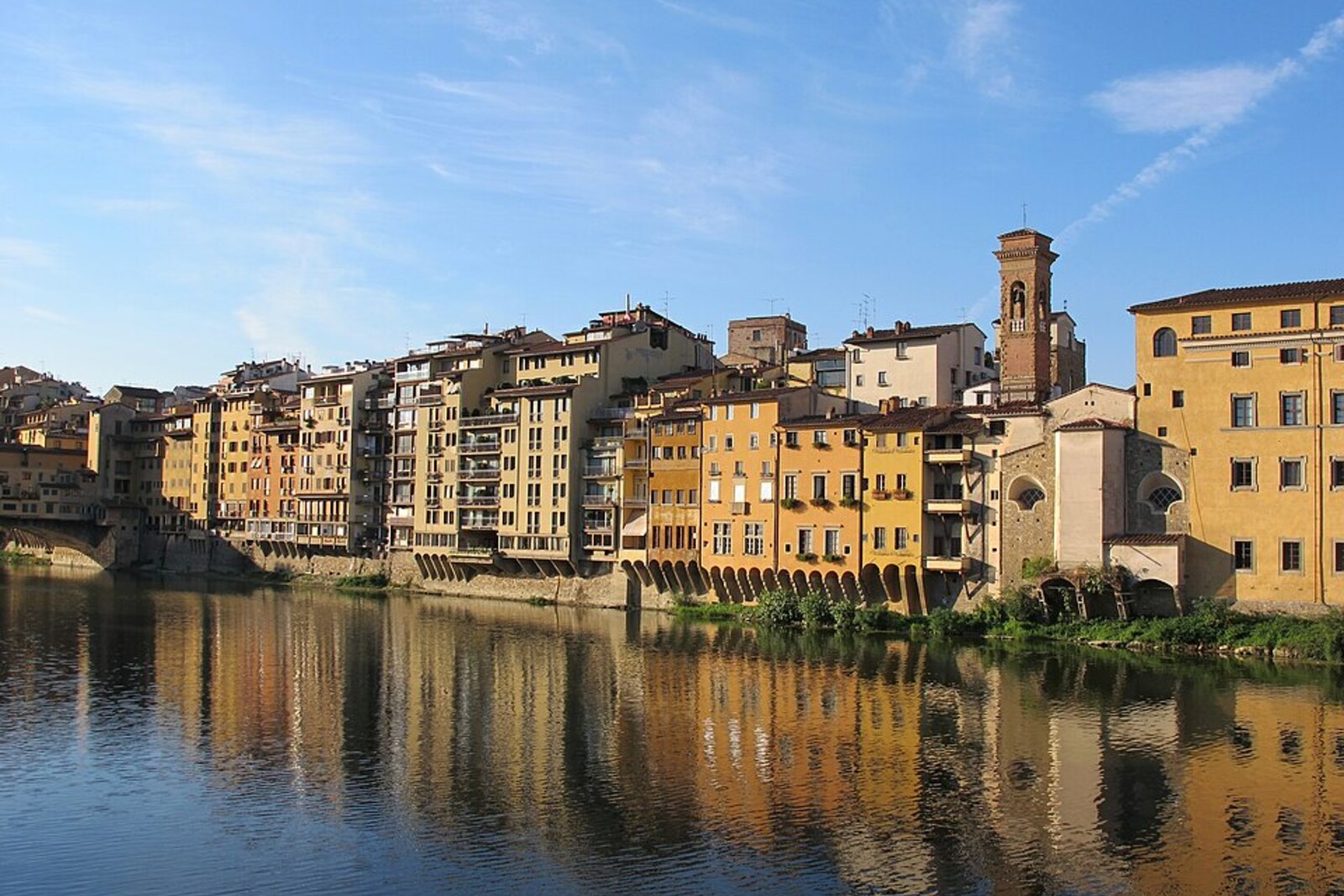
Look around first
What to notice
- Old tower houses
- Postwar façades
- The low arch of Palazzo del Corno
- Numbered stones
The story of the place
At the end of July nineteen forty-four, the German command ordered the residents of Borgo San Jacopo and neighboring streets to leave their homes by noon the following day. People were given less than a day. Many moved their belongings into the courtyard of Pitti Palace. Here, a home was often also a source of income: an inventory of the entire area near the bridge counted, among the future losses, three hundred eighty-six apartments, three hundred sixty-seven shops, and seventy-one craft workshops.
Ugo Procacci, an official with Florence's art-protection service, slipped into the Vasari Corridor and saw soldiers breaking open the doors of houses on Borgo San Jacopo. He realized that charges were being laid not only beneath the bridges. On the night of August third to fourth, sappers blew up the buildings at both ends of Ponte Vecchio. The bridge itself remained standing, while heaps of brick and stone were meant to block the approach to it for Allied troops advancing from the south.
In the morning, British units entered Oltrarno. The German units had already retreated to the other bank. The military barrier delayed the advancing troops only briefly; for the residents, its result was destroyed homes and workshops. Across the whole area by the bridge, one hundred twenty-three buildings were lost. On Borgo San Jacopo, the stretch nearest the bridge suffered especially badly.
Before the explosion, this was an old suburb within Florence, which had long since expanded. Here, the word borgo once meant a settlement beyond the early medieval wall. It grew up near the Church of San Jacopo sopr'Arno—Saint Jacopo above the Arno. Jacopo is the Florentine form of the name of the apostle Saint Jacopo, the patron saint of pilgrims. The church gave its name first to the settlement and then to the street.
Three weeks after the explosions, a city commission began clearing the rubble. It included the architect Giovanni Michelucci, who was to decide what could be saved and what the destroyed district should become. Collapsed façades revealed rooms that had previously been invisible from the embankment: cramped, dark, and almost without light. Michelucci decided that an exact reproduction of the former houses would bring back these dwellings along with their attractive outer shell.
For Borgo San Jacopo, he designed separate tower houses with gaps between them. The river and hills were to be visible through the gaps; stairways, galleries, and terraces would link the street with the Arno. Michelucci worked on this idea with young Florentine architects, although he himself did not take part in the competition announced by the city hall. His students incorporated some of the ideas into their own projects.
Twenty-two proposals were submitted to the competition. The commission did not choose a single winner: it selected five projects and assigned eighteen architects to combine them. The first joint version retained housing, craft workshops, and commerce here, limited the height of new houses, prohibited imitations of historic styles, and left public terraces and passageways along the Arno.
Construction then began. The housing shortage had to be made up quickly, while the demands of the owners of the destroyed plots also had to be considered. The volume of the houses was increased, and public passageways were reduced. The final development plan for the area between Borgo San Jacopo and the river was approved only in nineteen fifty-nine. Michelucci's galleries remained on paper, no continuous walking terrace above the Arno appeared, and the former mix of inexpensive housing and workshops gave way to offices, banks, and expensive apartments.
The architects concealed the most modern façades on the river side. Along the street, they repeated the former heights, arches, stone cladding, and uneven rhythm of medieval development. Old towers were left among the new houses, so surviving masonry and postwar walls stand directly alongside one another.
At number eleven, Palazzo del Corno, individual numbered stones can be seen in a low arch. Nello Bemporad, an architect with the state monument-protection service, ordered them preserved during the clearing of the rubble so they could be returned to their places. The palace itself was rebuilt after the explosion in modern forms; the numbered blocks show what part of the former Borgo San Jacopo was actually reassembled from the debris.
Useful on site
The street is open around the clock; the towers are viewed from outside.
Checked: June 28, 2026. Check the official source before visiting.The street is narrow and residential; choose a wider spot for your stop, without blocking entrances or traffic.