 Guide On Map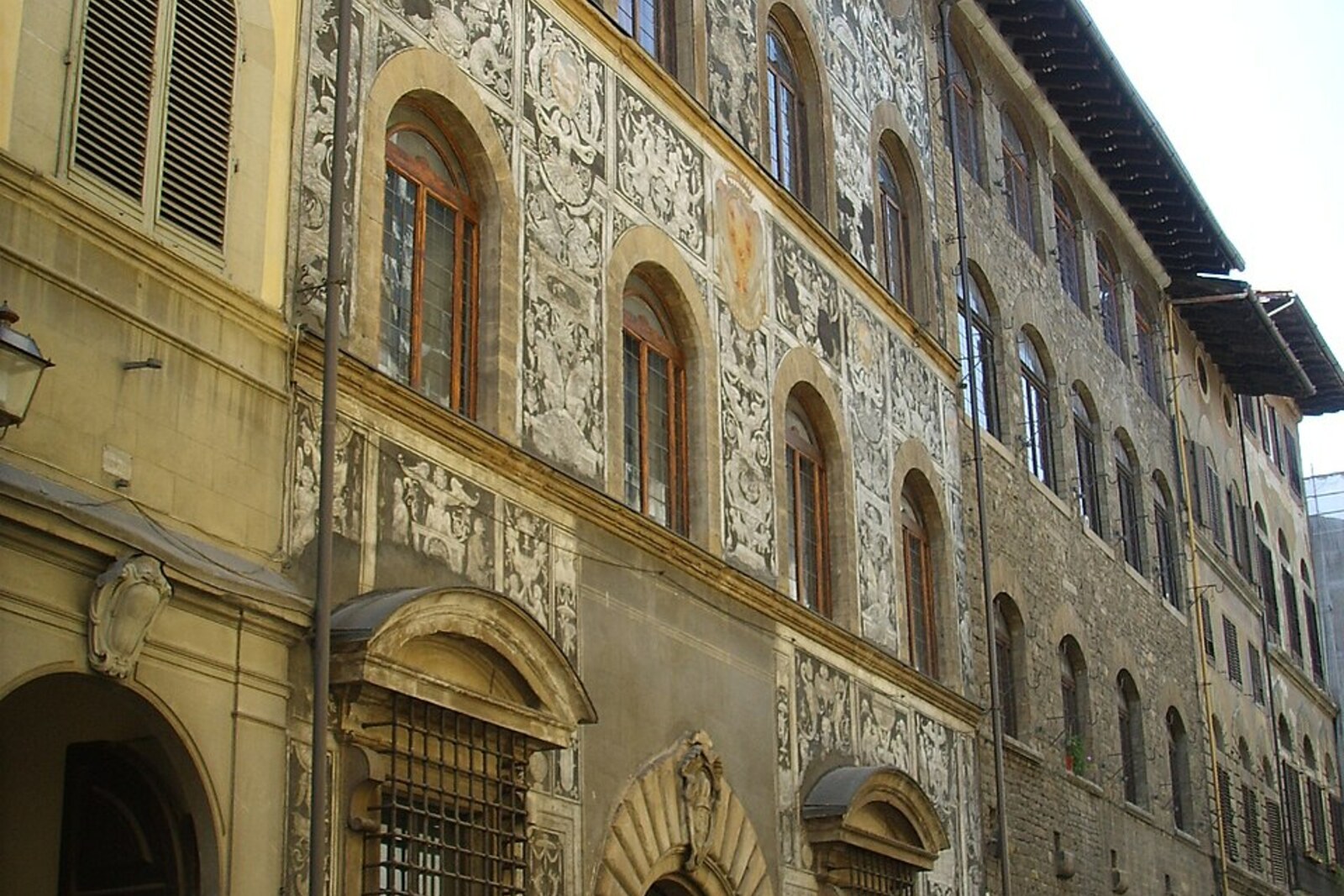
Look around first
What to notice
- Stone portal
- Coat of arms with a hat
- Black-and-white ornament
- Medici coat of arms
The story of the place
On Via Maggio, not far from Pitti Palace, stands a house that once belonged to the Corbinelli family. The stone portal and the lower row of windows appeared during the reconstruction led by the court architect Bernardo Buontalenti from fifteen seventy-three to fifteen seventy-eight. Later, the private house was transferred to Santa Maria Nuova Hospital, while the facade retained traces of its former owners.
Above the portal, a coat of arms with a hat is carved. It is a speaking emblem of the Cappello family: in Italian, their surname means “hat.” Higher up, amid the black-and-white ornament, is the Medici coat of arms. The two families ended up on the same facade because of an arrangement that suited three people.
In fifteen sixty-three, fifteen-year-old Venetian patrician Bianca Cappello fled to Florence to marry Pietro Bonaventuri. He was Florentine and worked at the Venetian branch of Salviati Bank. Bianca's father demanded that his daughter be returned, and the Venetian authorities intervened. Pietro lived on a salary, while Bianca lost her family's support; the marriage had to take place immediately after their arrival.
The couple was protected by Francesco de' Medici, the son of Tuscany's ruler, who governed the country in his father's name. He sought a relationship with Bianca and soon became her lover. Francesco was married. Pietro did not break off this union: Medici patronage brought him a position at court and significantly increased his income. The Treccani Biographical Dictionary states plainly that the husband agreed.
In fifteen sixty-six, Pietro bought an old house of the Corbinelli family on Via Maggio. Its location allowed Bianca to remain close to Pitti Palace while staying outside the official residence. In the documents, her husband remained the owner; Francesco supported the family with money and court connections; and the woman for whom all this was arranged lived here.
In fifteen seventy-two, Pietro was killed on a neighboring street. Who commissioned the murder is not reliably known. Francesco was suspected of involvement even then, but it never became an established fact. As a widow, Bianca, with Francesco's financial support, invited the court architect Bernardo Buontalenti to enlarge and remodel the house. Work continued from fifteen seventy-three to fifteen seventy-eight: the old Corbinelli residence received its present portal and lower windows. Florence's register of civil architecture links the reconstruction specifically to her widowhood and Francesco's money.
When Francesco's wife died, he secretly married Bianca. In the autumn of fifteen seventy-nine, the marriage was announced with ceremony, and the former runaway became Grand Duchess of Tuscany. Five years later, she transferred this house to Santa Maria Nuova Hospital.
Her hat, the lion of Saint Mark—a sign of the Cappello family's Venetian origins—and the Medici shield remain on the facade. The house long ago left Bianca's ownership, but it has kept her name and the distance from Pitti Palace at which Francesco housed his married mistress.
Useful on site
View the facade from the street; the building is used privately and as a residence, with no open museum admission.
Checked: June 28, 2026. Check the official source before visiting.This is primarily a facade stop: do not expect free access to the interior rooms.