 Guide On Map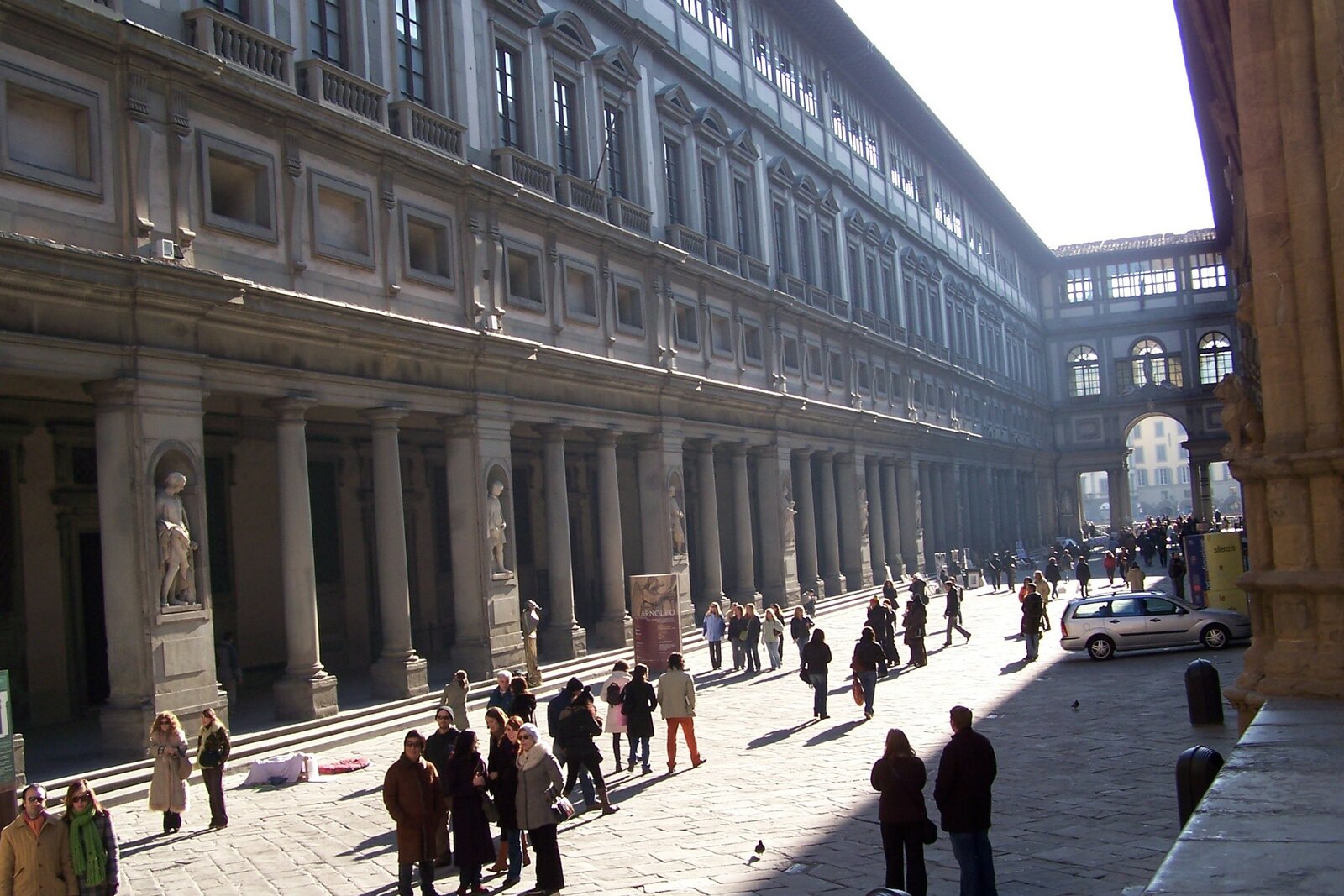
Look around first
What to notice
- Two identical buildings
- Porticoes
- Inscriptions above the doors
- The statue of Cosimo I de' Medici with Justice and Severity
The story of the place
The Uffizi Courtyard stretches between two long, identical buildings. The court architect Giorgio Vasari built them facing one another: separate offices stood beneath the porticoes, while the upper floors were occupied by the duke's chanceries and workshops. In these rooms, they decided whether the city would accept foreign coin, how much to charge for bread, and whether to consider a trade contract valid. The name Uffizi means “offices”; later, the upper gallery became a collection of ancient statues and family curiosities.
In fifteen sixty, Cosimo I de' Medici, Duke of Florence, ordered thirteen city magistracies to be gathered here. This was the name for the institutions that settled trade disputes, collected taxes, oversaw coinage, prices, and measures, and governed the guilds. Cosimo inherited them from republican Florence. The duke did not abolish them, but placed them under his own officials and decided to move them from different quarters closer to Palazzo Vecchio.
Cosimo presented the new premises as a convenience for the institutions themselves. He ordered them to pay for them, however: each magistracy and guild corporation had to contribute money and provide its share of stonemasons. The manufacturers' corporation, which united blacksmiths, stonemasons, carpenters, armorers, and locksmiths, could not cover the expenses assigned to it. The craftsmen lived on construction and craft commissions, and now they were paying for the building to which the duke intended to move their representatives.
The court architect Giorgio Vasari built two long, identical buildings facing one another. Separate institutions were housed behind the doors beneath the porticoes; above them were the duke's chanceries and workshops. Cosimo also ordered a covered passage to be thrown across from the complex directly to Palazzo Vecchio. This elongated courtyard thus appeared: it is the shared passage between rows of service premises. The name “Uffizi” means “offices.”
The names of the former occupants can still be read above the entrances: the Moneychangers' Guild, the Guild of Merchants, the Guild of Physicians and Apothecaries, and the Keepers of the Laws. Here they decided whether foreign coin could be put into circulation, how much bread should cost, and whether a trade contract was valid. Behind identical facades worked institutions on which the earnings of Florentine bankers, shopkeepers, and craftsmen depended.
The museum grew on the floor above. Cosimo's son, Grand Duke Francesco I de' Medici, ordered ancient statues and family curiosities to be displayed in the upper gallery, and Bernardo Buontalenti created the octagonal Tribune of the Uffizi for the most precious things. At first, only select guests were admitted there. In seventeen sixty-nine, Grand Duke Pietro Leopoldo opened the gallery to the public.
At the arch on the Arno side, the commissioner of the original building remains. A statue of Cosimo I de' Medici stands above the passage, flanked by marble figures of Justice and Severity. Below stretches a row of doors bearing the names of the institutions that he forced to gather and pay for their new premises.
Useful on site
The courtyard and the passage between the buildings function as an open urban space; entry to the Uffizi Gallery follows a separate schedule, ticket, and temporary notices.
Checked: June 27, 2026. Check the official source before visiting.You do not need a gallery ticket to read the architectural perspective. Stand to one side of the central flow: the courtyard remains a busy passage to the river.