 Guide On Map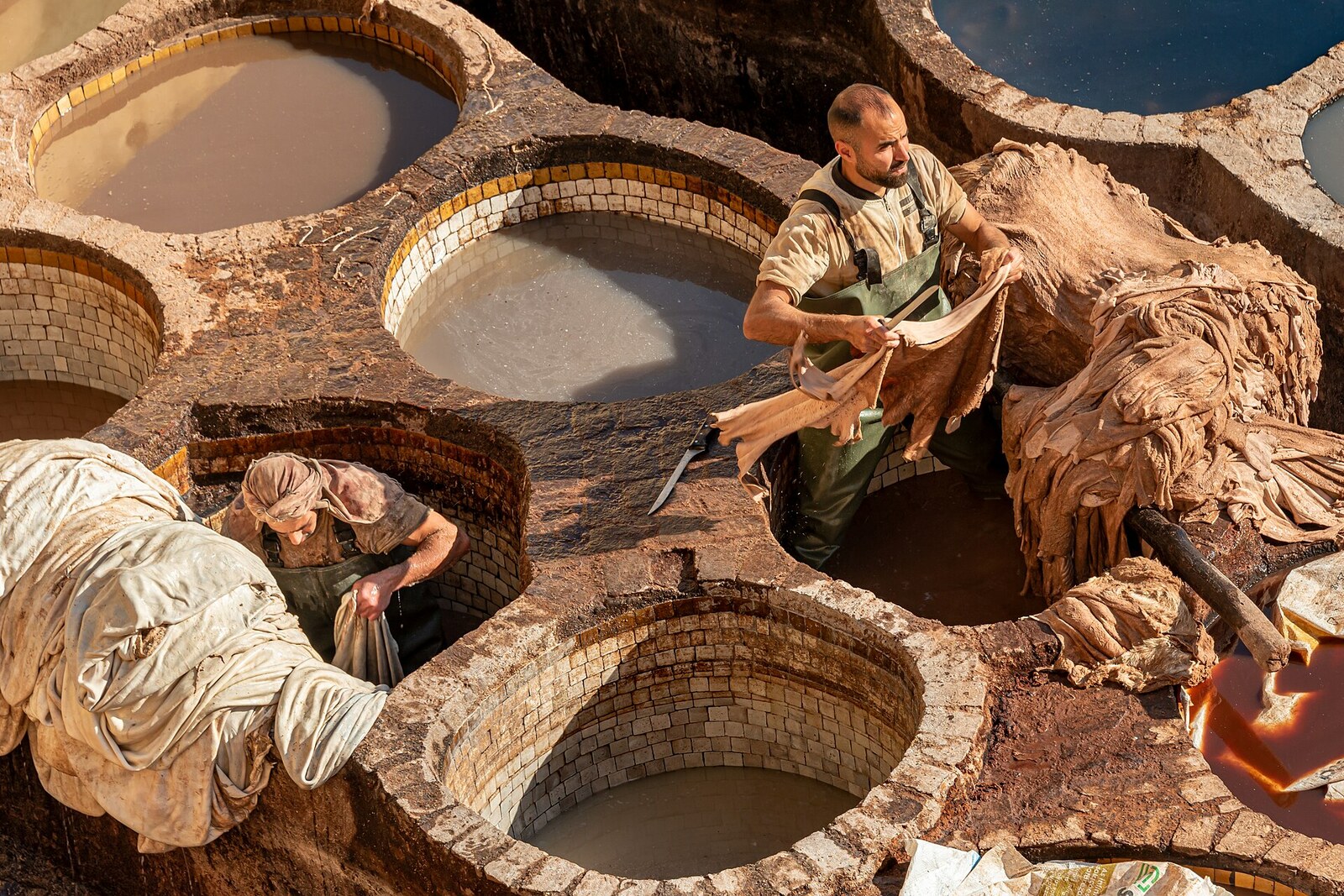
Look around first
What to notice
- White preparation baths
- Colored vats
- Hides in dye
- Shared washing pools
The story of the place
Chouara Tannery stands beside the channel of the Oued Fes. The round vats with whitish and colored water are connected to shared wells and washing pools: each operator has a separate work cell, but the work cannot continue without this shared water and equipment. When tanners settled here, the surrounding area was still the city’s outskirts; then the Medina of Fez closed in around the craft quarter. During the recent repairs, craftspeople returned to their sections in turn, and the yard retained its former work.
The colored vats of Chouara show the final part of the work. Before it reaches the dye, a hide must stop being a hide in the everyday sense—with hair, fat, and tissue that, without treatment, will begin to decompose.
Tanners soak the delivered hides in lime baths. The lime loosens the hair and remnants of flesh; both are removed by hand. Then come separate baths with pigeon droppings and bran. The substances they contain soften the hide and help remove the alkali. After that, the craftspeople treat it with vegetable tanning compounds: these bind the collagen fibers, and the leather no longer deteriorates in water as raw hide does.
Only now do the colored vats come into play. The tanner immerses the leather in a dye solution, turns it over, and kneads it with hands and feet so that the color penetrates evenly through its thickness. The dried pieces leave Chouara without fastenings, soles, or seams. They are bought by makers of babouches, bags, and saddles, by bookbinders, and by other craftspeople of Fez.
Water is constantly needed for this sequence: the hides have to be soaked, rinsed, and moved back into solution. That is why the tannery was built beside the channel of the Oued Fes. When the craft quarters were taking shape, this was the edge of the built-up area; later, the Medina of Fez grew around them. Chouara is often said to be an eleventh-century operation, although early documents do not make it possible to date this particular tannery with confidence. One thing is known more reliably: tanners worked in early Fez and set up their workshops by the river and springs.
By the early twenty-tens, this arrangement nearly changed. Some of the vats and passages had fallen into disrepair, the water supply was unreliable, and the drainage needed a new system. Plans to restore the river considered moving part of the production: the vacated yard could have been adapted for another use.
For the tanners, moving would have meant losing an entire system assembled on one site. Individual operators either own the vats and storerooms here or lease them, but the craftspeople use the wells, washing pools, and leather-kneading equipment together. One person may own a work cell, yet it is not possible to take a hide through every stage in a stand-alone workshop. Craftspeople who bought finished leather also depended on this yard.
The restorers kept the production in place and divided the work into stages, so that craftspeople could return as sections became ready. By the autumn of twenty fifteen, more than half of Chouara was operating again; around two hundred tanners had returned to their vats. After the main work was completed in twenty sixteen, the yard remained a working production site rather than becoming an empty stage set.
The round vats before you largely date from that restoration. Hides are once again inside them: the white baths prepare the fiber, the colored ones add color, and the shared pools still link the separate workshops into a single tannery.
Useful on site
Daily 08:00–19:00
Checked: June 19, 2026. Check the official source before visiting.Look only from an approved viewing point, and do not enter the production passages. The terraces may belong to private shops; ask about visiting conditions on site.