 Guide On Map
Craft Fez: From Nejjarine to Place Rcif
From Nejjarine Funduq through Chouara Tannery and Seffarine Square to Place Rcif
Guide On Map on your phone
Open the walk like a regular app
It takes about 10 seconds to install. No app store needed.
The whole path
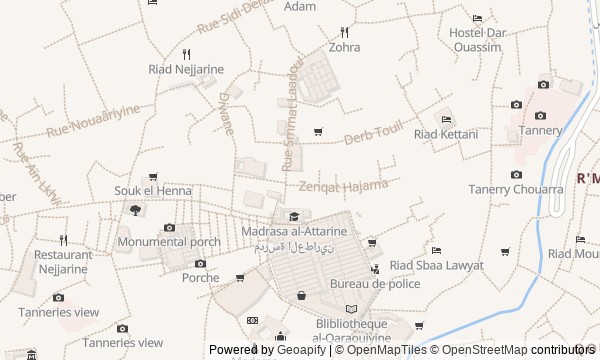
Route map
About the walk
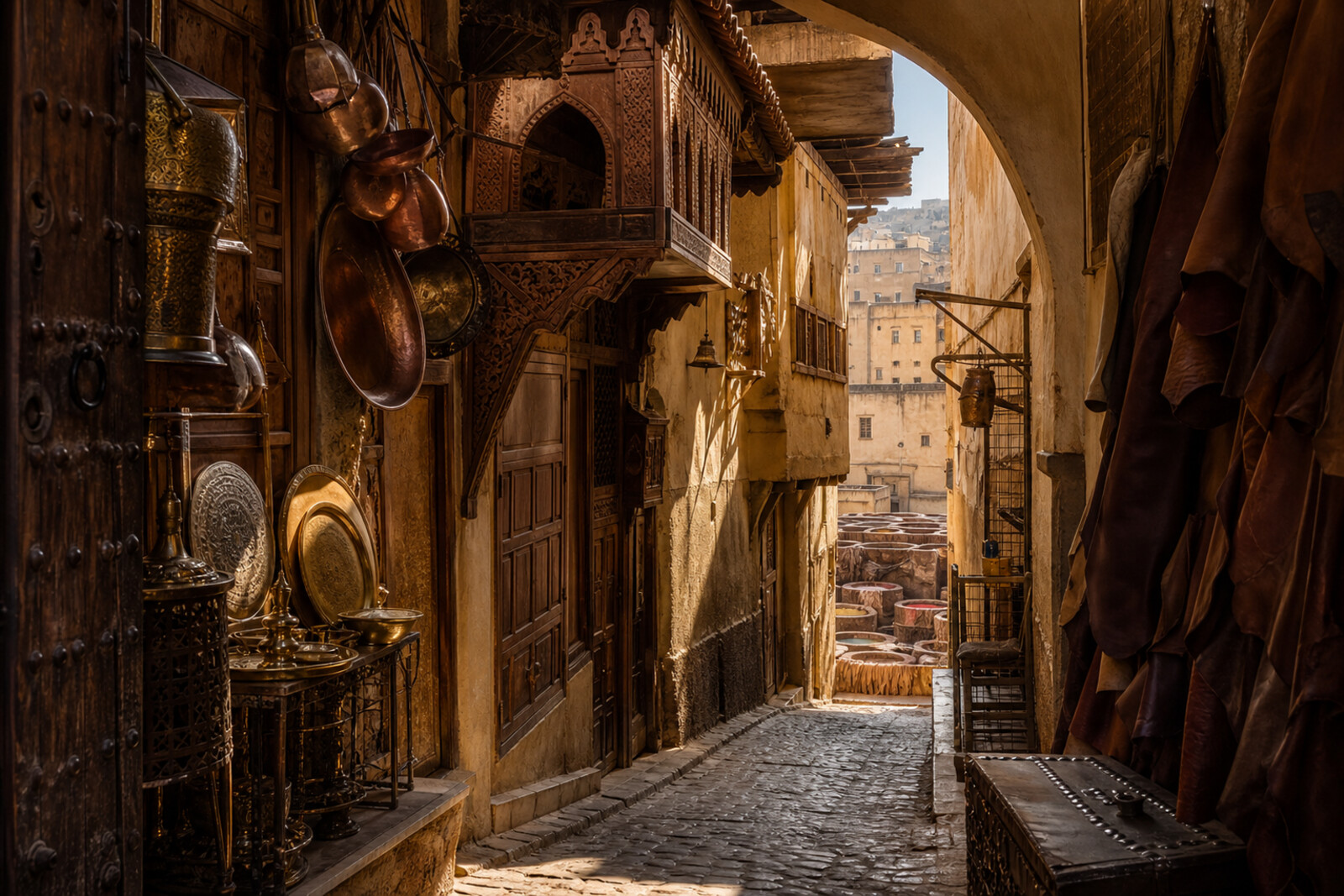
You will begin at Nejjarine Funduq, among merchants' galleries and old scales, and finish at Place Rcif, where a road for cars runs into the pedestrian medina. Between them lie the Henna Souk, the dyers' bridge, the vats of Chouara Tannery, and the coppersmiths' square.
This is not a walk through Fez's ceremonial facades, but through its working connections. You will trace how goods were received, a hospital was supported, a river was used, leather was worked, vessels were made, and cargo was brought to the shops. But the answers will not be handed to you in advance. Why did musicians remain in a former hospital longer than doctors did? What made craftsmen copy an imported teapot? And why will you need to look for one river beneath the pavement?
The story unfolds calmly and through tangible things: scales, an arch, a vat, a sheet of metal, and a civic dispute. By the end, you will be able to read Fez as a chain of courtyards, water, workshops, and roads—and explain why its craft medina has survived in precisely this form.
Why this order
Nejjarine Funduq establishes the route's commercial foundation: visiting merchants, goods, and the carpenters' market once converged here. Nearby Henna Souk continues the theme through urban economics: shops and property were tied not to lodging, but to supporting a hospital. The descent to Sebbaghine Bridge moves from trade to the river and shows how the crossing linked the markets on its two banks. Just beyond the bridge, Chouara Tannery turns water from an urban boundary into a working tool for large-scale production. The route then returns across Sebbaghine Bridge to Seffarine Square: after the shared chain of leather processing, another organization of craft comes into view, one in which a single metal object passes through several workshops. The final descent to Place Rcif broadens the question to the whole medina: here, it becomes clear how goods were brought to shops when the lanes no longer allowed cars through.
Those who want to understand how a craft medina works Those interested in urban economics and the history of labor Those who prefer concrete human solutions to legends of antiquity
Those looking for a route focused only on palaces and mosques Those who want an easy overview without the history of production Those who do not want to examine how trade changed the city
Before you go
Wear closed shoes suitable for the medina's uneven streets, and bring water. Your backpack or bag should not obstruct passage in narrow spots. In working areas, give way to craftsmen and porters, and do not handle tools, vessels, hides, or materials. Ask permission before photographing people. The smell of Chouara Tannery is noticeable even from viewing points; if you are sensitive to it, a scarf may help, but it is best to allow in advance for the possibility of shortening this stop. Treat a visit to the Nejjarine Museum of Wooden Arts & Crafts and access to terraces above the tannery as separate options whose availability you should check on site.
When to go
The first half of the day is better for observing the crafts: you are more likely to find the coppersmiths' square and the tannery yards at work. Leave extra time for the full route—the pace through the medina is rarely even, and workshops invite you to linger. In the hottest hours, Chouara Tannery smells stronger and can be harder to bear. Place Rcif works well as the end of the walk, when you can listen to the final story without rushing and watch the life of the square.
Backup plan
If you cannot enter the funduq, look at its carved entrance and fountain from the square, and listen to the story outside the building. At Henna Souk, do not search for remains of the maristan: the hospital has disappeared, and the stop is built around comparing its history with the current market. Closed workshops at Seffarine Square do not cancel the stop—metalware and working facades remain part of the place. At the bridge, a safe view of the river and the masonry is enough. If there is no suitable terrace above Chouara Tannery or the smell is too strong, do not enter the production area and shorten the visit. At Place Rcif, the whole main story can be read from the square; entering Rcif Mosque is not required for the route.
Route conditions
Surface. Paved — 706 m (data covers 40% of the route)
Facilities. Drinking water — 1
Elevation. Ascent — 34 m; descent — 39 m
OpenStreetMap extract of June 18, 2026: database data, not a check on the ground. Data © OpenStreetMap contributors, ODbL licence
Walk plan
Open in maps ↗- 1
Nejjarine Funduq: a Courtyard for Merchants and Carpenters
This stop shows how a merchants’ funduq came to be linked to a carpenters’ market and the future Nejjarine Museum of Wooden Arts & Crafts. - 2
Henna Souk
The trading square will help reconstruct the layout of the vanished hospital and its permanent income. - 3
Sebbaghine Bridge
The crossing will link the craftspeople’s bank to the history of two separately fortified cities. - 4
Chouara: how leather gets its color
Here, the entire chain that turns a raw hide into material for other craftspeople will become clear. - 5
Seffarine Square: Metal Under the Hammer
This stop will show how hand hammering came to coexist with machines and mass production. - 6
Place Rcif: The City Above a Hidden Channel
The finale will explain why the delivery of goods changed the channel and the layout of the medina.
Route features
Everything you need stays in the browser
Progress, saves and your trip plan are stored on this device.
Add Guide On Map to your home screen so the walk opens outside the browser.
How we handle sources, maps and corrections: our editorial standards