 Guide On Map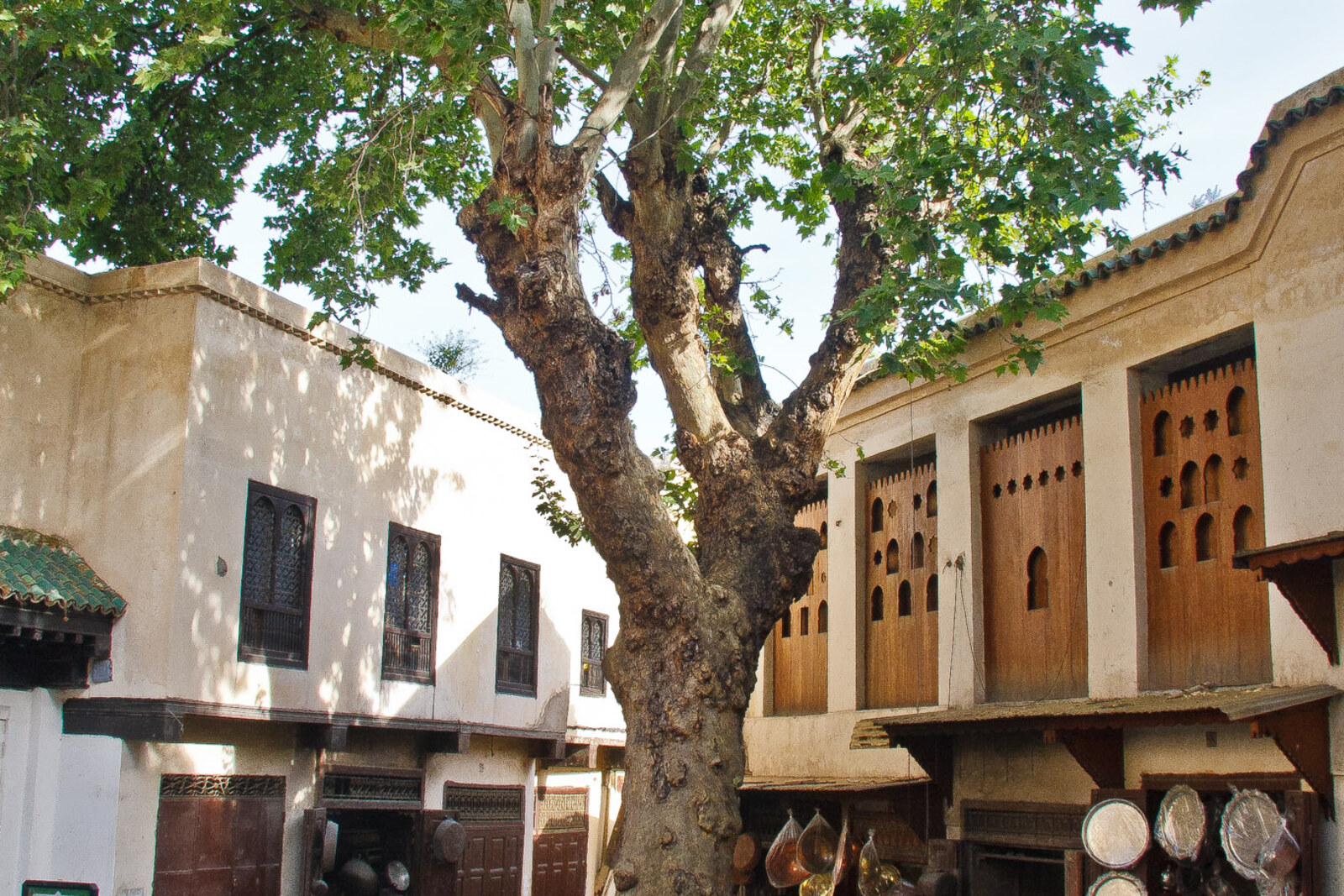
Look around first
What to notice
- Copper and brass vessels
- Tea trays
- Sheets of metal
- Workshops on the square
The story of the place
Seffarine Square takes its name from the yellow-metal craftsmen. The seffara worked with brass and yellow copper, making doors, lamps, jugs, and trays. Beside them sat the nhaysia—red-copper coppersmiths—who made pots, buckets, and large cauldrons. Municipal oversight of the trades required craftsmen of a single specialty to remain together: this made it easier to inspect goods, limit the number of workshops, and settle disputes. The profession occupied the square, then gave it its name.
At the beginning of the twentieth century, the local coppersmiths began to lose customers. Moroccans drank tea more and more often, but teapots and trays were imported from Europe. Manchester ware made by Wright sold especially well. Local craftsmen were advised to save themselves by making expensive items for the nobility and travelers. There proved to be few orders for such luxury goods.
Some craftsmen chose another path. Around nineteen ten, they formed a new association—the swaynia, or tray makers. They began taking imported ware apart as a model and reproducing it for local customers. Old cauldrons and jugs gave way to tea sets as the main product.
One of the apprentices of a local coppersmith was Abdelhadi Tajmouati. He hammered patterns for ten years, then became a maalem—a master responsible for an order himself and for training apprentices. In nineteen forty-six, friends invited him into a partnership: they wanted to move brassworking from a small workshop into mass production. A mechanical lathe also appeared in Fez at that time, and Tajmouati was among the first coppersmiths to master it.
In nineteen forty-nine, the partners opened the Et-Taj enterprise. It produced copies of Manchester Wright teapots: the form, lid, and decorative scheme remained English, while Fez craftsmen carved and hammered the patterns by hand. Machines sped up shaping and polishing, while the hammerers retained control of the metal surface. European suppliers had not yet restored their former trade after the war, and Fez ware occupied the market that had been left open.
The workshop quickly outgrew the old Medina of Fez. In nineteen sixty, Tajmouati moved production to a factory in Ain Kadous, and another five years later, three hundred people were already working there. From an apprentice on the square, he became a major industrialist; the business he started moved beyond tea ware and took up iron goods, construction materials, and porcelain.
The hand-worked part of the trade remained on Seffarine Square. For a long time now, a single item may be made at several addresses: one craftsman cuts the sheet metal, another hammers it, a third solders it, and a fourth polishes it. The workshops here now often repair old vessels and cauldrons. Craftsmen themselves have almost stopped using the word seffara, but the square still bears the name of the yellow-metal craftsmen.
Useful on site
Working days from early morning until evening; on Fridays, many workshops close by midday
Checked: June 19, 2026. Check the official source before visiting.Stay outside the work area, do not touch items without an invitation, and ask the craftsman before taking photographs. The loud hammering here is part of active production.