 Guide On Map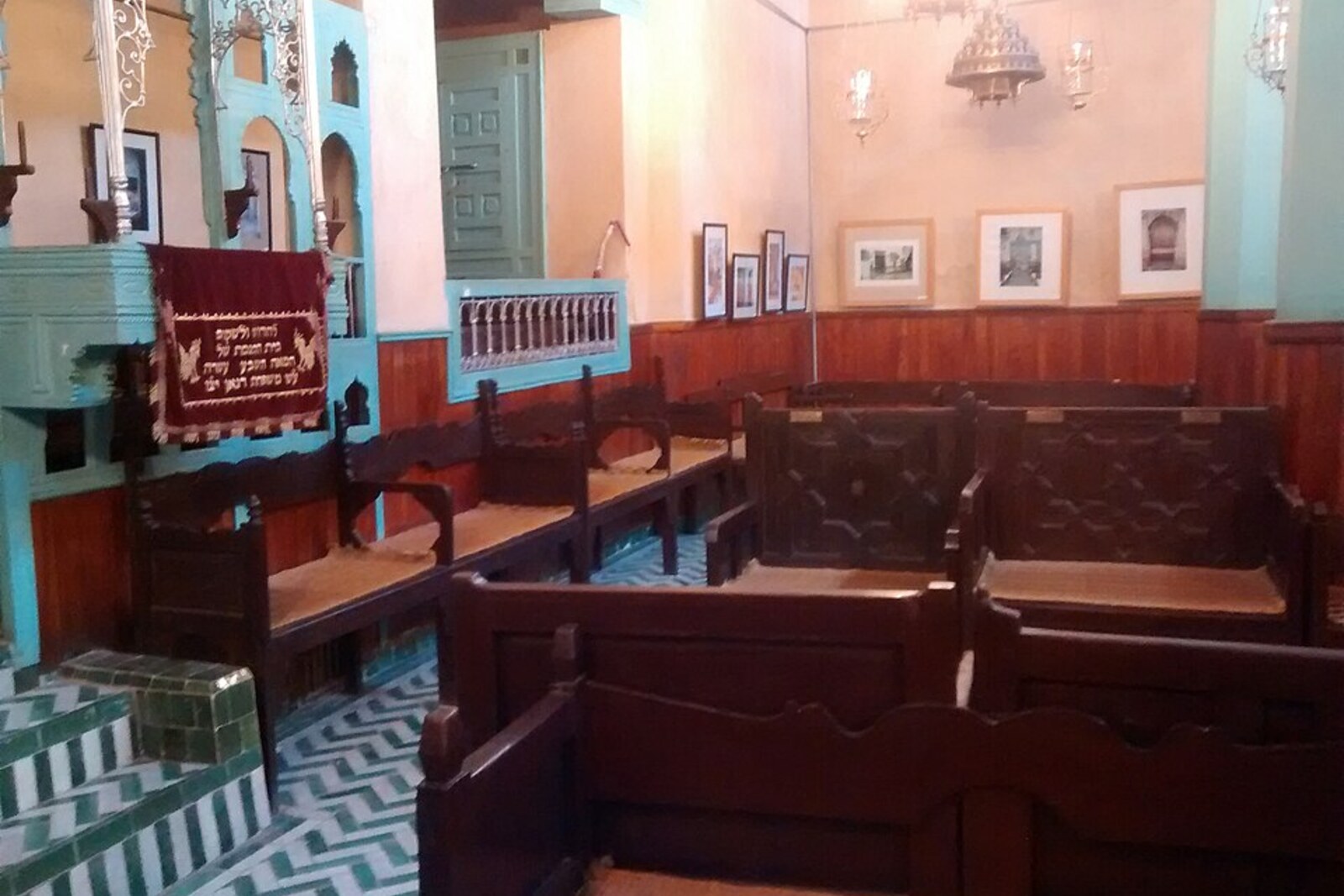
Look around first
What to notice
- Painted seats
- Carved doors of the Torah ark
- Reader's platform
- Wrought-iron canopy
The story of the place
In the seventeenth century, a separate house of prayer was built for the community in the Mellah of Fez, although nearby, converted rooms in residential houses more often served as synagogues. By the eastern wall of the quarter, it was surrounded by community buildings, and inside everything is arranged around the reading of the Torah: a cabinet for scrolls, benches for worshippers, and a forward-projecting reader's platform. The painted seats, carved cabinet doors, and wrought-iron canopy above the platform still preserve the layout of this small hall. Later, the house came under the care of a rabbinical family, and its name remained above the entrance.
By nineteen ninety-six, the roof above the prayer hall had sagged. The water-soaked beams were rotting, the plaster was cracking, and some of the windows had already lost their panes. Regular services stopped here after World War Two, when most of Fez's Jewish community left. The door continued to be locked, but the lock could not keep the building from falling into ruin.
The name above that door can be misleading. Shlomo Ibn Danan did not build the synagogue. In the seventeenth century, a local Jewish merchant, Maimon Bousidan, built a purpose-made house of prayer here—a rarity in the Mellah of Fez, where rooms in residential houses more often became synagogues. The site was chosen by the eastern wall of the quarter, on a plot with community buildings. From eighteen twelve, the Ibn Danan rabbinical family managed the synagogue. In the early twentieth century, Rabbi Shlomo Ibn Danan led services here; the building acquired its present name from him.
Shlomo came from a dynasty that gave Fez dozens of rabbis. For his family, this room was at once a house of prayer, a place of study, and inherited property. After the congregants left, the Ibn Danan descendants lived outside Morocco, while the family sanctuary remained in an alley of the Mellah of Fez, together with the reader's lectern, cabinets for Torah scrolls, benches, and a chair used during the circumcision rite.
The Jewish community of Fez began emergency repairs in nineteen eighty-nine. Seven years later, it secured the synagogue's inclusion on a list of monuments threatened with destruction. An association for its restoration then appeared, an American company allocated thirty thousand dollars, and Ibn Danan descendants, the Moroccan Ministry of Culture, and the Foundation for the Preservation of Moroccan Jewish Cultural Heritage joined the work.
In February nineteen ninety-nine, the synagogue was reconsecrated and opened to visitors. Inside, the painted seats, the carved doors of the Torah ark, and the forward-projecting reader's platform beneath a wrought-iron canopy were preserved. Above the entrance remains the name of the rabbi who led prayers here; the furnishings of his synagogue were preserved by descendants who returned to the family house specifically to save it.
Useful on site
The monument is open to visitors depending on the circumstances, but no stable official schedule in public sources was confirmed as of 2026-06-29; access may depend on the custodian and a small fee.
Checked: June 29, 2026. Check the official source before visiting.Do not assume that the interior is freely accessible: it is best to arrange a visit separately. Without the custodian, do not look for another entrance or try to open closed rooms.