 Guide On Map
Fes el-Jdid: palace, Mellah, and Jnan Sbil Gardens
From the gates of the Royal Palace of Fez through the Mellah of Fez to Jnan Sbil Gardens
Guide On Map on your phone
Open the walk like a regular app
It takes about 10 seconds to install. No app store needed.
The whole path
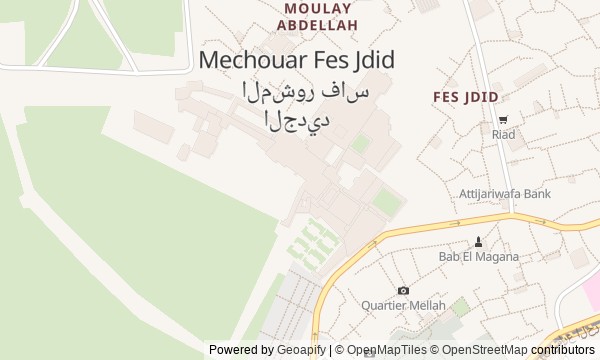
Route map
About the walk
You will begin at the seven golden gates of the Royal Palace of Fez, then head into Fes el-Jdid—through the Mellah of Fez, past the white rows of the Jewish Cemetery of Fez, and into the alley of a family synagogue. After the tight streets, the route passes through Bab Semmarine and ends among the greenery of Jnan Sbil Gardens.
This is not a walk through the maze of Fes el-Bali. It follows the palace city and the quarter beside the closed palace walls. You will learn why families had to bury their ancestors a second time, what was left behind the door of an abandoned prayer room, and why chairs were carried into a garden café. The answers lie in particular things: old rifles, rotted beams, whitewashed gravestones, carved door leaves.
The story will be calm and precise. It separates document from disputed chronicle, and a later façade from the older site of an event. By the end of the walk, you will read Fes el-Jdid through its boundaries: the palace wall, the gates of the Mellah of Fez, the passage beneath the towers, and the garden between the city's two halves.
Why this order
The later ceremonial entrance first shows the closed palace from outside. Just beyond it begins the Mellah of Fez: its closeness to the palace wall explains both the quarter's position and the route by which its residents once escaped. From the residential streets, the walk heads to the cemetery by the southern wall—where not homes, but the remains of earlier generations, were moved. Next comes the family synagogue: after the cemetery's shared space, the story narrows to one room and the things preserved by descendants. Its alley leads to Bab Semmarine, where the Mellah of Fez meets the palace city through a fortified passage. Beyond the gate, the route continues along Fes el-Jdid's main street and ends in Jnan Sbil Gardens: after the palace, the enclosed quarter, and military gates, an open garden for the city appears, where a political gathering could pass for a celebration.
Those who want to see Fez beyond Fes el-Bali Those interested in Morocco's Jewish history Those who like documentary stories without ceremonial rhetoric
Those looking for a walk only through markets and craft quarters Those who prefer light city legends to historical conflicts Those who find it difficult to hear about pogroms and forced resettlement
Before you go
Plan on the Royal Palace of Fez being an exterior stop only: trying to enter through the guarded gates is inappropriate. Access to the cemetery and synagogue depends on current conditions and the presence of a caretaker, so confirm the possibility of entry in advance through a reliable local contact if seeing the interiors matters to you. Choose comfortable closed shoes for the old streets and cemetery, carry water, and dress respectfully for religious sites. In the Mellah of Fez, remember that this is a residential and commercial quarter, not a museum set: do not photograph people up close without permission.
When to go
Set aside about two–three hours for the walk, not counting long waits at closed sites. Morning works well for quiet attention to the streets, while later afternoon brings softer light on the gates and a pleasant finish in the garden. If access inside the cemetery or synagogue is confirmed, allow extra time for an unhurried visit and a conversation with the caretaker.
Backup plan
Closed doors do not erase the route. At the cemetery, pause at the outer boundary and focus on the shift from dense building to open space; at the synagogue, treat the inconspicuous entrance as part of its story, without trying to find a way through neighboring buildings. If both sites are inaccessible, spend more time on the streets of the Mellah of Fez, noticing balconies, grilles, and outward-facing windows, then continue to Bab Semmarine. If the garden is closed as well, end the walk at its fence or an accessible entrance without going around locked gates, and save the water part of the story for a separate return.
Route conditions
Surface. Paved — 1.2 km; unpaved — 49 m (data covers 55% of the route)
Access. Wheelchair — limited; stroller — limited
Facilities. Toilets — 3; drinking water — 1
Elevation. Ascent — 18 m; descent — 21 m
OpenStreetMap extract of June 18, 2026: database data, not a check on the ground. Data © OpenStreetMap contributors, ODbL licence
Walk plan
Open in maps ↗- 1
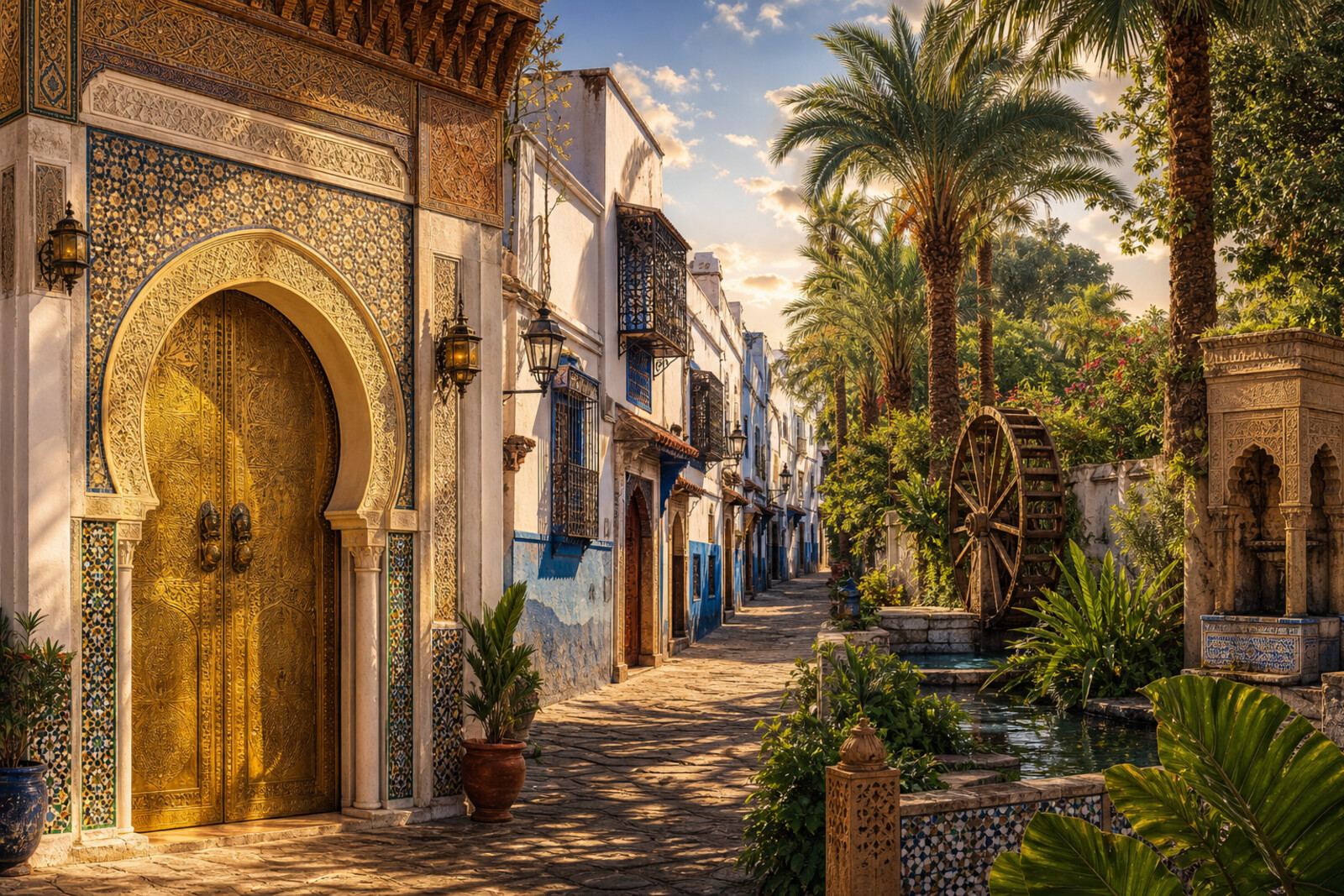
Place des Alaouites and the gates of the Royal Palace of Fez
Here, a later ceremonial facade conceals the place where the ruler's rescue turned into a political price to pay. - 2
Mellah
The palace’s proximity here will become a concrete escape route, while restored façades will conceal traces of a three-day devastation. - 3
Jewish Cemetery of Fez
The whitewashed rows preserve the trace of a forced relocation that affected several generations at once. - 4
Ibn Danan Synagogue
This stop will show which family belongings were preserved along with the building, which had nearly been lost. - 5
Bab Semmarine
The fortified passage explains how an alliance with the residents of a neighboring quarter decided the struggle for the palace city. - 6
Jnan Sbil Gardens
The finale moves the conversation from the enclosed palace spaces to a public garden, where an unofficial gathering became a state holiday.
Route features
Everything you need stays in the browser
Progress, saves and your trip plan are stored on this device.
Add Guide On Map to your home screen so the walk opens outside the browser.
How we handle sources, maps and corrections: our editorial standards