 Guide On Map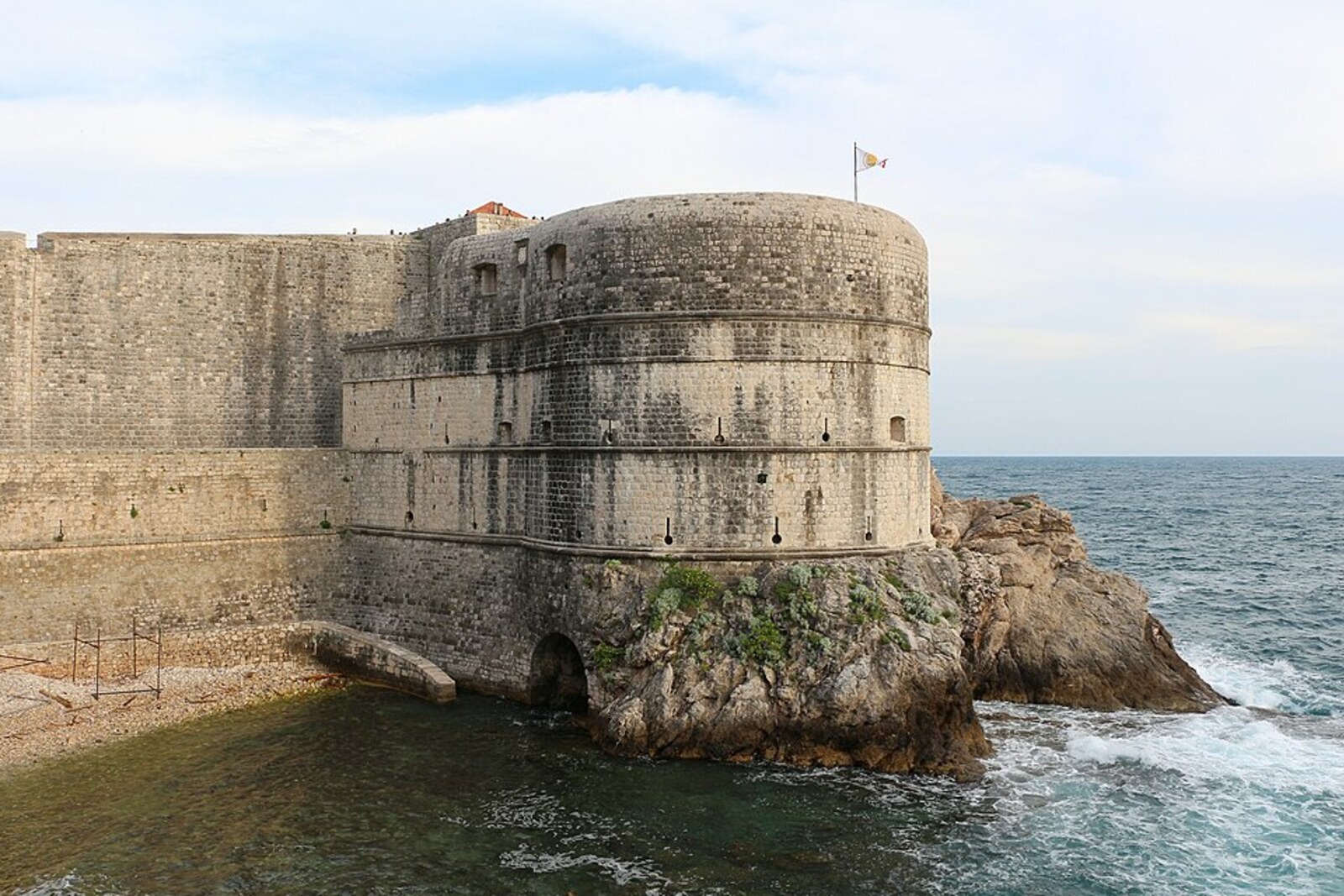
Look around first
What to notice
- The round fortress structure
- Gun embrasures
- Stone vaults
- The open upper platform
The story of the place
Beyond the city wall, round Bokar Fortress projects from a coastal rock, and stone vaults connect it to the defensive ring. The fortress kept the western approach from the sea, the bridge at Pile, and the moat under fire, so its structure was pushed far forward. In the thickness of the stone, two enclosed levels with gun openings lie one above the other, while an open platform survives above. The embrasures and the terrace show how shelter for artillerymen and a broad view were combined here.
In the summer of nineteen seventy-two, director Georgij Paro spent a month walking around Dubrovnik in search of a stage for Miroslav Krleža's “Aretej.” The play had already failed once: after its Zagreb premiere in nineteen fifty-nine, audiences and critics complained about its length, medical digressions, and convoluted plot. Krleža moved the characters from the third century to nineteen thirty-eight and made the same betrayals, blackmail, and murders recur under different names. In an ordinary theater, these transitions had to be explained through sets. Paro was looking for a building the audience could walk through.
Bokar Fortress was suitable because of a design conceived for artillerymen. The people of Dubrovnik pushed the round structure beyond the line of the city wall so they could fire on the western approach from the sea, the bridge in front of Pile Gate, and the moat. Part of the fortress was placed on a separate coastal rock, with the gap spanned by stone vaults. Inside, they created two tiers of casemates—protected rooms with gun embrasures—and left an open platform above them.
Paro turned this military layout into a route through five scenes. The audience followed the actors through the interior rooms and climbed to the upper terrace. One casemate represented the home of the doctor Aretej in the third century, while the terrace represented the hotel “The Twentieth Century.” The climb up the stairs marked a passage across sixteen centuries; no curtain was needed.
The cramped rooms held around one hundred spectators. Paro answered this limitation with two casts: the second company began the performance after the first. Only five performers had understudies; the other actors moved between the two performances and had to appear before each group at exactly the right moment. In one scene, both casts and both audiences met. The characters from different eras, whom Krleža had brought together on paper, physically found themselves side by side inside the fortress.
The premiere took place on August twentieth, nineteen seventy-two. The production, from which another failure of a difficult play had been expected, remained in the program for thirteen years—longer than any other performance of the Dubrovnik Summer Festival. Afterwards, theater historians placed the phrase “Aretej at Bokar Fortress” alongside the names of productions that defined the entire festival, and contemporary authors gained a place in the program that had previously been occupied mainly by classics.
The sets for “Aretej” are no longer here. The route of the performance remains: gun rooms on different levels, passages between them, and the terrace where the hotel “The Twentieth Century” was staged. Performances are still held at Bokar Fortress. No stage was built above the fortress—the actors still occupy the spaces left by the artillerymen.
Useful on site
The official Dubrovnik City Walls website showed 08:00-19:30 on 2026-06-25; after leaving, re-entry to the walls is usually not provided.
Checked: June 25, 2026. Check the official source before visiting.From outside, the fort's shape and its position above the bay are clearly visible; the interior rooms are not always accessible and may be used for events. Do not count on entering without checking separately.