 Guide On Map
Dubrovnik City Walls and Fortresses: The Defensive Ring
From Pile Gate along the walls of Dubrovnik Old Town to Fort Lovrijenac
Guide On Map on your phone
Open the walk like a regular app
It takes about 10 seconds to install. No app store needed.
The whole path
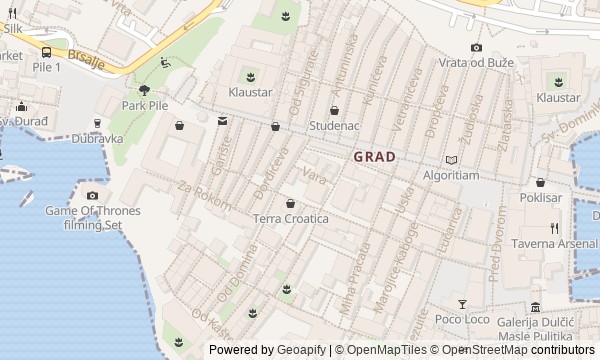
Route map
About the walk
You will follow Dubrovnik's defensive ring: from Pile Gate, climb to Minceta Tower, cross the northern wall, descend to Ploče and the Old Port, then walk above the Adriatic Sea to Bokar Fortress and the freestanding Fort Lovrijenac.
This is not a walk along grand streets, but along the city's edge. Beneath your feet will be casemates, bridges, a former moat, and bare rock. On one side, rooftops; on the other, the sea approaches that changed the thickness of the walls and the shape of the towers.
You will learn why another tower survives inside the round Minceta Tower. You will see the place where a master had to prove his craft with a single shot, and a fortress turned into a stage for two troupes. The story follows the documents and clearly separates them from the legend of a cannon that vanished beneath the cliff.
By the time you reach Fort Lovrijenac, you will read Dubrovnik as a fortress: through its gates, chain, gun embrasures, and the wall deliberately made weaker on the city side.
Why this order
At Pile, the route begins where defense depended not only on stone, but on the decision to open the gate. The climb to Minceta Tower immediately shows how the same landward front was adapted to artillery. From its height, the northern wall leads to the opposite entrance—Ploče and the outlying Revelin Fortress—so you can compare the city's western and eastern boundaries. Beyond Revelin Fortress, the wall runs into the Old Port, making St. John Fortress and its system for closing the sea entrance the next stop. From the harbor, the southern section changes the terms of defense: instead of a moat beneath the wall, there are sheer cliffs and open sea. Bokar Fortress completes this edge where it meets Pile's bridge and moat again. After the closed city ring comes Fort Lovrijenac: from its separate rock, the whole system becomes visible from outside, including the wall facing its own garrison.
Those who want to walk the full defensive perimeter of Dubrovnik Old Town Lovers of fortresses, military engineering, and maritime history Those who care about the human decisions behind stone structures
Those looking for a level route without stairs or changes in elevation Those seeking a walk focused mainly on palaces and churches Those uninterested in how fortifications work
Before you go
Before setting out, check the current access conditions for the walls and Fort Lovrijenac through official sources: visiting hours, possible restrictions, and what the ticket includes may change. Decide in advance whether you are ready to complete the ring without leaving early, and bring water, sun protection, and shoes with sturdy soles. Download the audio to your phone beforehand, and confirm separate visiting arrangements for the Maritime Museum in St. John Fortress and any interior spaces.
When to go
Choose a cooler part of the day and leave extra time for stairs, audio stops, and the walk to Fort Lovrijenac. In the midday heat, the exposed stone quickly becomes tiring, while strong wind makes the sea-facing side less comfortable.
Backup plan
If the walls are closed or the weather makes the elevated route unsafe, do not try to recreate the ring at the upper level. See Pile and Bokar Fortress from outside, cross the city to Ploče Gate and the Old Port, then view St. John Fortress from the waterfront. Leave Fort Lovrijenac for a time when access is open and the steps are safe. This version will not offer a continuous panorama, and the northern line with Minceta Tower will be harder to read, but it preserves the main sequence: the western entrance, landward defense, harbor, and outer fortress.
Route conditions
Surface. Paved — 1.7 km; unpaved — 90 m (data covers 86% of the route)
Stairs. Flights: 1, 12 m in total
Access. Wheelchair — no; stroller — limited (stairs)
Facilities. Toilets — 8; drinking water — 8
Elevation. Ascent — 47 m; descent — 53 m
OpenStreetMap extract of June 25, 2026: database data, not a check on the ground. Data © OpenStreetMap contributors, ODbL licence
Walk plan
Open in maps ↗- 1
Pile Gate
Here the route shows how the decision to open the gate proved stronger than the entire system of barriers. - 2
Minceta Tower
This stop explains how a medieval tower was incorporated into a fortification for artillery warfare. - 3
Ploče and Revelin Fortress's Stone Shield
The eastern entrance links the republic's border defense with the workshop where a visiting founder underwent his test. - 4
St. John Fortress
Here you will see how an open trading port was turned into a closed basin in just a few steps. - 5
Southern Edge: The City Above the Adriatic Sea
This section restores the geography of the early settlement on the rock and of the former strait where Stradun now lies. - 6
Bokar Fortress: From Gun Embrasures to the Stage
This story shows how a director turned artillery rooms and stairways into the structure of a performance. - 7
Fort Lovrijenac
The finale will show why the isolated fortress was defended not only against an attack from the sea, but also against its own garrison.
Route features
Everything you need stays in the browser
Progress, saves and your trip plan are stored on this device.
Add Guide On Map to your home screen so the walk opens outside the browser.
How we handle sources, maps and corrections: our editorial standards