 Guide On Map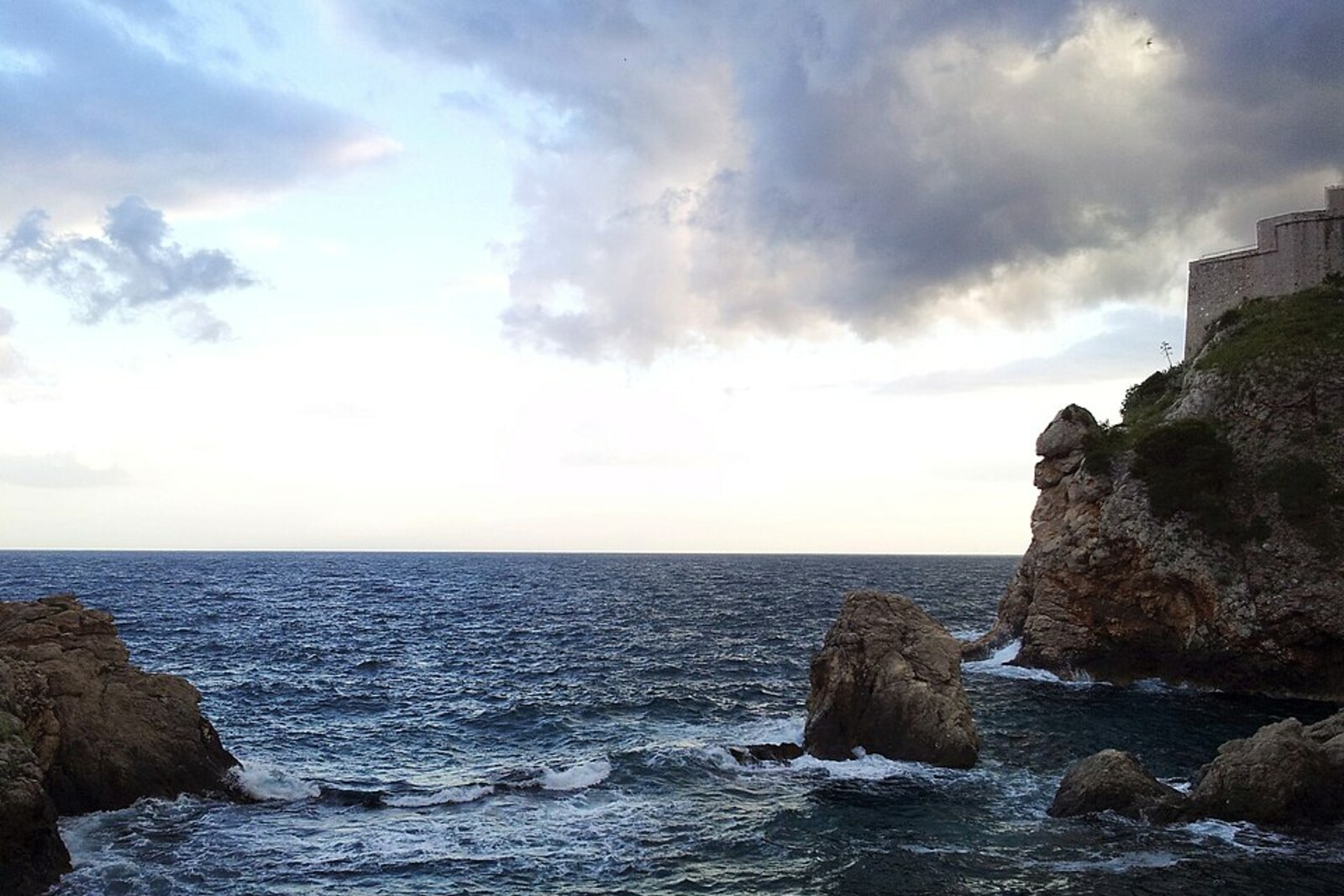
Look around first
What to notice
- Sea wall
- Rocky cliff
- Stradun
- Southern districts of the Old Town
The story of the place
Beneath the present sea wall, the rock drops steeply toward the Adriatic Sea. In the early Middle Ages, this southern promontory held almost the entire city. A shallow strait lay where Stradun is now, separating the rock from the mainland. The districts north of the main street appeared later.
A Byzantine chronicle of the tenth century links the beginning of Dubrovnik to refugees from Epidaurum, a Roman port city on the site of present-day Cavtat. According to this account, at the beginning of the seventh century, Epidaurum was sacked by the Avars and Slavic detachments, and the surviving inhabitants moved to this rock. About fifteen kilometers from here, they left behind homes, a harbor, a market, and the aqueduct that supplied their city. They needed a refuge from which they could continue maritime trade: without it, many families lost their livelihood.
This story should be regarded as a legend with a historical basis, not as an exact record of the city's founding. After the earthquake of nineteen seventy-nine, archaeologists found traces of a settlement from the Greek and Roman periods in the old center, as well as freshwater springs near the cathedral. The refugees did not arrive on an empty, waterless rock. Most likely, they joined a community that already existed here and significantly increased it.
The southern edge suited them because of the very shape of the coast. On the seaward side, the sheer slope made it difficult to land people and bring up siege engines. The northern slope beyond the strait was more dangerous: there the ascent was gentler. At the highest point, the settlers built a fortification of dry stone and wood. They called it Castellum, meaning a fortress. They then enclosed the neighboring St. Peter's Quarter with a wall. On the seaward side, that early enclosure ran high above the cliffs, approximately along the line of the present wall.
The community held on and grew. By the middle of the ninth century, walls already enclosed three districts on the southern rock; the inhabitants built ships and expanded the harbor. Later, they filled in the strait and connected the settlement to the mainland. A broad Stradun, today's Stradun, appeared where the water had been, and early Ragusa—as Dubrovnik was then called—spread northward.
The wooden Castellum disappeared, and the former strait is hidden beneath the paving of Stradun. A spatial connection remains: the sea wall beneath your feet follows the edge of the rock where the inhabitants of Epidaurum found refuge and built a fortified settlement.
Useful on site
The official City Walls Dubrovnik website showed 08:00-19:30 on 2026-06-25; check seasonal hours and weather warnings before your visit.
Checked: June 25, 2026. Check the official source before visiting.Do not go right up to the edge for a photograph, and hold loose belongings firmly in the wind. On this long exposed stretch, ration your water in advance.