 Guide On Map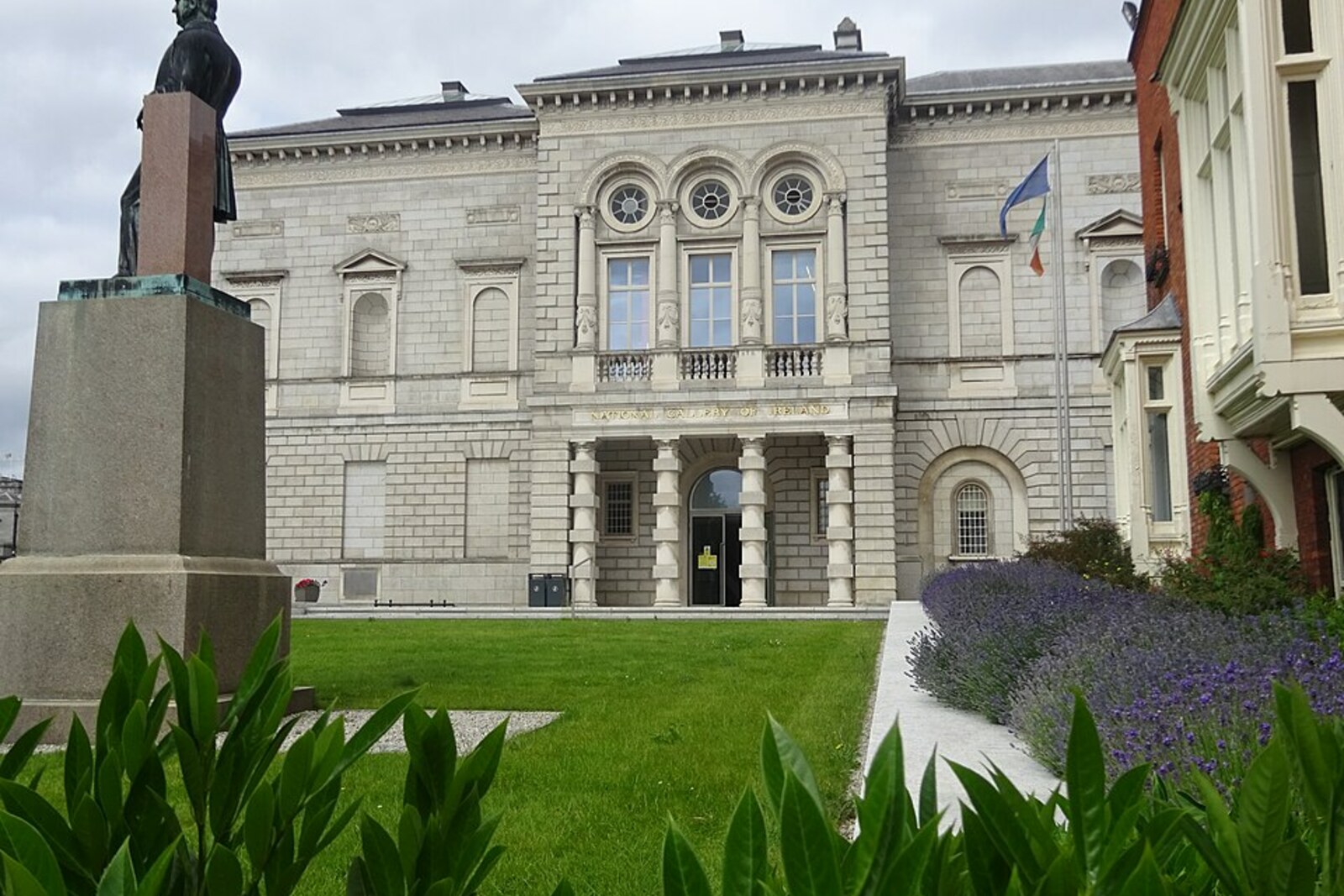
Look around first
What to notice
- Commemorative inscription on the façade
- Bronze statue of William Dargan
- Portrait of William Dargan
- Dargan Wing
The story of the place
The commemorative inscription on the façade names the National Gallery of Ireland: paintings by Irish and other European masters are collected here for the country's shared collection. Medieval paintings hang beside works by contemporary artists; they are studied, restored, and displayed free of charge. On the lawn behind this building, an enormous temporary structure once stood, with a metal and wooden frame enclosed in glass.
In June eighteen fifty-two, the railway contractor William Dargan came to the Royal Dublin Society with a risky proposal. He would pay for a large exhibition on the lawn beside Leinster House if the society undertook to organize it.
Dargan was a farmer's son and lived on the income from construction contracts. He began as a surveyor, then built canals, rebuilt harbors, and laid more than six hundred miles of railway. Now he intended to invest what he had earned from the rails in temporary pavilions. Dargan wanted to repeat the success of London's Crystal Palace Exhibition and show that Irish manufacturers could exhibit their machinery, textiles, and goods alongside products from other countries.
Preparation took eleven months. On Leinster Lawn, behind the present gallery, they erected an enormous structure of iron, wood, and glass. On May twelfth, eighteen fifty-three, the public was admitted inside. Among the industrial exhibits, Dargan and the organizers placed an extensive exhibition of European painting. It proved to be one of the most visited parts of the entire undertaking.
By the end of October, more than one million people had passed through the pavilions. The exhibition brought Dargan a loss: ticket sales did not cover all the money he had invested. But visitors gave the organizers an answer that no one could guarantee before the opening: Dublin had an audience for a permanent collection of paintings.
After the exhibition closed, supporters of the gallery created the Irish Institution. While officials decided whether money and a site could be found for its own building, its members organized temporary exhibitions of borrowed works. In eighteen fifty-four, Parliament passed an act establishing the National Gallery in Dublin. Dargan became one of its first trustees.
It remained to decide whose name the new institution would bear. Townspeople raised money in gratitude to Dargan, and the fund's trustees proposed naming the building the Dargan Institute. The other founders pressed for the name “National Gallery of Ireland”: paintings were to be collected here for the country, not to create a monument to one benefactor. The Dargan Committee yielded, but set conditions. A commemorative inscription was to appear on the building, Dargan's portrait was to hang inside, and his statue was to stand in front of the entrance.
Fundraising and construction took another ten years. The gallery opened on January thirtieth, eighteen sixty-four. The first rooms held only one hundred twelve paintings, some of them borrowed. Dargan lived to see the opening of the institution that grew out of his loss-making exhibition.
Today, the gallery's staff collect, study, restore, and display the national collection of Irish and European art—from medieval paintings to works by contemporary artists. The permanent display is free to visit. The glass pavilions of eighteen fifty-three are no longer here. Dargan's bronze statue remains in front of the façade, and the oldest part of the building is called the Dargan Wing. Above the entrance, another name has survived—the one for which the committee gave up the Dargan Institute: National Gallery of Ireland.
Useful on site
National Gallery of Ireland: Mon 11:00-17:30; Tue/Wed 09:15-17:30; Thu 09:15-20:30; Fri/Sat 09:15-17:30; Sun 11:00-17:30. Entry stops 15 minutes before closing.
Opening hours by day
The painting requires a visit to the Gallery; before your walk, check whether it is available for viewing. If you go inside, let your eyes adjust to the dark scene before looking for the self-portrait.