 Guide On Map
Georgian Dublin South: parks, literature, and parliament
From St Stephen's Green along Kildare Street to Oscar Wilde's house
Guide On Map on your phone
Open the walk like a regular app
It takes about 10 seconds to install. No app store needed.
The whole path
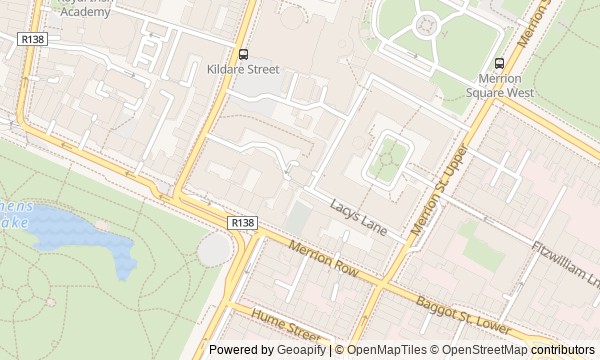
Route map
About the walk
You will walk through Georgian Dublin south, from the lawns of St Stephen's Green to the university houses, the museums of Kildare Street, parliament, and Merrion Square. The route stays close to two gardens and a neighborhood where private houses, learned societies, and exhibition halls changed owners and purposes. In one place, you will look for bullet marks on an entrance arch; in another, for a first edition that returned to the place where its author had once been refused publication. Other questions will emerge nearby: why an unprofitable exhibition gave the city a gallery, how a room intended for a few months became parliament, and what happened to the site of a future cathedral. The story moves at an unhurried pace, through decisions, failures, and things that remained in place. By the end, you will be able to explain why Georgian Dublin south can be read through open gates, preserved names, and one house with a doctor's office downstairs and a literary salon upstairs.
Why this order
St Stephen's Green first sets the theme of access: a park that once required keys became public, while its railings became a military boundary. On the southern side, the same gates lead to Newman House, where access to education proved harder, yet a student refusal became literary legacy. Crossing the park toward Kildare Street, you move from a private educational project to a museum that demanded a national name before independence. A short loop around Leinster House then brings you to the gallery, whose story began on the exhibition grounds of that same complex. Returning to the main facade matters because, after the national collections, you will see how a former lecture hall became parliament. From here, the road continues to Merrion Square: the temporary parliament became permanent, while the garden beneath the future cathedral opened to the public. The final crossing of the square leads to a private house where public history ends with a family trial and a literary salon.
Those interested in urban decisions with unexpected consequences Lovers of Irish literature, museums, and Georgian neighborhoods Those who prefer specific human stories to a broad survey lecture
Those looking above all for a route of pubs and waterfront views Those expecting to spend the whole walk outdoors Those who prefer to avoid stories of execution and criminal accusation
Before you go
Decide in advance which interiors are essential for you: Museum of Literature Ireland (MoLI), National Museum of Ireland – Archaeology, National Gallery of Ireland, and Oscar Wilde's house can noticeably extend the walk. Check visiting conditions for each one immediately before setting out.
Leinster House is an active parliamentary building: without a visit arranged in advance, expect to see it only from outside. It is also worth checking park access on the day of your walk, especially if you are going early or toward evening.
The route is best heard through headphones, but take them off or pause the recording at crossings.
When to go
Allow 1.5–2 hours without visiting interiors. If you want to take in the exhibitions at even 2 museums at an unhurried pace, or visit Oscar Wilde's house, it makes more sense to allow 3–4 hours.
Backup plan
If a museum is closed or a queue breaks the rhythm, do not rebuild the whole walk: listen to the story by the facade and continue in order. At the National Museum of Ireland – Archaeology, focus on the very idea of an accidentally discovered past; at the National Gallery of Ireland, on the story of a painting found beyond museum walls; and at Oscar Wilde's house, on the building's link to the monument across the road.
In rain, use any accessible museum stops for shelter, but do not count on entering parliament. If Merrion Square Park is closed, walk around it on the outer sidewalk: the facades, Le Fanu House, Plunkett House, and the Oscar Wilde monument can be tied into the same story from the perimeter.
Route conditions
Surface. Paved — 1.8 km; unpaved — 400 m (data covers 90% of the route)
Stairs. Flights: 1, 6 m in total
Access. Wheelchair — no; stroller — limited (stairs)
Facilities. Toilets — 2; drinking water — 1
Elevation. Ascent — 13 m; descent — 14 m
OpenStreetMap extract of June 25, 2026: database data, not a check on the ground. Data © OpenStreetMap contributors, ODbL licence
Walk plan
Open in maps ↗- 1
St Stephen's Green Park
This stop introduces two themes of the route: access to the city and decisions whose consequences will outlive their makers. - 2
Museum of Literature Ireland (MoLI) and Newman House
Here, an unsuccessful university venture will connect the route with literature that will return to the same houses as museum heritage. - 3
National Museum of Ireland – Archaeology
This stop will show how one word in a name outlived a director, his dismissal, and a change of state. - 4
National Gallery of Ireland
Here it becomes clear how a private loss turned into a permanent public collection. - 5
Leinster House
This stop will take the route from the national collections to the system of government that settled into someone else’s hall. - 6
Merrion Square Park
Here, the theme of access returns through a garden that was prepared for a cathedral but opened to city residents. - 7
Oscar Wilde's House
The finale will bring together a doctor's consulting rooms, a family court case, and a literary salon in one house.
Route features
Everything you need stays in the browser
Progress, saves and your trip plan are stored on this device.
Add Guide On Map to your home screen so the walk opens outside the browser.
How we handle sources, maps and corrections: our editorial standards