 Guide On Map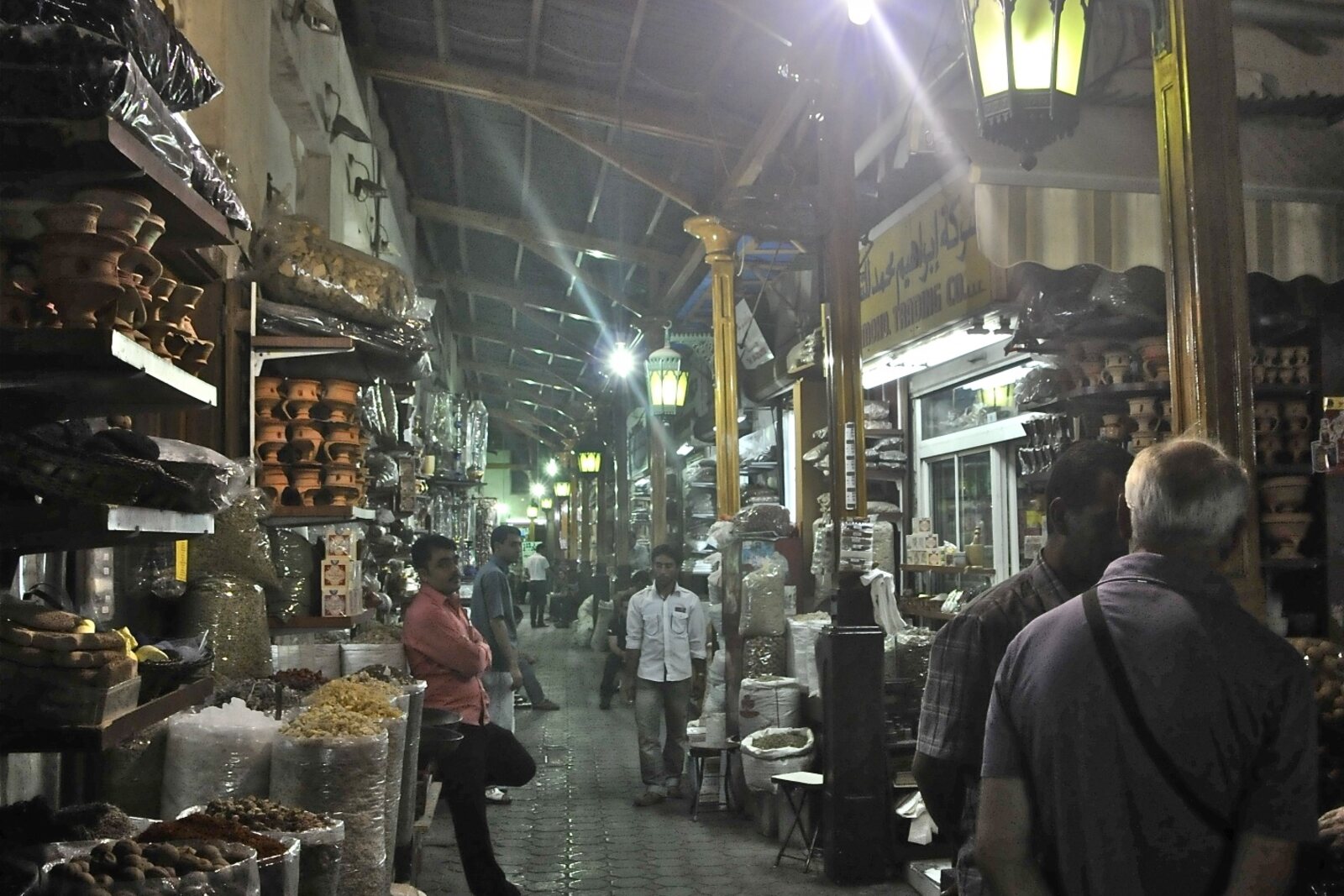
Look around first
What to notice
- Open sacks, dried lemons, red saffron threads, pieces of resin, roots, and jars of herbs.
The story of the place
In old Deira, the Spice Souk brought together a kitchen, a storehouse for the road, and a home pharmacy in one place. Dried lemons and roots lie in open sacks; red saffron threads, pieces of resin, and jars of herbs are visible on the counters. Pearl divers, fishermen, and sailors bought provisions for the journey here, along with remedies for heat, dehydration, fever, diseases of the skin and stomach. Before air conditioning and modern pharmacies became widespread, city residents also came for such purchases.
This market has no grand entrance. But it has a smell that reaches people before the signs and the sellers do. First, sweetish cinnamon appears in the air, then the dry bitterness of herbs, warm saffron, smoky resin. And suddenly, a sharp note, as if somewhere nearby someone had opened a jar of a very angry medicine. That is how asafoetida smells. Here it is called haltit.
The Spice Souk can easily be mistaken for one huge kitchen. Sacks hold cardamom, pepper, dried lemons, buds, and roots; resins darken in display cases, and saffron is kept almost like a piece of jewelry. But old Deira's market was not only a kitchen. It was also a pharmacy, a storehouse before a journey, and a place people came to for advice.
Before air conditioning and modern pharmacies appeared, a seller's advice could become part of one's equipment. Pearl divers, sailors, and fishermen bought remedies here for heat, dehydration, fever, skin diseases, and stomach upset. A sea voyage began not only with checking the sail and water supplies. Sometimes it began with a small bundle of herbs hidden among one's belongings.
Haltit smells so sharp that it is hard to suspect it of good intentions. Yet it was considered beneficial for circulation and digestion. Al murr—myrrh—behaves quite differently. Its warm, fragrant smell seems almost solemn. Myrrh was used as a natural antiseptic for wounds and skin. The two goods lay almost side by side: one repelled with its smell, the other enticed with it, while both had entirely practical purposes.
Such counters required more than just a merchant. They needed someone who remembered hundreds of names, distinguished quality by color and aroma, and understood a customer before the customer had finished a sentence.
Such a person was Hassan Abdulraheem from the family shop Mohammed Ali Abbas Trading. He said he could tell with a single glance why a visitor had come. In a report from two thousand eleven, a Pakistani construction worker approached him. Hassan immediately spoke to him in Urdu: something for digestion? Then, among hundreds of jars and piles, he found the right packet—al Haloul, a senna tea.
He had three languages of trade at his command: Arabic, Hindi, and Urdu. But the main language remained knowledge of the goods. The shop passed from generation to generation in the family; Hassan himself had run it for more than thirty-five years, and he learned the art of making mixtures in the most direct way—by trying the ingredients on himself. In such a school, a mistake is remembered especially well.
Conversation at the counter was rarely limited to the price. The customer described heat, pain, or heaviness in the stomach, while the seller searched through memory, smells, and family experience. The market worked like a living card catalog: information was kept not in reference books, but in the hands of people who opened jars every day, rubbed leaves between their fingers, and recognized regular customers by the way they walked.
One of the best-known merchants here arrived in Dubai from Iran in nineteen sixty-seven. Abdulla Asad was sixteen years old. In Deira, he came to be called Abdu, and also Giyahi Mard, which in Persian means “herb man.”
He began as a porter. He carried sacks of spices on his back and earned two dirhams a day. In his recollections, the market of those years appears almost intimate: barely six herb and spice shops, with local residents as the main customers. Goods were sometimes brought by bicycle and laid out right by the road.
Even decades later, Abdu himself came to his trading spot by bicycle. An entirely different Dubai had already grown up around him, while his daily route seemed to preserve the city's earlier scale—the one in which a sack was carried on shoulders, customers were known by sight, and the distance between home and shop was measured not by a car's speed but by the turning of pedals.
By two thousand twenty-one, Abdu counted more than two hundred thirty shops in the market. Six had become hundreds. Customers, packaging, and volumes of trade had changed, but the market itself retained its old talent: turning distant lands into smells at arm's length.
This is especially noticeable before Ramadan. There are more family purchases among the counters, and saffron becomes one of the season's main characters. In one report, two women—Umm Mohammed Al Ali from the United Arab Emirates and Umm Mohammed Al Baloushi from Oman—used a wheelchair as a cart and loaded it with purchases. Saffron was among them.
At that time, one gram cost no less than ten dirhams, and before Ramadan the price usually doubled. It seems almost unbelievable: a whole sack of dry leaves may stand beside a tiny portion of fine red threads, and it is that portion that will be more precious. Saffron needs very little space to carry within it labor, distance, and the expectation of a festive table.
That is why the Spice Souk tells of Dubai not through the height of its buildings or the gleam of its display cases. Here, the city first becomes a smell. Sharp, sweet, medicinal, expensive, sometimes unpleasant—yet always real.
Behind every pile of goods, someone's journey emerges. A sixteen-year-old porter becomes the herb man. A family merchant learns to read customers without words. A sailor takes away a remedy for heat, and a family stocks up on saffron for Ramadan. And the whole market turns out to resemble one large mixture, whose composition changed over decades, but in which no aroma ever disappeared completely.
Deeper into the story
Smell as a Map of Connections
After fabric, this market changes the sense organ: now the city is read with the nose. Spices and resins matter here not as a list of ingredients, but as geography: they recall that the creek connected not only shores, but also kitchens, ships, languages, and ways of trading. The most useful pause is not by the brightest display case, but in a narrow passage where smells mix and cease to belong to a single shop.
Useful on site
A shopping area with individual shops; unified hours have not been published on the official Visit Dubai page. It is best to plan for the afternoon or early evening.
Checked: June 28, 2026. Check the official source before visiting.Do not touch or taste goods without an invitation; when buying, clarify the name, quantity, and final price in advance.