 Guide On Map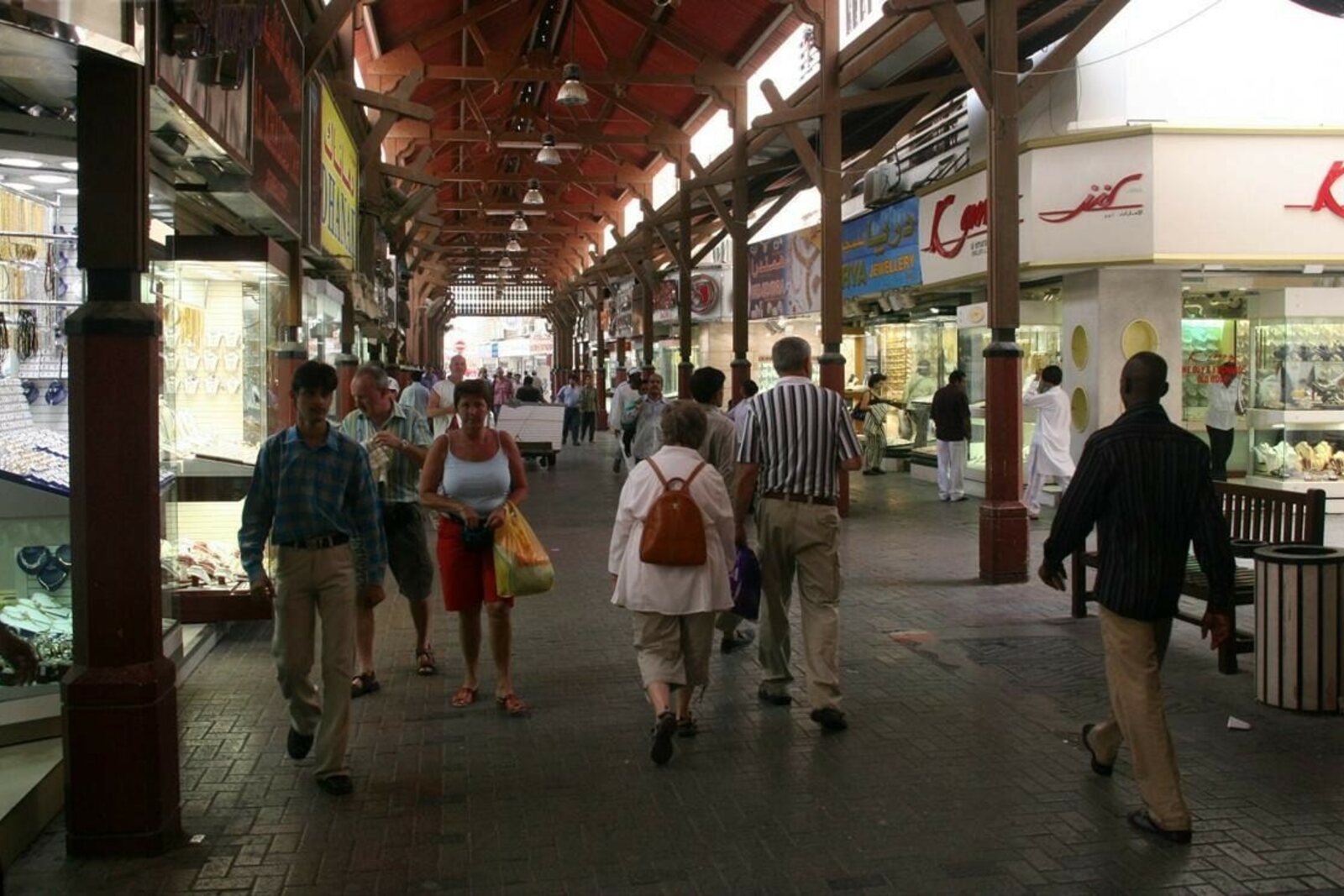
Look around first
What to notice
- Heavy necklaces, rows of bracelets, scales, metal price boards, and differences in karats.
The story of the place
Here, the market changes color. Spices absorb the light, while gold reflects it back. It lies behind glass in dense rows: chains, bracelets, rings, heavy wedding necklaces. The display windows seem to compete over which can hold more brilliance. But the true scale of the Gold Souk is measured not by the number of jewels, but by maritime routes, family histories, and trust among people who, until recently, did not speak the same language.
One such story began in 1948. Lakshmichand Mohanlal Shahooja arrived in Dubai from Gujarat on a dhow and opened a jewelry shop near the Creek, close to the Abra boat market in Bur Dubai. The trading rows looked nothing like today's galleries. A canopy of palm leaves stretched over the shops, which is why the market was called Chapra—covered with a palm roof.
Lakshmichand held an official trade license with a single-digit number and a P.O. box numbered 197. These details feel almost domestic: a small town, short numbers, sellers who know their customers by face. Lakshmichand himself wore a dhoti, and locals called him Gandhi, while close ones called him Laku.
His son Suresh first saw Dubai as a nine-year-old boy. The journey from Bombay took a full week on an old ship. The child had no passport of his own, so his name was entered into his mother's passport. In Bastakiya, Suresh studied under Indian teachers Krishna Singh Varky and Mariamma Varky. His school route was unusual: between classes and his father's shop, the boy carried gold jewelry.
Gradually, gold won over schooling. Suresh left his studies and entered the family business, where it quickly became clear that a jeweler needs more than knowledge of karats and clasps. One needs memory, caution, and the ability to stay silent about others' choices. Women from the ruling family would come to the shop, select jewelry, and Suresh would deliver the jewelry to Zabeel Palace. There, decisions were made on what to keep; everything else he returned to the shop. Gold traveled through the city without today's armored cars or complex security. Its main escort was the family's reputation.
The connection with the palace extended beyond precious metals. The Shahooja family sent crates of fruits and vegetables brought from India. In return, they received fragrant mangjak fruits, which were pickled at home. In this story, gold bracelets, ship crates, and jars of homemade preserves appear side by side. Old Dubai knew how to connect the grand with the everyday as if there were no boundary between them.
Later, Suresh recounted that his father and uncles participated in discussing the first projects for the Gold Souks of Dubai and Sharjah. Their experience was particularly needed at a time when the city was looking for a new commodity for large-scale trade.
For a long time, the wealth of the Persian Gulf shores was associated with pearls. But the pearl trade collapsed, and gold took its place. In the early fifties, a chain formed that researchers from Harvard's Belfer Center described in detail. After restrictions on gold sales were introduced in India, the metal arrived in Dubai from the UK and Switzerland. From there, it was transported further by dhow and unloaded near the Indian coast for local buyers.
In this trade, legal deals coexisted with smuggling. The risk was enormous, but profits, according to some estimates, could exceed 300 percent. Gold quickly filled Deira's shops, along with which local trading rules were born. One of them survives to this day: the cost of a piece is split into two parts. First, the price of the metal itself; then, the price of the craftsman's work. The buyer understands how much they pay for grams of gold and how much human skill costs to turn it into a pattern.
This clarity became the foundation of a market where sellers had to convince people from different countries every day. Kirti Kishor Dhandoji arrived here with his father in 1958 to open a shop for the jewelry house Shandji Motiram & Sons. Fifty-five years later, he was still working behind the counter, now alongside his son Bimal.
Over these years, Kirti learned Arabic, Urdu, Bengali, Persian, Gujarati, and English. Not for the sake of collecting languages—the market demanded it. Initially, buyers were mostly from Asia. Then Europeans and Africans appeared. Clients from Nigeria bought twenty-two-karat gold items in bulk to resell at home. Some chose jewelry for weddings, others turned gold into merchandise, while others stored family savings in it. One counter could simultaneously be a display window, a workshop, an exchange point, and a place for negotiations.
Trust here was not left solely to the seller's conscience. Screens showing the current price per gram of gold of various karats appeared at the entrance. The municipality checks the scales in the shops. Seller Vishal Mandaliya explained the meaning of the screens simply: buyers do not always trust a price spoken by a person behind the counter. When the metal's cost is visible to everyone, arguments remain only about the craftsman's work.
Therefore, the bargaining here is more nuanced than it seems. The gold price comes from the global market, weight accuracy is confirmed by the city, and space for conversation remains where craftsmanship begins. How much does a pattern, soldering, clasp, or patience cost? Here, the seller's character meets the buyer's.
This is Dubai's final brilliance. Not just thousands of lights reflected in display cases, but the ability to transform a small shop under a palm canopy into a market of global scale. Dhows gave way to airplanes, single-digit license numbers to massive trading systems, and the boy carrying jewelry between school and shop became part of the city's history. But the main commodity here remains the same: gold is sold by weight, work by agreement, and trust passed from generation to generation.
Deeper into the story
The Finale on Trust, Not Just Brilliance
After the Spice Souk, this market sharply shifts register: from smell and kitchen to price, weight, karat, and reputation. There is a very precise Dubai logic here. A city grown by a creek constantly translated movement into value: fabric into clothing, spices into cuisine, water into routes, gold into status and contract. Therefore, it is more honest to end here than on a beautiful waterfront.
Useful on site
Trading zone with individual shops; no unified hours published on the official Visit Dubai page. Allow extra time for dense crowds and return transport.
Checked: June 28, 2026. Check the official source before visiting.Separate the cost of gold from the craftsman's labor; compare conditions in several shops and ask for all parts of the price to be stated clearly.