 Guide On Map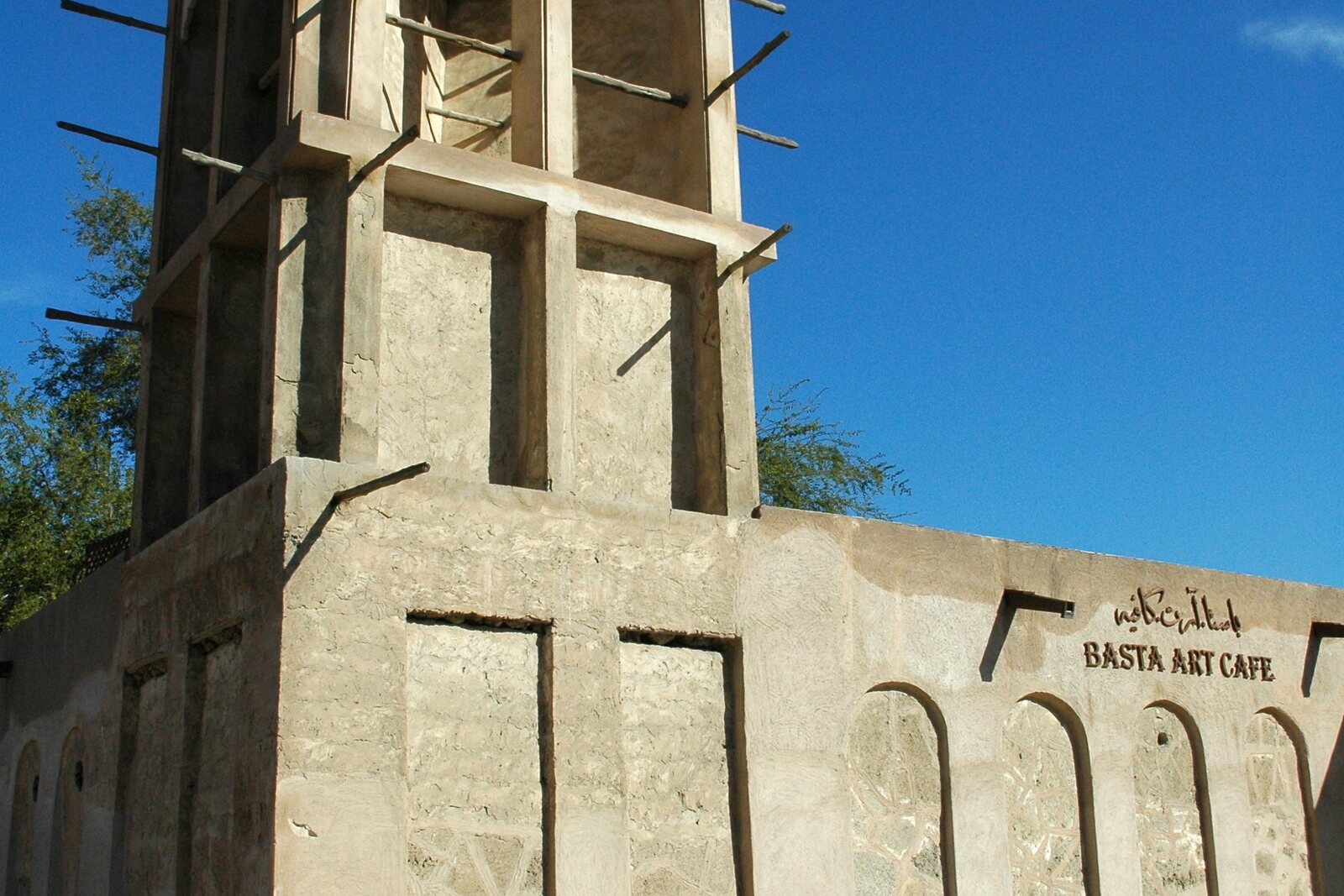
Look around first
What to notice
- Open facets of wind towers, thick sand-colored walls, shaded alleys, and internal courtyards.
The story of the place
At the entrance to Al Fahidi, old Dubai begins almost imperceptibly. Behind the noisy streets lie sand-colored walls, narrow passages, and towers with open openings. They look like small fortress turrets, but they were not built for defense. These are badgirs—wind traps. High above the roofs, air entered the tower, descended through a vertical shaft, and brought coolness into the rooms. Long before air conditioners, a house here knew how to breathe on its own.
Once, this quarter was called Bastakiya. Behind its walls lived merchant families, and the layout of their homes changed with the time of day and season. In the late sixties, British geographer Anne Coles observed this way of life. She befriended local women through a newly formed women's society and gradually found herself behind closed doors, in spaces where an accidental foreigner was usually not invited.
Summer turned the house into a sort of multi-story calendar. Sometimes the family would leave for the mountains to escape the heat. If they stayed in the city, they moved higher up following the airflow: from the ground floor to the first floor, then to the roof. During the hottest hours of the day, women would settle on cushions along the walls under the wind tower. After noon, the wind changed direction, and with it, the entire rhythm of the house shifted.
Anne tried to understand how much coolness a badgir actually provided. Her instruments were simple, and her measurements far from laboratory-grade. But numbers here were only part of the answer. The tower worked together with thick walls, a shaded courtyard, narrow alleys, and the habits of its residents. Architecture did not conquer the desert—it negotiated with it. Even the narrow passages between houses helped: the sun reached the ground briefly, while the wind accelerated between the walls.
In one of these houses lived the merchant Bukhash family. The house was started in 1924 by Mohammed Sharif Bukhash. Half a century later, in 1974, a young British architect named Peter Jackson arrived here. He was tasked with measuring the building: wall lengths, room widths, internal courtyards, staircases, and the wind tower. The letter of recommendation for the family had been written by none other than Anne Coles.
Jackson's assistant was thirteen-year-old Rashad Bukhash. The boy's job was simple—hold one end of the tape measure while the architect recorded the dimensions of Rashad's grandfather's house. One stands at the wall, the other pulls the tape across the room. A standard measurement, one of dozens an architect might take. No one could have known then that this tape measure would stretch not just from corner to corner, but through a quarter of a century.
Jackson soon left for work in Africa. He returned to Dubai twenty-six years later and almost immediately received unexpected news: he was being sought by the head of the municipal department of historic buildings. It turned out to be Rashad—the very boy who had held the tape measure. In the intervening years, he himself had become an architect, founded the Emirates Heritage Club, and dedicated himself to preserving old Dubai.
Their new meeting led to a book about wind towers. Starting with the dimensions of one house, it grew into a story about the families of an entire quarter. Elderly residents recalled where guests were received, which rooms were used to escape the heat, who slept on the roof, and how men and women divided the space. The walls provided the building's plan, but people gave it back its voice. Jackson later said that without these stories, something more fragile than plaster would have disappeared: the memory of the last generation that knew Bastakiya as a living neighborhood.
By then, the houses themselves had become fragile. In the late eighties, part of the quarter was already demolished to expand the government complex. The remaining buildings were used as warehouses and housing for workers. Where wind once descended into family rooms, boxes and construction materials stood. The old district was viewed not as heritage, but as a plot of land waiting for new use.
Then, British architect Rainer Otter moved into one of these houses. He renovated the building and began a campaign to preserve Bastakiya. The situation seemed almost hopeless: the decision to demolish was practical, land was expensive, and dilapidated walls had not yet become attractions.
In 1989, Dubai expected Prince Charles. Otter wrote him a letter. The request worked: the prince wanted to see Bastakiya and walked through the quarter with the architect. Among the blind walls, courtyards, and wind towers, Otter explained what the city risked losing. After the visit, the prince spoke in favor of preserving the district. The demolition plan was canceled.
Thus, an entire quarter was saved thanks to a chain of almost accidental encounters. A geographer befriended local women and wrote a letter of recommendation. A boy held a tape measure and grew up to become a guardian of architectural heritage. An architect moved into a doomed house and sent a letter to someone whose voice could be heard. Much here was preserved because someone, in time, treated old walls as a home rather than an obstacle.
Later, the quarter was restored and renamed Al Fahidi. Today, its wind towers no longer save families from summer heat. But they still explain the city better than many modern skyscrapers. Dubai grew not only upward and not only quickly. Once, it grew around courtyards, along shaded walls, and toward the wind. And the entrance to Al Fahidi is a boundary beyond which this forgotten scale of the city becomes human again.
Deeper into the story
Climate as Architectural Logic
The official description of the district separately highlights bargils, dense alleys, public squares, and traditional materials like gypsum, teak, palm wood, and stone. This is not a romantic reconstruction of 'the old East,' but a set of solutions for a hot trading city by the water. Before heading further to the markets, it is useful to consider Al Fahidi as a technical introduction: here you can see how houses, shade, and wind prepared the city for exchange.
Useful on site
Dubai Culture: daily 07:00-20:00 for the district; hours of individual museums, galleries, and cafes inside vary.
Checked: June 28, 2026. Check the official source before visiting.Walk slowly and compare sunny and shaded areas; the surface is uneven in places, and passages are narrow.