 Guide On Map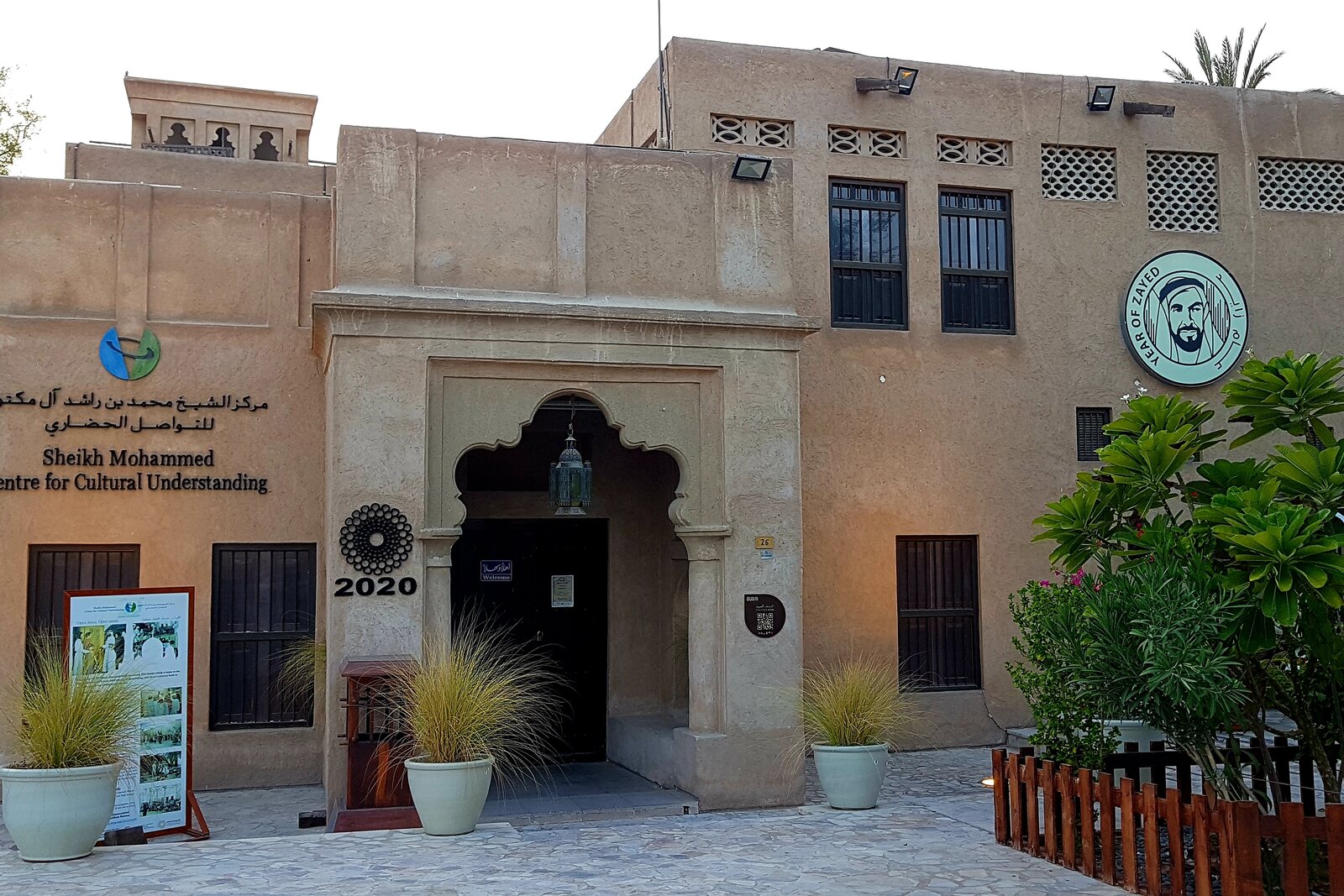
Look around first
What to notice
- The wind tower, open courtyard, room doors, and places where guests sit next to each other.
The story of the place
This house has a number—twenty-six. It has a wind tower, an inner courtyard, and an age that one publication from twenty-twenty-one defined very precisely: one hundred thirty-two years old. But its main feature is not the old walls. Here people ask questions they have carried for a long time but were afraid to voice.
The center’s history began far from this courtyard. Abdullah bin Isa Al Serkal studied and worked in the United States when he was young. To those around him, he turned out to be someone from a world about which many knew only fragments of news and others’ retellings. People asked him about Islam, about Arab family life, about clothing, prayers, and Emirati customs. He did not have ready-made answers. He had to explain everything in his own words and, at the same time, notice how the simplest things seemed completely incomprehensible to someone raised in another culture.
When Al Serkal returned to Dubai, it turned out that an ocean was not needed for such a distance. In one city lived people of dozens of nationalities. They met at work, in shops, on the streets, standing next to each other every day—and yet remained strangers. Arrivals often feared asking questions so as not to offend accidentally. Emiratis did not always understand why they should explain what was a natural part of their lives for them. Silence looked polite but gradually filled with guesses.
The first programs of the future center appeared during the Dubai Shopping Festival in nineteen ninety-five. The festival itself was a noisy celebration of new Dubai: shopping, entertainment, guests from all over the world. Amidst this glitter arose a simple idea—to sit locals and visitors side by side and let them talk.
The most difficult part, Al Serkal recalled, was convincing both sides to come. Emiratis were asked to spend time talking with completely unfamiliar people. Foreigners were told that an sincere question is not considered an insult. It was necessary not only to open the door but also to remove the inner lock—the very one that makes you smile, nod, and clarify nothing.
In nineteen ninety-nine, local Channel 33 offered the center a weekly broadcast. Thus, the phrase "open doors, open minds" became the name of a television program. It turned out to be almost the perfect formula for this place. The door here opens not just for hospitality. Behind it lies the habit of judging a person in advance.
This became especially noticeable during mosque tours. At first, about fifteen guests would come. Then one hundred fifty people, and sometimes even two hundred, gathered at the doors. The conversation almost always began cautiously. Why do men wear white and women black? How many times a day does the call to prayer sound? What does this or that gesture mean?
Such questions are like checking water with fingertips. But after some time, people grew bold. Then talk turned to weddings, family decisions, faith, child-rearing, and relationships between men and women. About things usually discussed only with close ones—or not at all.
The current director of the center, Hala Al Marzouki, formulated the local rule quite simply: a visitor can ask anything, even what they would not ask outside these walls. There is a rare form of hospitality in this. The guest is offered not just food and shade, but also the right to be awkward. It is not shameful not to know here. Much more important is that after the question, someone begins to answer.
Food appeared in this story before House twenty-six. In nineteen ninety-eight, Al Serkal and volunteers began inviting expats to their homes for Ramadan dinners. During Ramadan, the daytime fast ends with iftar—the evening meal after sunset. The first dishes for guests were prepared by Umm Abdullah, the founder’s mother.
Perhaps that is why the center has never resembled an institution from the very beginning. Its first school of understanding arose not in a conference hall, but at a family table. First, a dish was placed before a person, and then the conversation began. Home cooking did what official speeches handle poorly: it turned a stranger into a guest.
In twenty-four, iftars were moved here, to this old merchant house with a wind tower. Thus, under one roof came several eras of Dubai. The merchant past remained in the structure of the house and its courtyard. Family history—in memories of Umm Abdullah’s first dishes. The new city entered here through many voices and accents.
The inner courtyard itself seems created for conversation. There is no long stage or distant pulpit. People sit side by side, hear intonations, see their interlocutor’s reaction. A question can no longer be thrown into an anonymous crowd. It is addressed to a specific person who answers not on behalf of the huge and complex world, but from themselves.
This is the character of House twenty-six. Outside, it preserves old Dubai—walls, tower, memory of the merchant quarter. Inside, it engages in a quite modern task: teaching neighbors not to remain mysterious silhouettes for each other. Over decades, a city of glass, speed, and international connections has grown around it. And one of its most important bridges is still built the old way—in the courtyard, over shared food, with a question that was finally dared to ask.
Deeper into the story
"Open doors, open minds" without a showcase
SMCCU formulates its task as cultural understanding through questions and conversation, not as museum distance. Therefore, House 26 is better perceived as a living translator of the quarter: it explains why next to trade are so important coffee, dates, invitations, modesty, and a question asked without embarrassment. Even if you do not go on a tour, this place changes the tone of the entire walk.
Useful on site
SMCCU Office: daily 08:00-20:00; Heritage Tour and cultural meals follow a separate schedule and require verification/booking.
Checked: June 28, 2026. Check the official source before visiting.Plan cultural programs and meals separately; do not expect to attend specific events without booking.