 Guide On Map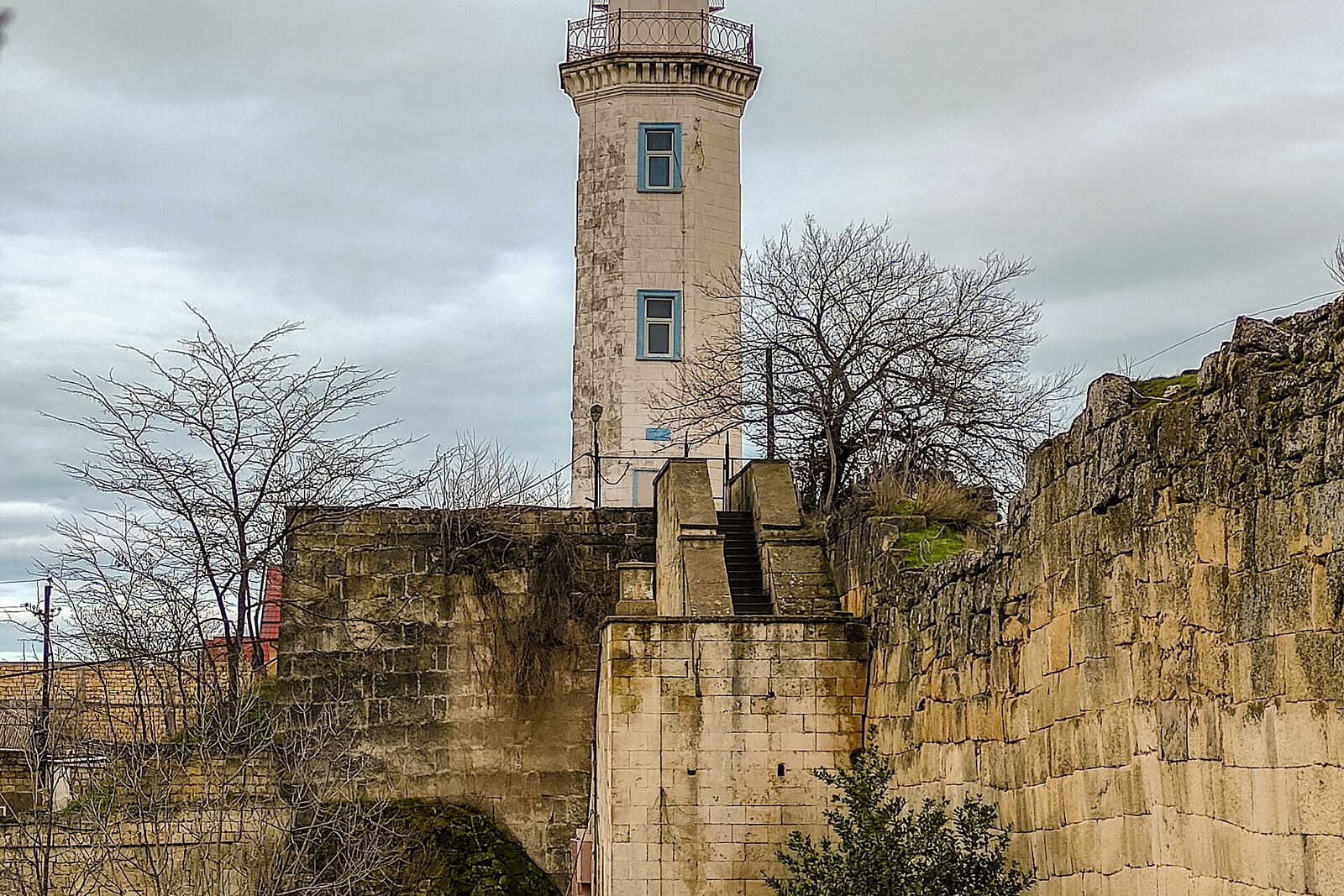
Look around first
What to notice
- Octagonal tower
- External staircase
- Lantern gallery
- Bastion with buttresses
The story of the place
The white lighthouse light repeated every two minutes and could be distinguished from fourteen nautical miles away. Stepped lenses gathered the lamp’s light and directed it toward the horizon from a height of nearly eighteen meters. Its stone parts have survived on the northern fortress wall: an ancient bastion with buttresses, an external staircase, an octagonal tower, and a lantern gallery. The first tower on this site disappeared, while the lighthouse still operates, although its lighting apparatus has been changed.
In eighteen fifty, Mikhail Vorontsov, the viceroy of the Caucasus, ordered a lighthouse to be installed in Derbent. Mail and passenger steamships were already traveling along the western shore of the Caspian Sea, trade with Persia was growing, and captains needed a reliable landmark as they approached the port. They carried people, mail, and goods; an error in identifying the city lights threatened the vessel and everyone on board.
Savinichev, the naval captain assigned to the project, chose a northeastern section of the fortress wall. An ancient bastion provided a ready-made stone foundation on high ground, although the sea was about a kilometer away. On the first of May, eighteen fifty-three, the new light was lit for the entire navigation season—from evening twilight until morning twilight.
Five lamps shone for about ten nautical miles. So that captains would not confuse the lighthouse with the city lights and another lighthouse on the coast, a separate lamp was installed about three and a half meters below the main lantern. Its light was directed only toward the sea through a window in the tower.
The calculation still proved unsuccessful. Sailors complained that the light was weak. The houses and the fortress stood higher than the first tower, so their windows sometimes served as more noticeable landmarks than the purpose-built lighthouse. Savinichev succeeded in giving Derbent a signal light, but captains still had to pick it out among the city.
Thirteen years later, the lighthouse service replaced the former tower with a stone, octagonal tower nearly eighteen meters high. The light was raised higher, and craftsmen installed a system of stepped lenses that gathered the lamp’s light and directed it toward the horizon. The steady white light now produced a flash every two minutes and was visible for fourteen nautical miles. Captains had a signal they could recognize by its own rhythm.
Savinichev’s first tower has not survived. Its stone successor stands on the northern wall: a bastion with buttresses, an external staircase, an octagonal tower, and a lantern gallery. The lighting apparatus has been changed since then, but the lighthouse still operates. The white tower on ancient masonry is the answer to sailors’ complaints: the city light had once proved more noticeable to them than the lighthouse light.
Useful on site
Viewable only from the public street; there is no tourist access inside.
Checked: date not specified. Check the official source before visiting.The lighthouse is operational: view it from the public street, do not enter the service area, and do not expect to go inside.