 Guide On Map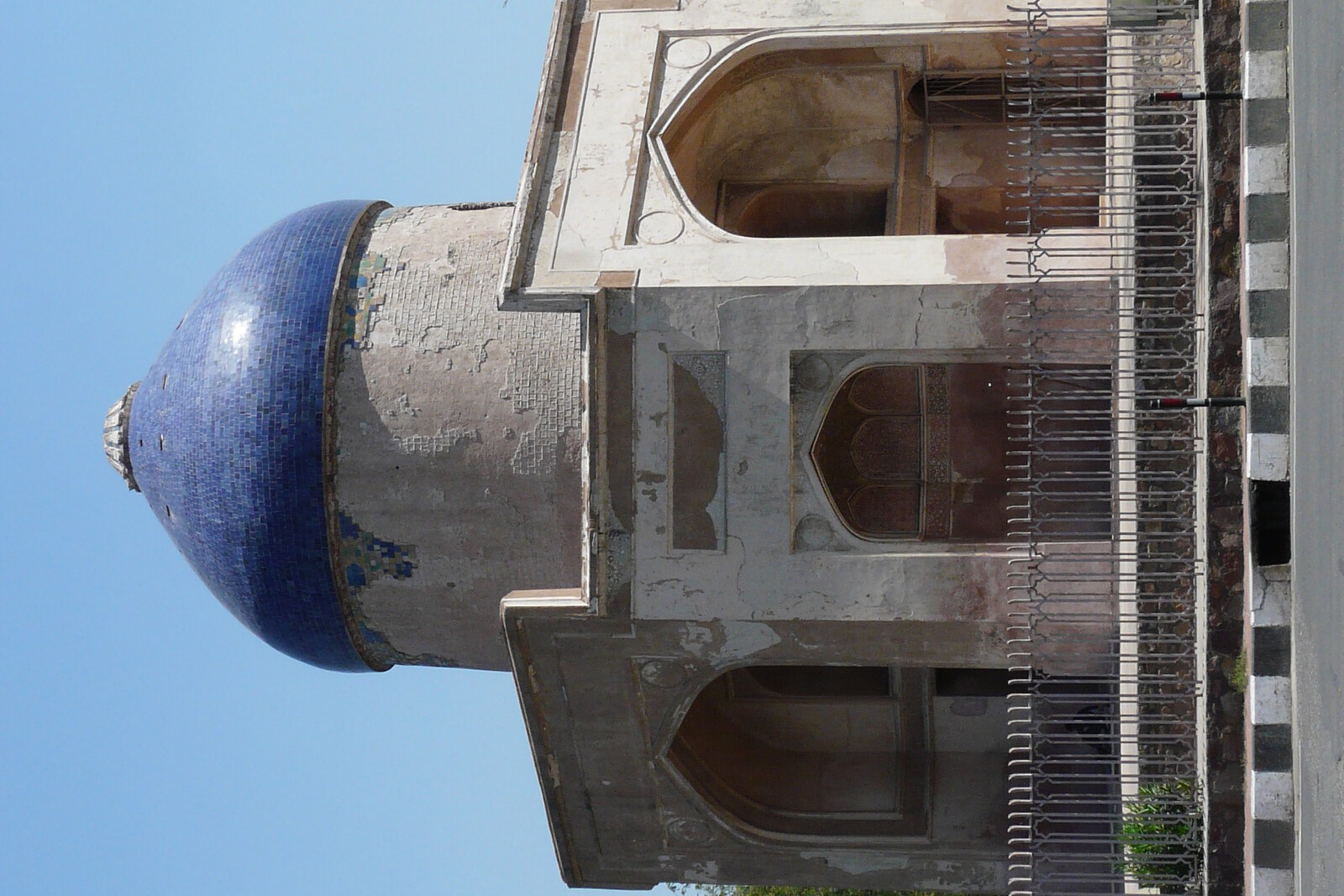
Look around first
What to notice
- Turquoise dome
- Multicolored glazed tiles
- Green lotus-shaped finial
- Gaps in the uncovered painting
The story of the place
In two thousand seventeen, scaffolding was erected inside Sabz Burj. Faint patches of paint showed through beneath the later plaster on the domed ceiling. Anupam Sah, a conservator of monumental painting, led the specialists who had to remove the cement and chemical coatings without removing the sixteenth-century design with them. Marks from an earlier chisel already showed the cost of a mistake: wherever people had tried to chip off the plaster, the ancient paint had vanished.
Over three years, Sah's team uncovered the surviving part of the painting, covering about thirty-six square meters. Against a dark-blue background were flowers drawn in black lines, red and yellow paint, and particles of real gold. The blue pigment was made from lapis lazuli, an expensive stone brought from far away. This ceiling is now considered the earliest surviving painting in a Mughal building.
The room beneath it was a burial chamber. Sabz Burj is a mausoleum built, judging by its architecture, in the fifteen thirties, soon after the Mughals appeared in Delhi. At the time, it stood in a walled garden at the northeastern edge of the lands around Nizamuddin's dargah. Its closeness to the grave of the revered saint explains why a high-status patron chose this particular place. But there is no inscription bearing a name here, and no written record has been found. The gold and lapis lazuli suggest a commission of royal rank; researchers cannot name the person buried here.
Around nineteen oh four, the British administration adapted the mausoleum for the Nizamuddin Police Station. The police needed working premises, so the walls and ceiling were plastered and whitewashed. The station remained here for another roughly ten to fifteen years. The wall painting was almost entirely lost, while the ceiling painting was sealed beneath later layers.
The next damage came during repairs. By the nineteen eighties, most of the old glazed facing on the dome had fallen away. In nineteen eighty-five and nineteen eighty-six, the Archaeological Survey of India removed the remaining tiles and covered the dome with modern blue tiles made on a terracotta base and set in cement. The cement retained moisture. Water reached the inner dome and irreversibly destroyed the edges of the painting.
Sah's team decided not to paint over the losses. The specialists uncovered and consolidated only the original paint; the destroyed sections remained blank. Outside, the craftsmen removed the nineteen-eighties tiles together with the cement and dried the masonry for several months. They then made glazed tiles close in composition to Mughal ones and fixed them with lime mortar. They preserved the old tiles on the high drum even where the glaze had already worn away.
In Persian, “sabz” means “green,” and “burj” means “tower.” The name refers above all to the green tiles on the lotus-shaped finial and to the green in the drum's ornament. The main surface of the dome is still turquoise, while below it dark blue, turquoise, green, and yellow alternate. That is why the mausoleum also has another local name: Nili Chhatri, “the blue umbrella.” From the road, you can see the result of the tilers' work; the golden ceiling and the gaps left by the conservators are hidden inside.
Useful on site
Exterior viewing from the safe side of the roundabout; interior access is usually closed.
Checked: June 28, 2026. Check the official source before visiting.The tower is surrounded by heavy traffic: do not cross the roadway for a closer shot. If interior access is closed, limit yourself to viewing it from the safe public side.