 Guide On Map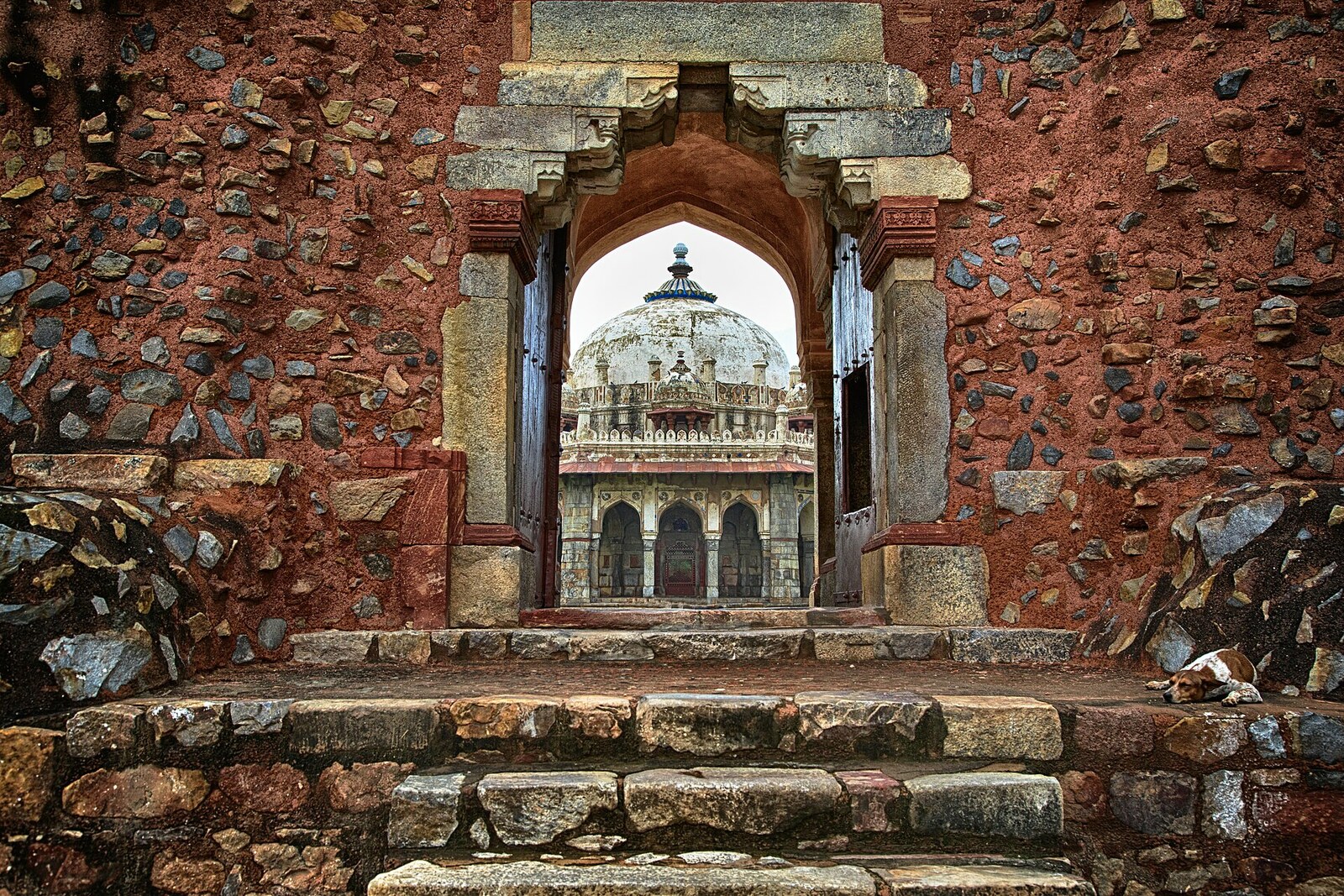
Look around first
What to notice
- Octagonal mausoleum
- High garden wall
- Round turrets
- Red slab above the prayer niche
The story of the place
A high wall with round turrets outlines the octagonal garden. A domed mausoleum stands in the garden, a mosque has been arranged on its western side, and several unnamed tombstones survive inside. The site was prepared for family burials beside the dargah of Nizamuddin Auliya, the shrine of a revered Sufi master: such proximity was considered a blessing. A series of mausoleums gradually arose around the dargah, and this garden came to lie at the entrance to Humayun's Tomb Complex.
Isa Khan, the chief hajib—the head of palace service—who backed one of the claimants to the Afghan throne, ordered this tomb built for himself while he was still alive. A Persian inscription inside dates his commission to fifteen forty-seven to fifteen forty-eight.
Two years earlier, Isa Khan had made a choice on which his position, fortune, and life depended. The Afghan sultan Sher Shah, father of two possible heirs, was killed during the siege of Kalinjar Fort when a powder charge exploded beside him. His elder son Adil Khan, whom his father had designated as his successor and who intended to take the throne, was far away. The younger son, Jalal Khan, was closer to the army.
The courtiers feared leaving the throne vacant. Isa Khan led those who immediately sent for Jalal Khan. Five days later, the younger son was crowned; he took the throne name Islam Shah. For Isa Khan, this meant placing himself between the new sultan and his elder brother, who had not given up his claims. Had Adil Khan prevailed, the chief hajib would have become the supporter of the man who had taken Adil Khan's inheritance from him.
Adil Khan marched on Agra with an army. In battle, Isa Khan helped Islam Shah defeat the rebels. Adil fled and soon disappeared from the chronicles. Islam Shah held on to the throne and rewarded his supporter with a maintenance grant for ten thousand cavalrymen, a drum, and a scarlet tent—signs of an independent military commander. Isa Khan's sons were promoted as well.
Soon after this victory, Isa Khan began preparing a family mausoleum here. He chose a site beside the dargah of Nizamuddin Auliya: burial near a revered saint was considered a blessing, and by then an entire belt of mausoleums was already taking shape around his grave. Isa Khan enclosed his own tomb in an octagonal garden with a high wall and round turrets, and built a mosque on its western side.
Several tombstones lie beneath the dome. Isa Khan intended to gather his family here, but he left no names of relatives: the other graves are uninscribed. Yet a red stone slab survives above the prayer niche. It identifies the patron as the son of Niyaz Afghan and as chief hajib, and calls the tomb he built a “refuge of paradise.” The name of Islam Shah, whom Isa Khan helped put on the throne, is carved there as well.
Humayun's Tomb appeared next door almost two decades later. That is why the first structure at the entrance to today's Humayun's Tomb Complex is the Afghan family mausoleum: the slab retains the name of the chosen sultan, beneath the dome lies the grave of the courtier who made that choice, and there are the unnamed graves of his close relations.
Useful on site
Admission with a ticket for Humayun's Tomb Complex; ASI lists hours from sunrise to 21:00.
Checked: June 28, 2026. Check the official source before visiting.Walk all the way around the mausoleum: its layout reveals itself in sequence, not from a single point. Protect the restored surfaces and do not lean on the grilles.