 Guide On Map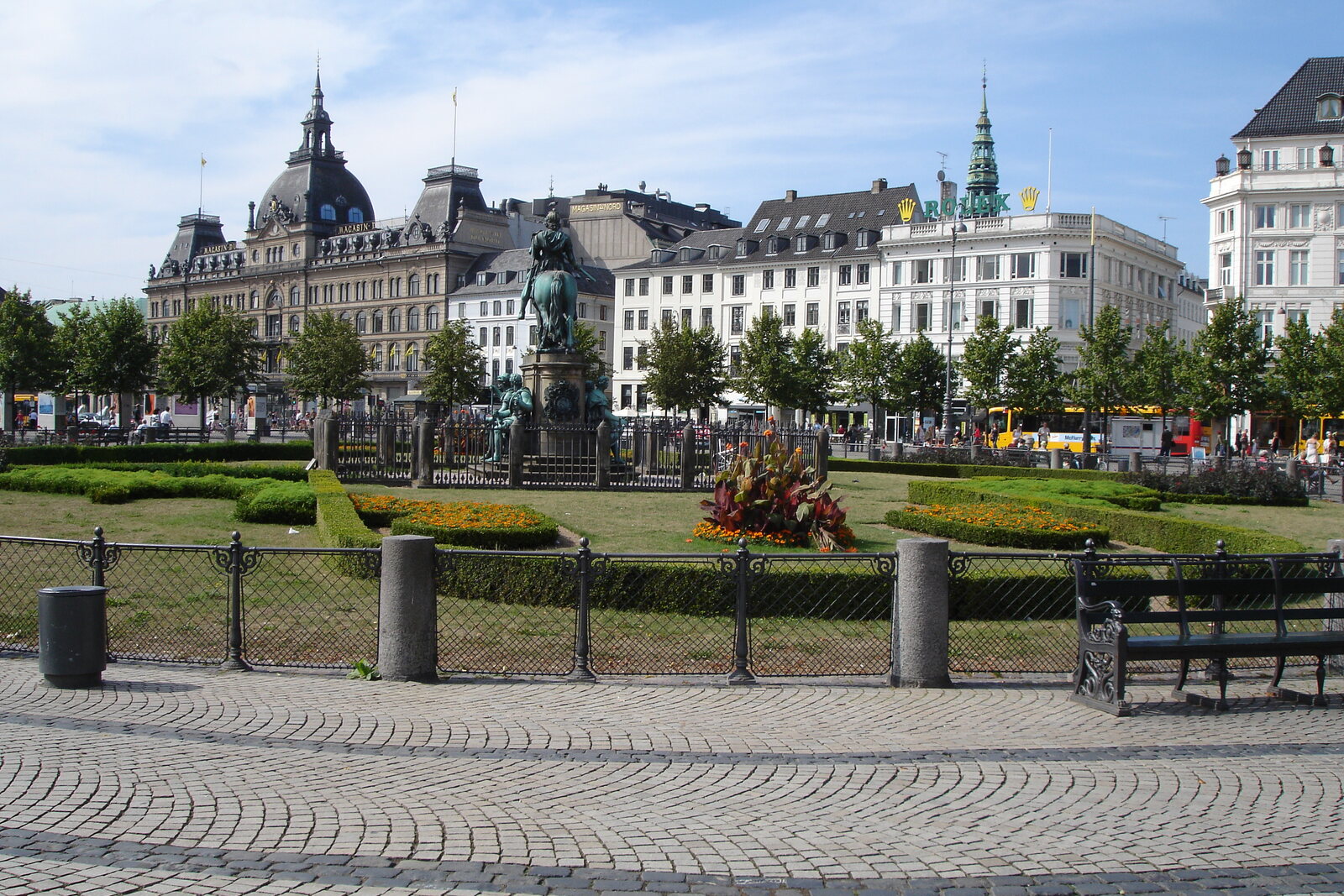
Look around first
What to notice
- Oval garden
- Bronze rider
- Roman helmet
- Figure of Envy beneath the horse
The story of the place
The oval garden occupies the middle of the large city square, and the bronze rider draws the square together around itself. Beneath the horse, a naked figure of Envy is visible, with its knee pressed against the sculpture's heavy body: this is how the hidden support works. The monument was planned as the first equestrian monument to a monarch in Northern Europe, and the metal was cast in a workshop at the edge of this same square. The present bronze replaced the earlier lead statue, which is now kept in The Lapidarium of Kings.
Kongens Nytorv translates literally as the King's New Square. The king in question is quite specific: Christian V, the rider at the center of the oval garden. It was new to medieval Copenhagen. Before Christian, the site contained the remains of dismantled fortifications, a moat, earthen mounds, and the city dump. The townspeople mockingly called the uneven site Halland Ridge; boats belonging to merchants from Halland and Scania docked at its edge.
Christian V received the crown in February sixteen seventy. Danish kings were no longer elected by the estates: the throne had become hereditary. The new monarch decided to move the city center to the former eastern gate, at the junction of old streets and a quarter under construction. He ordered the site cleared and paved, and the owners of surrounding land to build stone houses of no fewer than two stories along the square. Wealthy courtiers began building town palaces here. A canal to the harbor was also laid out from here, so that goods could reach the new center directly. That is why the old town, the streets of the northeastern quarters, and the road toward the water still converge on the square.
So that no one would doubt whose name the new market square bore, Christian placed his own equestrian statue at its center. The commission went to the French sculptor Abraham-César Lamoureux, who had come to Copenhagen to serve at court. He made his living from this service: the royal treasury paid him four hundred rigsdalers a year and provided a house, materials, firewood, and coal. Now Lamoureux was to create the first equestrian monument to a monarch in all Northern Europe.
The sculptor began work around sixteen eighty-two. In a casting yard at the edge of this same square, he cast the horse and the king, dressed as a Roman general, in lead. The surface was covered with gold leaf. The horse rears, and beneath its belly crouches a naked man—an allegory of Envy, whom the king tramples with his hoof. The figure also had a practical engineering role: its bent knee supported the horse's heavy lead belly.
In sixteen eighty-eight, the gilded rider was installed in the middle of the new garden. Lamoureux died four years later, and his brother Claude completed the remaining figures at the pedestal. The sculptor's main work remained in the square, but its material gradually damaged it. The gilding wore away, the soft lead sagged under its own weight, and the horse and rider had to be repaired again and again. By the twentieth century, the royal figure had become noticeably deformed.
The sculptor Einar Utzon-Frank took a mold from the monument, corrected its proportions, and cast a copy in bronze. It was unveiled in nineteen forty-six. Today, it is this bronze version that stands at the center of Kongens Nytorv: the Roman helmet, the horse's raised forelegs, and Envy beneath its belly repeat Lamoureux's design. The lead king, for whom the square was created, has been removed from it and is kept in The Lapidarium of Kings.
Useful on site
Walk around the monument: the support and the allegorical figures are difficult to make out from a single angle. When crossing the square toward the theater or Nyhavn, watch for traffic and cyclists.