 Guide On Map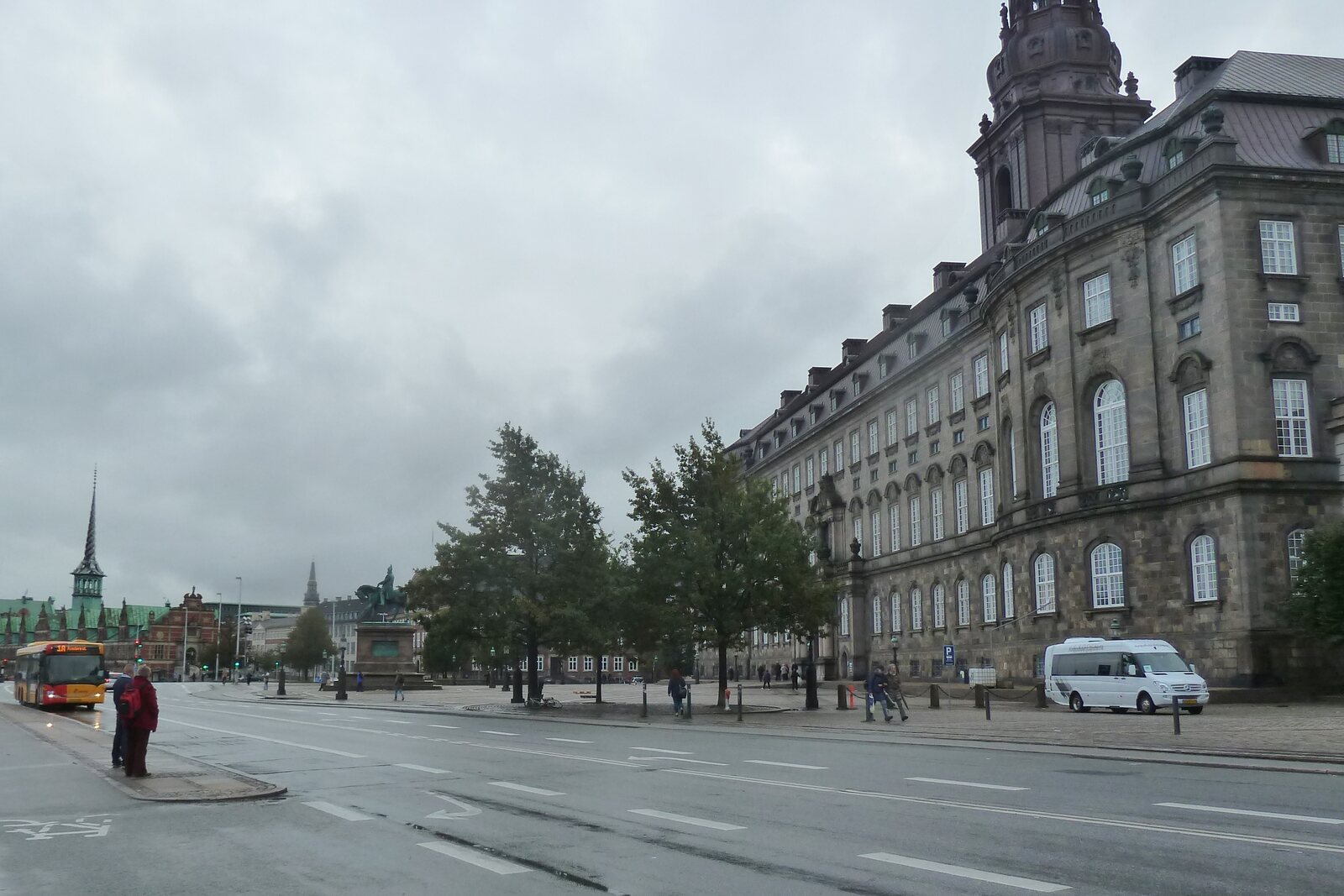
Look around first
What to notice
- Equestrian statue of Frederick VII
- Inscriptions on the pedestal
- Facade of Christiansborg Palace
The story of the place
Behind the facade of Christiansborg Palace stand side by side parliament, the Prime Minister's Office, and the Supreme Court of Denmark, while some of the palace rooms are reserved for royal use. The present palace was built on the foundations of the burned residence. The equestrian statue in the center of the square outlived the old building and was erected in honor of Frederick VII after the monarch's death.
On March twenty-first, eighteen forty-eight, the equestrian statue was not yet standing in the center of the square. Between twelve and fifteen thousand Copenhagen residents stood here, while Lauritz Nicolai Hvidt entered the palace. He was chairman of the city representation, one of Denmark's largest shipowners, and a director of Danmarks Nationalbank. He brought the king a demand to dismiss the ministers.
Since sixteen sixty, Danish kings had formally decided affairs of state alone. But by the beginning of eighteen forty-eight, revolutions had already begun in Paris, Berlin, and Vienna. In the Kingdom of Denmark, there was also a dispute over Schleswig: Danish National Liberals wanted to tie the duchy more closely to Denmark, while the German movement sought an independent Schleswig-Holstein. When alarming news from the duchies reached Copenhagen, the expectation of reforms gave way to a demand for an immediate decision.
The text for the king was drafted by Orla Lehmann, a lawyer and leader of the National Liberals who sought a free constitution. He already knew the price of public speech: Lehmann had spent three months in prison for criticizing absolutism. On the evening of March twentieth, he addressed two and a half thousand people at the Casino Theatre, which then served as a large meeting hall. The petition declared that the king's advisers had lost the citizens' trust and ended with a warning: the monarch was asked not to drive the people to “desperate self-help.” In the days of European uprisings, the meaning of that phrase was clear without explanation.
The following morning, Hvidt led the city representatives from the city hall of that time to Christiansborg Palace. Thousands of people followed them. They filled the square while Hvidt handed the petition to Frederick VII, the king who had inherited both the crown and the old ministers only two months earlier.
The decision had matured before the delegation appeared. During the night, Frederick refused to continue the previous course, and in the morning he dismissed the cabinet. He gave Hvidt a brief reply: the request had already been granted, and the ministers had returned their powers. When Hvidt came out of the palace and announced, “The ministry has been dismissed,” the people cheered the king, accompanied the city representatives back to the city hall, and dispersed. On this square, the revolutionary threat ended without gunshots or barricades.
The next day, Frederick called himself a constitutional monarch and appointed the March Ministry. Hvidt and Lehmann, who had come to the palace demanding a change of cabinet, themselves joined the new ministry. Hvidt took part in preparing the draft constitution; Lehmann soon left the cabinet but continued to advocate the adopted program.
On June fifth, eighteen forty-nine, Frederick signed Denmark's first constitution at Christiansborg Palace. The king became the last Danish absolute monarch and the first constitutional monarch. A bicameral parliament, the Rigsdag, was created. Far from everyone received the right to vote at that time: men over thirty could vote if they were not in domestic service and did not live on poor relief. In January eighteen fifty, parliament occupied some of the palace rooms.
Memory quickly made the king the main hero. According to later testimony, Lehmann found Frederick's terse reply about the dismissed ministers too meager. For a newspaper report, he added in the monarch's name a promise to be the people's faithful leader “to honor and freedom.” It was this longer version that spread across the country as the king's speech.
The equestrian statue was installed in eighteen seventy-three, after Frederick's death. The palace Hvidt entered burned down eleven years later; the present Christiansborg Palace was built on its foundations. The Folketing now meets behind the facade, while the Prime Minister's Office and the Supreme Court of Denmark work there, and the king uses some of the halls.
The statue outlived the old palace. On the front of its pedestal is engraved: “June fifth, eighteen forty-nine”; on the side: “Frederick VII, giver of the constitution.” The twelve to fifteen thousand people who waited for his answer on this square are not named in the inscription.
Useful on site
For the main story, it is enough to view the square and the surviving service buildings from outside. The stables, theater, and palace rooms have their own visiting conditions.