 Guide On Map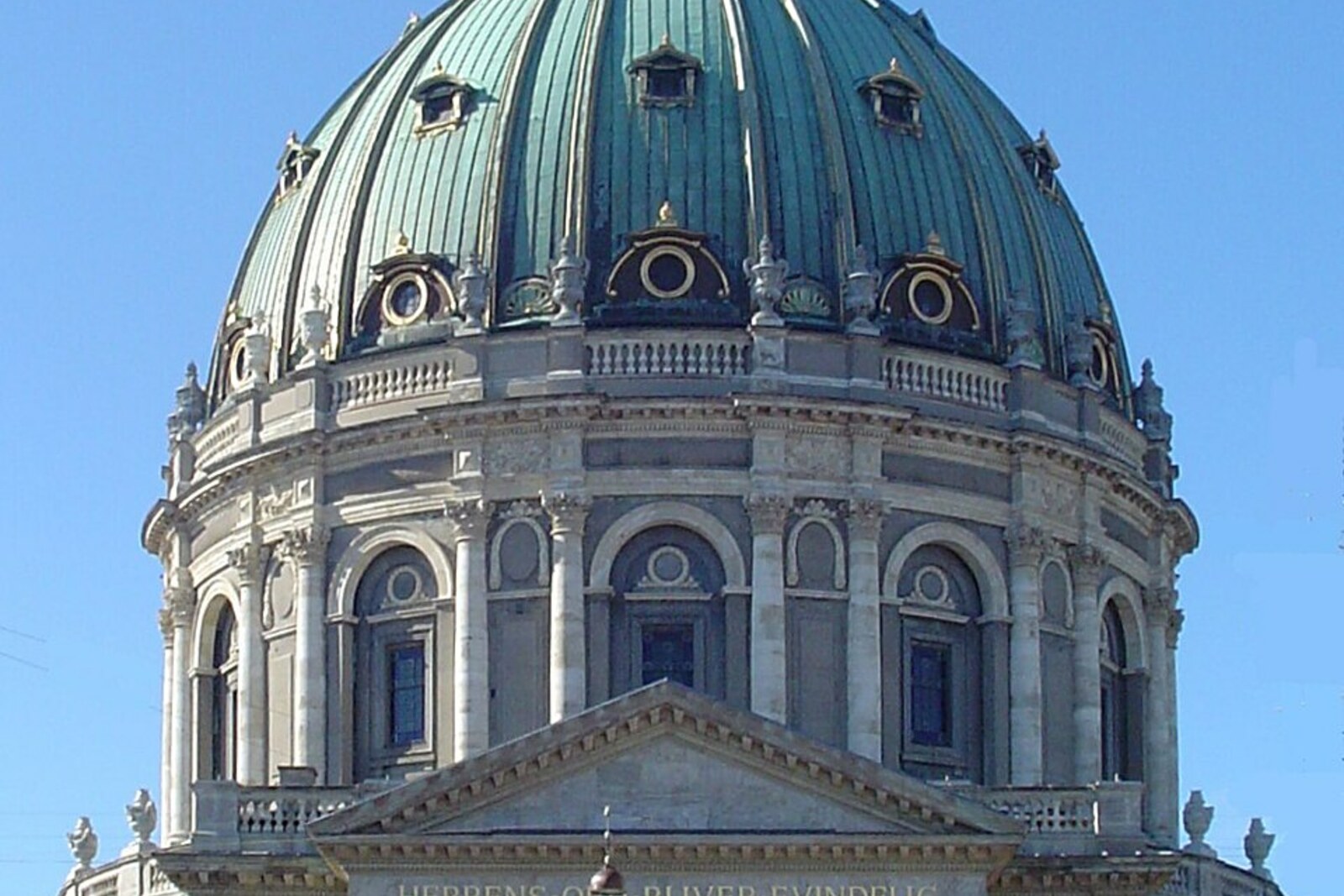
Look around first
What to notice
- Gray marble on the lower tier
- Plastered upper section
- Copper dome
- Relief with a model of the church
The story of the place
Baptisms, weddings, and Lutheran services are still held in this church. A church entrance is usually placed on the west side, but here it was turned toward Amalienborg, the royal residence, along the line of the ceremonial district. The lower part is clad in gray Norwegian marble; above it are plastered brick and limestone, and the dome is covered in copper. The plots around it were developed with apartment buildings and sold to raise part of the money for completing the church.
In seventeen forty-nine, the Danish king Frederick V came to the garden of Princess Charlotte Amalie, which occupied this site. The king was creating a new ceremonial district and wanted to place at its center a church in honor of the three hundredth anniversary of the House of Oldenburg on the Danish throne. To the sound of drums and trumpets, Frederick personally laid the first stone, concealing gold and silver jubilee medals inside it. They are still somewhere beneath the present altar. The church's official name, Frederik's Church, refers specifically to this king.
The district was also named Frederiksstaden, “Frederick's city.” Its architect, Nicolai Eigtved, laid out a transverse line from the church through Amalienborg. For the sake of this line, the church was turned away from the usual east-to-west church orientation: its entrance faces the royal residence. This explains why this particular site was chosen for such an enormous church.
The decision was made to clad the walls inside and out in Norwegian marble. That is where the city's informal name for Frederik's Church comes from. The lower tier before your eyes really is built of gray Norwegian marble. But this decision made an already grand design too expensive.
In seventeen seventy, Johann Friedrich Struensee, cabinet minister to Christian VII and already familiar from the history of The King's Garden, ordered spending to stop. By then, the walls had risen in places to about nineteen meters. After Struensee's fall, attempts were made to resume construction, but no one provided the money. For more than a hundred years, a marble ruin stood in the middle of the ceremonial district.
Carl Frederik Tietgen, director of Privatbanken, which financed steamship companies, railways, and telegraph companies, decided to take it on. In eighteen seventy-four, Finance Minister Andreas Frederik Krieger made an unusual deal with him. Tietgen bought the ruin and the adjacent land, undertook to complete the church within ten years, and transfer it to the state. He was allowed to develop the plots around the church with apartment buildings and sell them to recoup part of the costs.
The Folketing accused Krieger of disposing of state land too cheaply without parliament's consent. The minister and two of his successors were sent to the Court of Impeachment, a special court for members of the government. All three were acquitted: the judges decided that the state had suffered no loss because it would receive a finished church. The agreement with Tietgen remained in force.
But the banker missed the ten-year deadline. Privatbanken was going through a crisis, and Tietgen had to invest his personal money to save it. Copenhagen caricaturists depicted the financier on his way to the unfinished church with the caption: “Tietgen goes to meet his ruin.”
The architect Ferdinand Meldahl retained the old marble lower section and built the upper part from cheaper materials—plastered brick and limestone. Even the copper roof of the dome at first seemed an excessive expense to Tietgen. The artist Lorenz Frølich suggested raising donations for it, and residents brought old copper utensils, coins, and money.
In eighteen ninety-four, the church was consecrated. Construction had taken twenty years; Tietgen himself covered about a third of the final costs, while the rest came from the sale of plots and donations. On the day of the consecration, he transferred the church to the state. Seven years later, after the financier's death, an official memorial service for him was held here.
Today it is an active Evangelical Lutheran parish of the Church of Denmark: services, baptisms, and weddings are held here. The houses surrounding the church in a tight ring appeared because of the deal that paid for its completion. Inside, on a memorial relief, Tietgen and his wife Laura hold a model of the church, while beneath the altar remain the medals Frederick V placed in the first stone.
Useful on site
Mon–Thu 10:00–17:00, Fri 12:00–17:00, Sat 10:00–17:00, Sun 13:00–17:00. Dome tours operate on a separate schedule and ticket. Hours may change because of services, weddings, and concerts.
Checked: June 28, 2026. Check the official source before visiting.The main idea of this stop is clearly visible from the square. If the doors are open to visitors, enter quietly and keep in mind that a service may be taking place inside.