 Guide On Map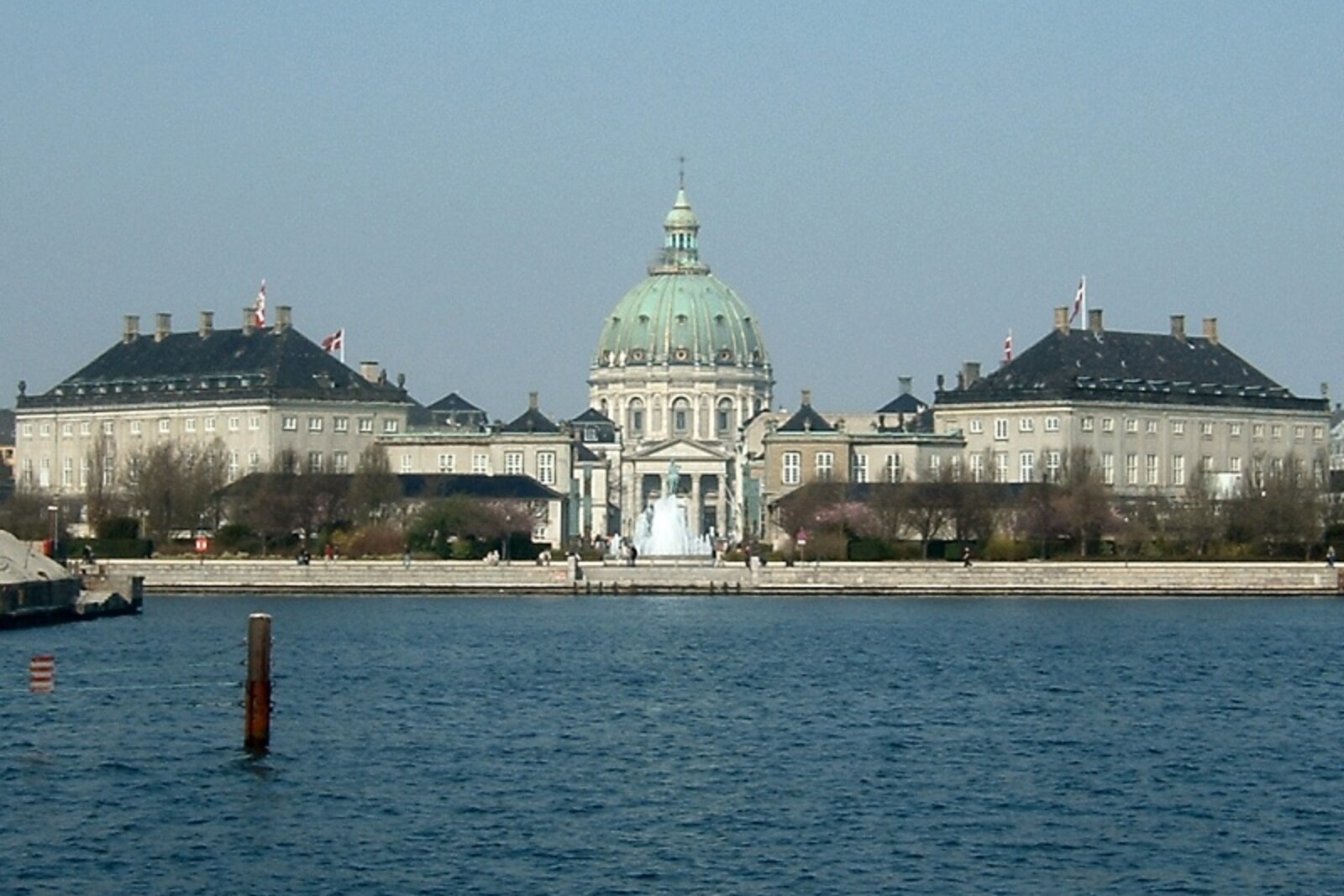
Look around first
What to notice
- Four identical palace façades
- The equestrian statue of Frederick V
- The covered passage above Amaliegade
- Columns with a sandy paint finish
The story of the place
The square is composed of four palace façades facing the equestrian statue at its center. Behind this precise symmetry lie four separate properties: aristocrats were allotted neighboring plots and instructed to build to a single design by Nicolai Eigtved. The quarter took its name from Sophie Amalienborg, which had stood nearby long before the current houses. At first, this entire ensemble did not serve as a royal residence.
Above Amaliegade, the two southern palaces are connected by a covered passage on Ionic columns. The columns look like stone, although they were turned from wood: sand was mixed into the paint. This economy is explained by the builders' calculation—the passage was intended to be dismantled after a few years.
Amalienborg's name predates its current façades. In sixteen sixty-nine, Queen Sophia Amalia, the wife of Frederick III, built Sophie Amalienborg nearby. Twenty years later, it burned down. Nothing remains of it here except the name, which passed to the new quarter.
The four current buildings appeared under Frederick V—the king whose equestrian statue stands at the center of the square. He allocated plots to four aristocrats and required them to build separate mansions with identical façades to a design by Nicolai Eigtved. That is why four independent houses lie behind the outward symmetry. They were not initially intended for the royal family.
Everything changed on the night between February twenty-sixth and twenty-seventh, seventeen ninety-four. Christiansborg Palace, then the Danish king's residence, caught fire. By morning, Christian VII, his son, and the entire court were left without habitable accommodation. Within a few days, the king bought two neighboring mansions at Amalienborg. Christian himself was housed in the former Count Moltke Palace, now called Christian VII's Palace. Crown Prince Frederick occupied the former Schack family palace, now Christian IX's Palace.
Father and son became neighbors, but an ordinary street could not separate them. Because of his mental illness, Christian VII took little part in state affairs. From seventeen eighty-four onward, sixteen-year-old Frederick governed the country in his name. He secured a rule under which laws and decrees entered into force only after two signatures—the king's and the heir's. Ten years later, the signatures were in different palaces, while the Council of State, meetings, and receptions required constant passage between them.
Frederick commissioned the court architect Caspar Frederik Harsdorff to link the houses. The architect raised an enclosed corridor above the street: carriages continued to pass below, while the king, the heir, and their guests could move from palace to palace without stepping out onto the square. Wooden columns were chosen because, after Christiansborg Palace was restored, the royal family intended to leave, and the temporary gallery was to be dismantled.
Christian VII remained king until his death in eighteen oh eight. Frederick governed the state in his name throughout that time, then ascended the throne as Frederick VI. Christiansborg Palace was rebuilt, and Amalienborg's other mansions also passed to the royal family, but it retained its residence here. Harsdorff's wooden passage still connects the two palaces, and members of the royal family still use that same temporary route between the father’s and son’s houses.
Useful on site
The square is open around the clock. The museum in Christian VIII's Palace usually operates 10:00–16:00; closed on Mondays from November through April. The changing of the guard takes place daily at 12:00.
Checked: June 28, 2026. Check the official source before visiting.You can explore the square without visiting the museum. Keep clear of service passages and do not interfere with the guards' work; the palace collections require separate planning.