 Guide On Map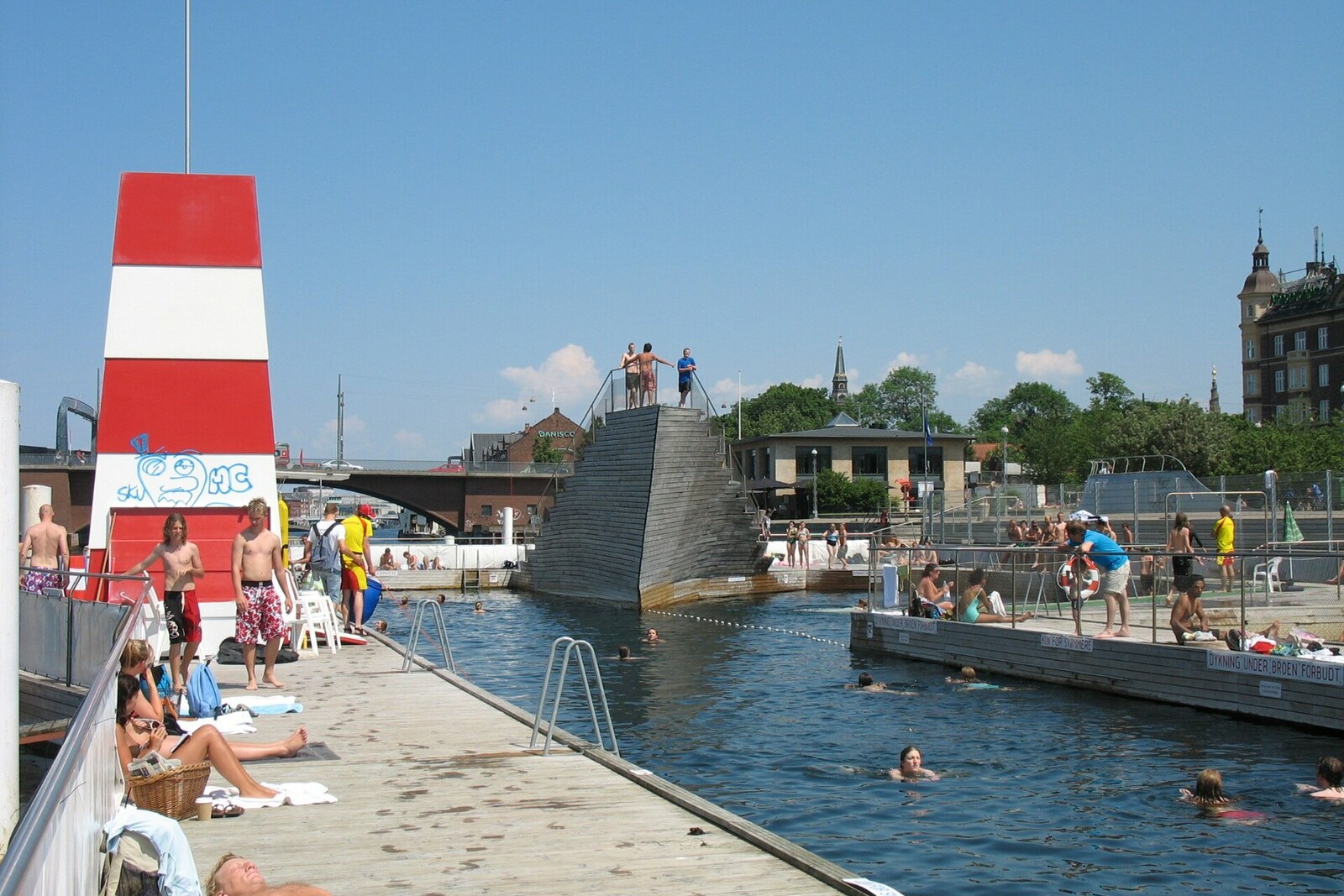
Look around first
What to notice
- Red-and-white towers
- Five pools
- Wooden pontoons
- Warning post
The story of the place
A separate pool with a solid bottom was made for families: they had requested it after the first swimming season. In the other four, people swim, play, and dive from the tower; the wooden decks are arranged like ship decks, and the tower itself recalls a vessel's bow. The towers, painted white and red, and the row of pools belong to the permanent harbour bath. It was built in place of the temporary complex, which was later towed to Havneholmen; a signal post remains by the decks.
The pools at Islands Brygge contain the same water as Copenhagen Harbour. It is not piped in here or treated separately. The wooden pontoons merely separate swimmers from the shipping channel. That is why the harbour bath was made possible by something that is barely noticed: a pollution-warning system.
The last old harbour bath in the harbour closed in nineteen fifty-four. Factories and heavy shipping had made the water unsafe even for fishing. In the nineteen nineties, municipal engineers began rebuilding the sewer system and constructing reservoirs to receive rainwater. After ten years of this work, tests showed that swimming in the harbour was already possible most of the time. One serious danger remained: during a heavy downpour, the sewers overflowed, and for about a day the water quality again fell below the standard.
In November two thousand one, members of Copenhagen City Council who sought to bring residents back to the water created a working group from four municipal departments. Officials studied residents' proposals and chose the shore at Islands Brygge. Havneparken was already nearby, enough people lived around it, and the current carried pollution away from this part of the harbour more quickly. The proximity of the shipping channel required a protective barrier; when a large vessel passed, the harbour bath was cleared.
Environmental-control staff responsible for swimmers' safety linked sensors at sewer overflows to a forecasting system. If wastewater entered the harbour after rain, the energy service switched on a warning signal on the shore. Environmental specialists calculated when the polluted water would clear and the harbour bath could be allowed to reopen.
On July fifteenth, two thousand two, a mobile trial harbour bath was installed here. So many people came in the first season that the temporary pools proved insufficient. At the same time, no serious incidents occurred, and monitoring samples confirmed that the harbour bath had never remained open when water quality was unacceptable.
After that, city council members allocated money for a permanent structure. The Sports and Cultural Facilities Foundation insisted that the project be entrusted to two architects who were almost beginners—Bjarke Ingels and Julien De Smedt. They worked at the young studio PLOT and aimed to turn a successful experiment into a place designed for hundreds of visitors. The architects created five pools: for swimming, playing, children, and diving. One was given a solid bottom—the very kind of pool families had requested after the first season. The wooden decks were shaped like ship decks, the diving tower like a vessel's bow, and the lifeguard post like a ship's funnel. This work became a professional breakthrough for both architects.
The red-and-white towers and five pools in front of us belong to the second, permanent harbour bath. In two thousand three, the first mobile complex was towed to the other side of the harbour, to Havneholmen. And on the Islands Brygge shore, the warning post still stands: before every swim, the decision still depends on water data.
Useful on site
SvømKBH lists regular hours as 06:00-22:00; swimming depends on the season, water quality, the flag, and lifeguard coverage.
Checked: June 26, 2026. Check the official source before visiting.Swim only in the permitted area, and follow local signals about access and water quality.