 Guide On Map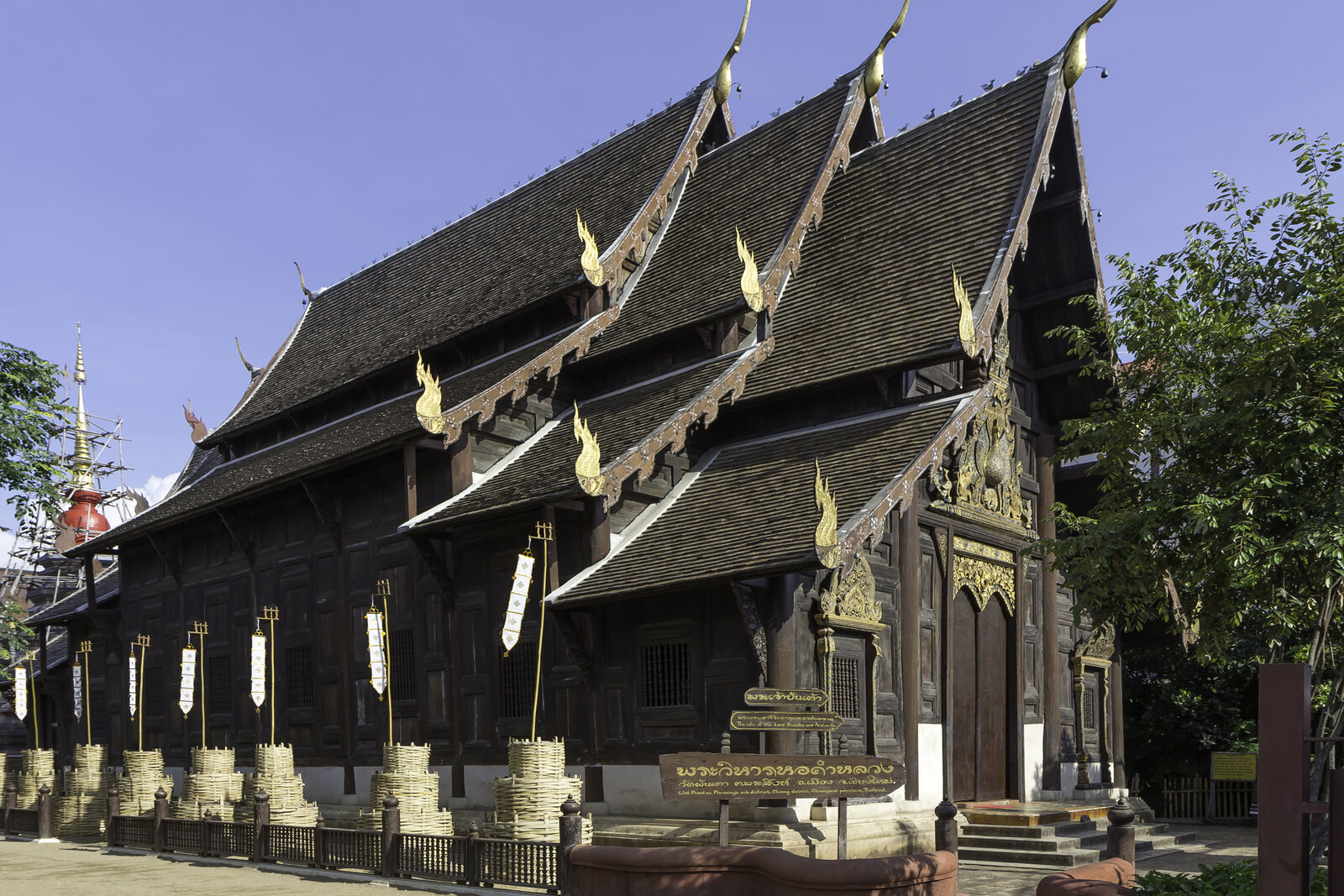
Look around first
What to notice
- Teak viharn
- Carved peacock
- Tiered roof
- Bronze Buddha statue
The story of the place
A tiered roof covers the teak viharn of Wat Phan Tao, a hall of a Buddhist monastery. Monks read texts here, while laypeople gather to make offerings before a bronze Buddha statue; it is several centuries older than the wooden building here. A carved peacock, a royal emblem, survives on the gable. Some explain the temple's name through the thousandfold merit of an offering, while others link it to a legend of a thousand bronze-casting furnaces: archaeologists found crucibles nearby, but sources do not confirm the furnaces themselves.
The dark teak hall before the entrance once belonged to Mahotaraprathet, the fifth ruler of Chiang Mai. Here he received visitors and dealt with city affairs. Such a hall was called a ho kham—a “golden house.” Its furnishings could be golden, but its function mattered more: without his own ho kham, a ruler had nowhere to hold public audiences.
After its owner's death, the building lost its former purpose. Each new ruler established his own residence, while the relatives of a deceased ruler could give his house to a monastery. In Lanna belief, such a transfer brought religious merit to the dead person: the timber continued to serve people, and the benefit from it was credited to its former owner.
In eighteen seventy-five, Inthawichayanon, the seventh ruler of Chiang Mai, ordered carpenters to dismantle Mahotaraprathet's ho kham. He was then renovating the temples around Chedi Luang and decided to turn the palace hall into the viharn of Wat Phan Tao—a space where monks and laypeople gather before an image of the Buddha, listen to readings, and make offerings. The logs were moved and reassembled within the temple enclosure. Eleven years later, Inthawichayanon held a joint consecration for the restored halls of Wat Phan Tao and neighboring Chedi Luang.
The exact origin of the frame remains disputed. A chronicle calls it Mahotaraprathet's palace, but one hypothesis holds that some of the timber came from an even older ho kham of Kawila. The dispute changes its presumed age, but not the building's known fate: in the nineteenth century, a princely hall was dismantled and reassembled here as a Buddhist viharn. The carved peacock above the entrance is a royal emblem that preserves the building's former status. Beneath it, rulers no longer hold audiences, but temple ceremonies now take place; a bronze Buddha stands in the altar, cast several centuries before the palace itself.
The name Wat Phan Tao is explained in two ways. The older form “Pan Thao” was understood as “a thousandfold”: it was thought that an offering made here brought merit multiplied a thousand times. According to another local legend, “Phan Thao” means “a thousand furnaces”—bronze was supposedly melted in this quarter for the enormous Buddha statue at Chedi Luang. Archaeologists did find casting crucibles nearby, but sources do not confirm a thousand furnaces. Before the altar stands the result of another, well-documented transfer: the house of one ruler, which another ruler gave to the temple for the posthumous merit of its former owner.
Useful on site
It is best to plan around daytime access to the grounds; access to the teak viharn and its interior may be restricted or may change depending on conservation conditions and local work.
Checked: June 15, 2026. Check the official source before visiting.If the viharn is open, remove your shoes and do not disturb a ceremony; you can examine the palace carvings right at the entrance.