 Guide On Map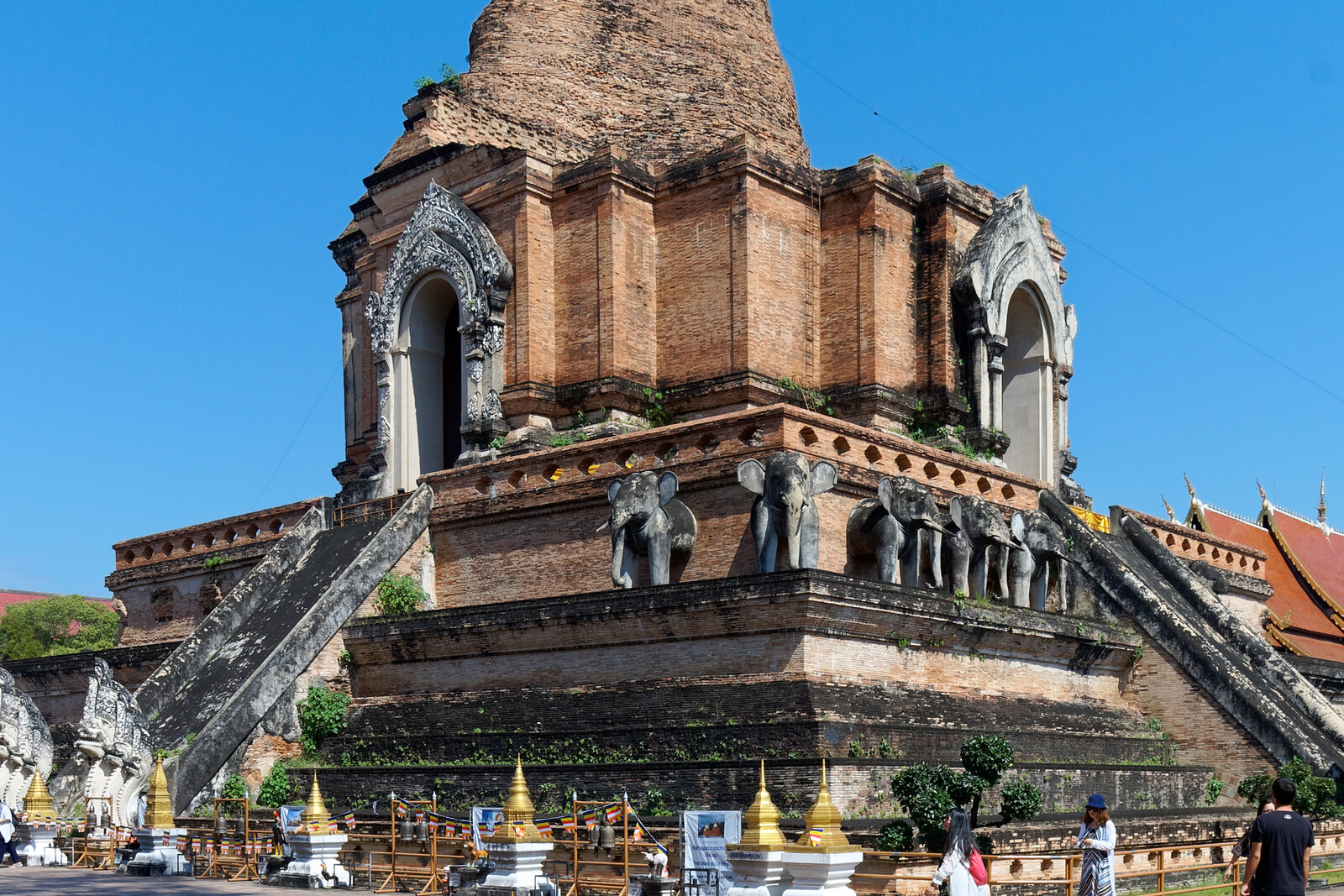
Look around first
What to notice
- Collapsed brick stupa
- Elephant figures
- Eastern niche
- Jade Buddha statue
The story of the place
Chedi Luang is called the Great Stupa. Such shrines are built for Buddhist relics, and a monastery still lives around this one. In the fifteenth century, it was enlarged for the royal capital of Lan Na, covered with gilded copper, and decorated with elephants; their figures still project from the brick tiers.
High in the eastern niche of the collapsed brick tower sits a small figure of dark jade. It was installed in nineteen ninety-five. The previous Buddha was removed from here by a king who had to choose between two thrones.
The tower is called Chedi Luang—the Great Stupa. A chedi serves as a repository for Buddhist relics; an active monastery surrounds it. In the fifteenth century, King Tilokaraj enlarged the stupa, decorated it with elephant figures, and covered it with gilded copper. In fourteen sixty-eight, he brought the Emerald Buddha to Chiang Mai. According to one chronicle, the king ordered the statue placed specifically in the eastern niche.
This small figure confirmed the ruler's legitimacy and was considered the protector of his country. That is why Tilokaraj chose the enormous royal stupa in the middle of the capital: here, the Emerald Buddha became part of Lan Na's principal shrine.
In fifteen forty-six, Chiang Mai's nobility faced the task of finding a king. The previous ruler had died without leaving a son. Officials and senior monks invited Setthathirath, a young prince of neighboring Lan Xang. Through his mother, he was the grandson of the deceased king of Lan Na, and through his father, he was the heir to another state with its capital in Luang Prabang. His right to the Chiang Mai throne rested on this lineage and on the consent of the people who chose him.
After his coronation, Setthathirath made the Emerald Buddha his sacred protector. Soon his father, King Photisarath, died. If Setthathirath had stayed in Chiang Mai, he might have lost his inheritance in Lan Xang. By leaving, he risked losing the Lan Na throne he had received through his mother.
He went to Luang Prabang and ordered the Emerald Buddha taken from Chedi Luang. The statue was meant to confirm that one ruler legitimately inherited both crowns. According to the chronicle, Setthathirath promised Chiang Mai's officials that he would return, but he never ruled here again.
He obtained the throne of Lan Xang and kept the Emerald Buddha with him. He failed to retain the Lan Na crown: in fifteen fifty-one, Chiang Mai's nobility chose another king, Mekuti. Later, Setthathirath moved his capital to Vientiane and built a separate shrine there for the figure he had taken away.
After further wars, the Emerald Buddha ended up in Bangkok, where it remains in the royal temple. Neither the statue nor the summit of the stupa, which collapsed during an earthquake, returned to Chedi Luang. A jade copy now stands in the eastern niche—exactly where Setthathirath ordered the previous figure removed.
Useful on site
It is best to expect daytime or early-evening access to the temple complex; individual sacred spaces may close for services and local ceremonies.
Checked: June 15, 2026. Check the official source before visiting.Follow the temple signs and do not enter beyond the barriers; the city pillar may be inaccessible for viewing.