 Guide On Map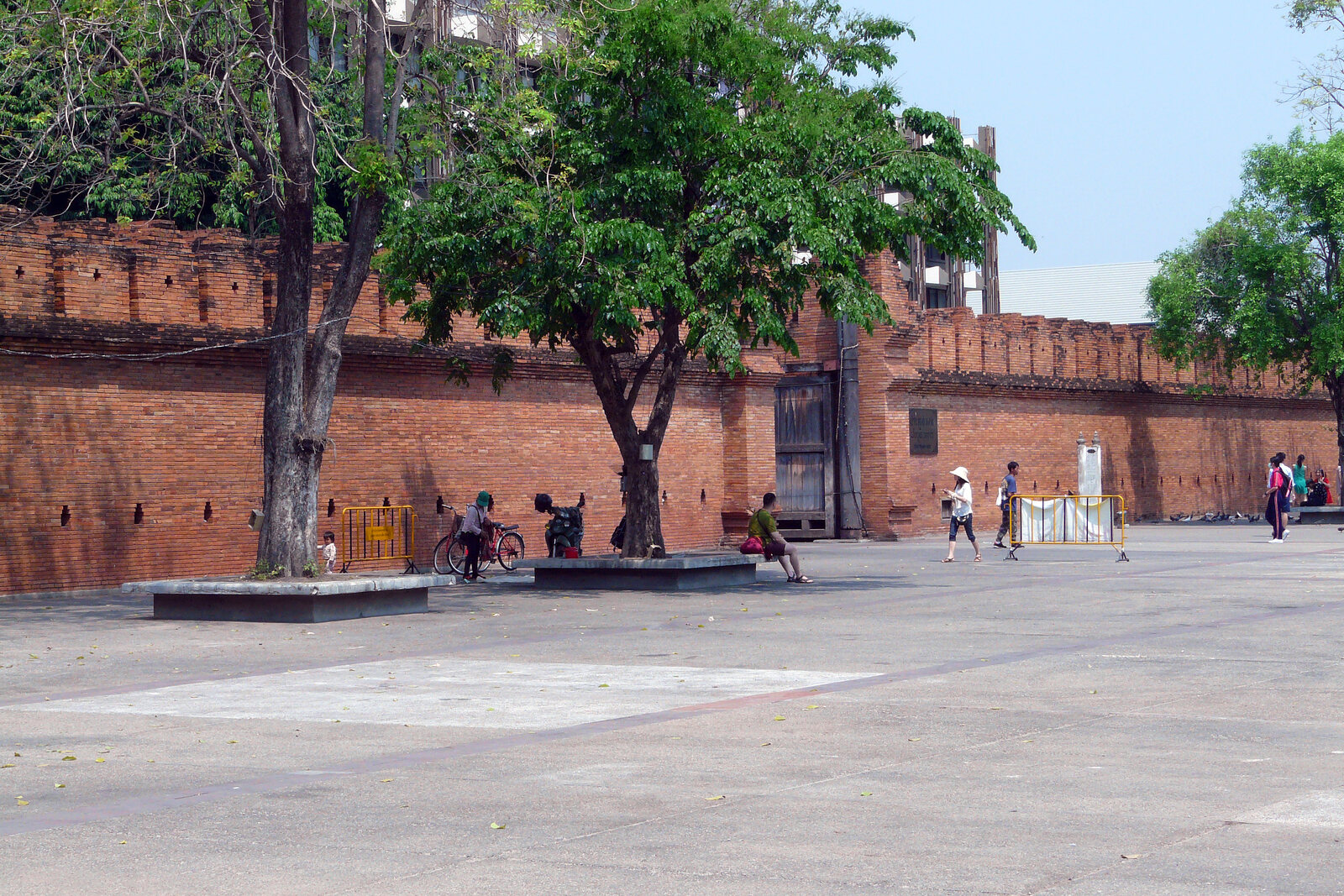
Look around first
What to notice
- Brick arch
- Wooden doors
- City square
- Bridge across the moat
The story of the place
The brick arch with wooden doors stands by the bridge across the moat, at the boundary of old Chiang Mai. This passage belonged to the inner defensive belt, while the name Tha Phae once belonged to another gate farther east. From there, the road led to the Ping River, where rafts and boats carrying cargo arrived; the name itself recalls a river landing. Now the Sunday market begins by the arch, and the square brings the city together for celebrations.
In nineteen eighty-four, Chiang Mai Governor Chaiya Poonsiriwong was shown an old photograph of a city gate. The governor was an architect by training, had previously headed the city planning department, and decided to use the photograph to restore the historic appearance of the eastern entrance. On the site of the present brick arch stood a gate built in the nineteen sixties without a reliable old model. A road for cars ran through it.
Chaiya wanted to dismantle that structure, build another one, and close the roadway to create a city square. Some residents objected: over two decades, the newer gate had come to be regarded as genuine antiquity. The governor was accused of destroying a monument and even of bringing misfortune upon Chiang Mai by interfering with the city boundary. He raised funds for the project from residents and local businesspeople, so he depended on the support of the very community he was arguing with.
Chaiya began construction anyway. Staff from the Fine Arts Department studied the foundations and transferred the form from the old photograph into a drawing. The exact location from which the photograph was taken is still debated: it may have shown another gate, including the vanished outer Tha Phae Gate. The height and dimensions of the model were reduced because modern buildings already stood around it. This is how the brick arch, wooden doors, and square in front of them appeared in the mid-nineteen eighties. Most of the visible brickwork dates from this reconstruction. During the work, Renu Wichasin, a researcher of Lan Na inscriptions written in Tai Tham script, received another assignment. The former wall had already been dismantled, the builders were constructing a new one, and a four-sided stone pillar bearing writing remained nearby. Renu had to make a paper copy of it before construction went any further.
She could not read the copy. The signs in Tai Tham script looked meaningless. Renu left the sheets to dry in the sun, then held one up to the light and saw the letters on the reverse side. The carver had deliberately cut the text in mirror image. The pillar bore numerical tables, astrological circles, and the Pali word “indakhila,” the name for a city pillar, a support at a threshold or gate. Who made this stone, and when, is unknown.
After the construction, the pillar disappeared from view. Some researchers believed it had been given to the Chiang Mai National Museum; museum staff searched the collections and found nothing. For almost forty years, no one could show where it was. In the fall of twenty twenty-three, a group of archaeologists and city specialists opened a locked room inside the present gate. The pillar stood upright there: the builders had not taken it away but enclosed it within the new brick structure.
The gate's name also belonged to another location. This inner passage was formerly called Chiang Rueak Gate, after the neighboring settlement. The real Tha Phae Gate stood farther east, in the outer defensive belt. Beyond it, the road led to the Ping River, where boats and rafts were unloaded: “Tha Phae” means “raft landing.” When the outer gate was dismantled, its name passed to the remaining inner passage.
On Sundays, the market begins here along the closed Ratchadamnoen Road, and city celebrations are held in the square—precisely for such gatherings that Chaiya removed the roadway for cars. Inside the brick wall, the locked stone pillar still stands, with the mirror-image letters that Renu Wichasin first read by holding them up to the light amid that construction.
Useful on site
The public square by the gate is accessible at any time; on Sundays from late afternoon and in the evening, the place is connected with Sunday Walking Street and its rhythm changes sharply.
Checked: June 15, 2026. Check the official source before visiting.The gate is easy to view from the square; the hidden room and the slab found inside it are not part of an ordinary visit.