 Guide On Map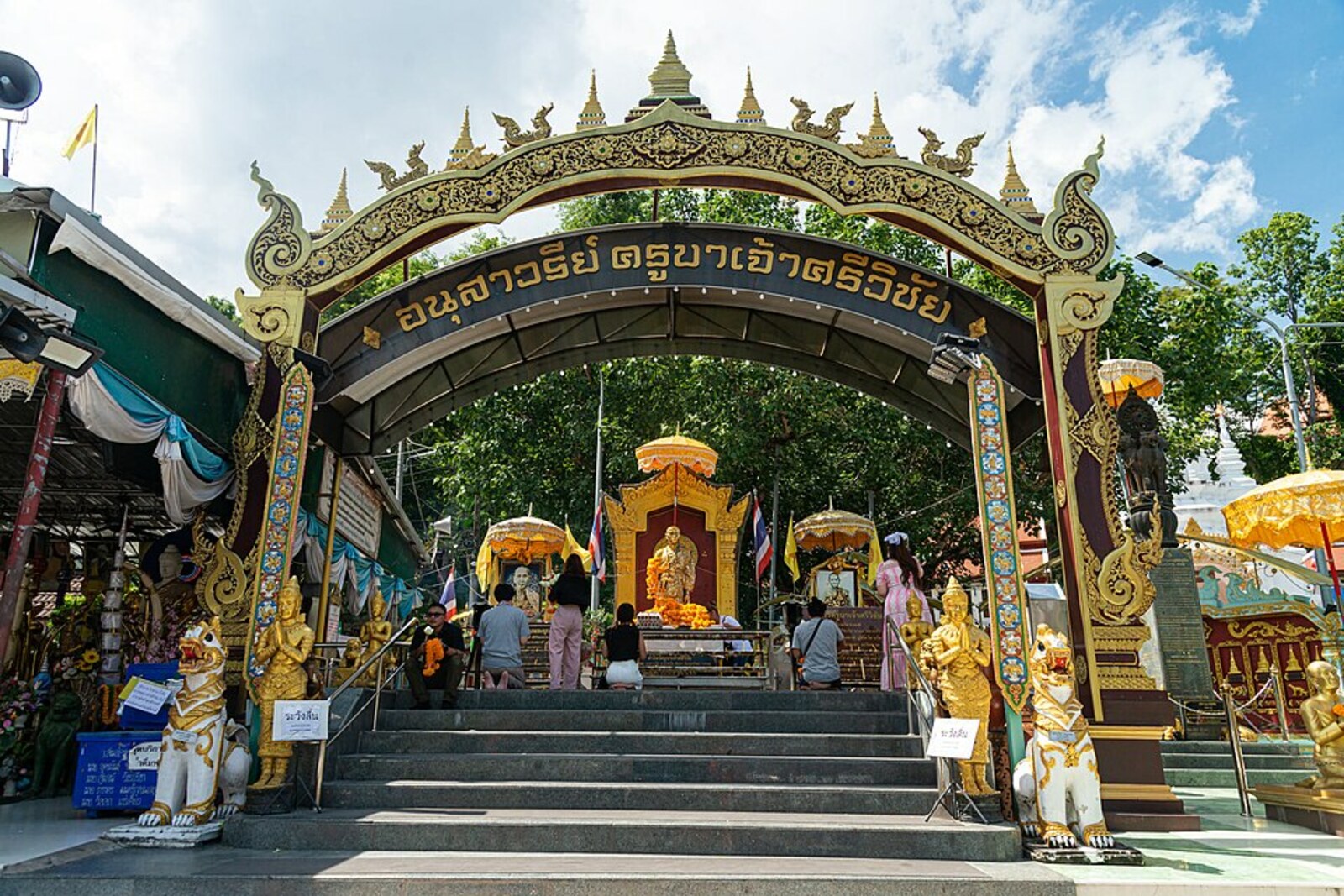
Look around first
What to notice
- Bronze figure of a monk
- Flowers and offerings
- Mountain road
The story of the place
At the foot of Doi Suthep, the bronze monument stands where the mountain road to the temple leaves the city. The provincial authorities installed it in nineteen sixty-three. The eleven and a half kilometers of this road were initially unpaved, then widened, paved with asphalt, and supplied with electricity. Flowers lie at the feet of the figure, while beside it the road climbs the mountain and still carries pilgrims and drivers to the shrine.
Before the bronze figure of Kruba Srivichai—a revered northern monk who worked to secure a road to Wat Phra That Doi Suthep—people leave flowers and offerings before ascending the mountain. “Kruba” is the form of address for a monk-teacher used in northern Thailand. Srivichai was called the saint of Lanna, the historical region around Chiang Mai. Here, his name is connected with a very tangible act: the road begins in the same place where he began building it.
In the early nineteen thirties, people reached the temple on foot along mountain trails. Wealthy pilgrims could ride an elephant or a horse, or hire porters. Luang Sri Prakat, the first representative from Chiang Mai, wanted to bring electricity to the shrine and came to Srivichai for help. The monk suggested building a road first: then it would be easier to deliver poles, wires, and equipment.
Srivichai had no road department, machinery, or state budget. He lived on monastic alms, and restored temples through donations and the labor of his followers. This time, he risked the only thing that made it possible to begin such enormous work without money: trust in his name.
On November ninth, nineteen thirty-four, people began digging here, at the foot of the mountain. News spread through the northern provinces. Farmers and highlanders came with their own hoes, shovels, and baskets for earth. There were more volunteers than were needed. Srivichai first assigned each village ten wa—about twenty meters of road—and then reduced the sections to two or three wa so that everyone who had arrived could have work.
In five months and twenty-two days, they built eleven and a half kilometers of dirt road. On April thirtieth, nineteen thirty-five, a car drove up it for the first time. Later, the road was widened, paved with asphalt, and supplied with electricity—in exactly the sequence Srivichai had proposed.
The construction project brought a grave consequence for him. The Bangkok leadership of the Buddhist community had already accused the monk of conducting ordinations and leading temples according to old Lanna customs, without asking the center's permission. During the road works, dozens of northern monasteries decided to come under his leadership; about ninety temples supported this movement. At the end of nineteen thirty-five, Srivichai was taken to Bangkok and kept at Wat Benchamabophit for more than six months. His followers were forced to renounce the monastic documents he had issued them, and Srivichai himself was forced to sign a commitment to obey the general rules and obtain permission for new construction projects. He could no longer gather people independently for such work.
In nineteen sixty-three, the provincial authorities installed his bronze figure beside the place where the road had begun. Today, pilgrims and drivers still stop here before the ascent. Offerings lie at Srivichai's feet, and beside him Si Wichai Road climbs uphill—an extension of those short sections that had to be divided among the extra volunteers.
Useful on site
Open around the clock, free access
Checked: June 28, 2026. Check the official source before visiting.People still pray and leave offerings at the monument; keep quiet, do not block the approach, and do not touch the offerings.